




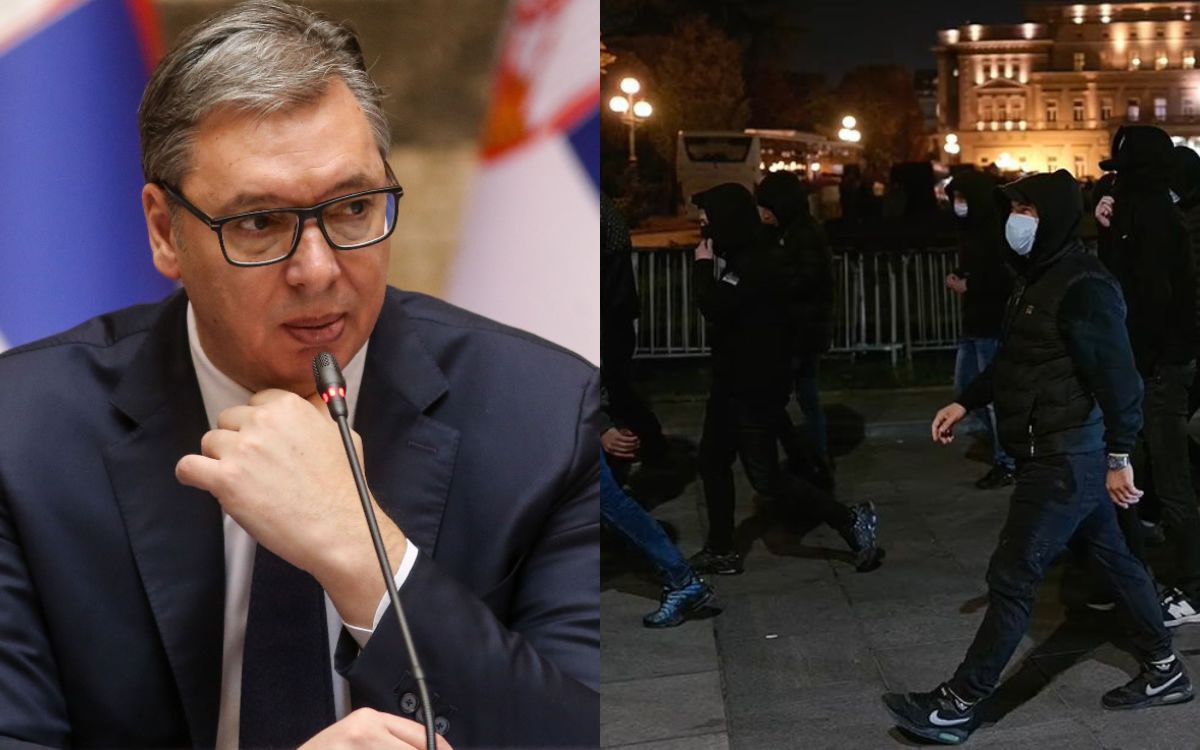
Former Serbian leader Aleksandar Vučić withdrew security forces from Pionirski Park on election night thanks to the European Union (EU), which pressured him not to initiate something that could have ended in a civil war, former Belgian Ambassador to Belgrade Denise de Hauwere has said.
In an interview with Insajder television, Denise de Hauwere pointed out that the EU was not merely an observer of events in Serbia ahead of the October 25 elections and on election day, when Vučić’s government deployed a large number of security personnel around the Presidency and the Republic Electoral Commission, heightening fears of a confrontation.
Asked whether she believed Brussels would monitor developments in Serbia more closely once the Student List, which won a landslide victory in the parliamentary elections, formed the government, the former Belgian ambassador said that the EU had been doing so “even before the fall of the Vučić regime itself.”
“You have surely heard that it was precisely thanks to the European Union that Vučić withdrew the soldiers and police from Pionirski Park. The Union put pressure on him not to initiate something that could have ended in a civil war. This means that the EU is following developments very closely,” De Hauwere said.
De Hauwere said she believed the EU was “ready to help the Serbian people, because the most important thing now is to put things in Serbia on the right track, preserve the functioning of the economy and maintain a stable political situation.”
“Now is not the time for revenge or settling scores with political opponents, but for working on institutional reform. The European Union is here and ready to help,” said De Hauwere, who served as Belgium’s ambassador to Belgrade from 2006 to 2011.
She said there was now “great hope for Serbia that it can begin a better period” and congratulated members of the student movement on their courage, as well as the Serbian people who supported the students on their perseverance.
“This truly shows that democracy in Serbia is still alive, and that faith in freedom can achieve so much. What happened is truly fantastic. You had a movement without leaders, but with many good leaders, I would say. These are very, very intelligent people, down-to-earth and capable,” De Hauwere said about the student movement.
The former ambassador also commented on claims that the European Commission had taken a lenient approach towards Vučić during the Serbian Progressive Party’s (SNS) time in power. She said Brussels had long prioritized regional stability over problems in the functioning of Serbian institutions, but that this approach “was not entirely bad.”
“It is true that the EU was very much focused on ensuring that the Western Balkans remained stable. Preserving stability in the Western Balkans also means preserving stability in Serbia, because Serbia is a very important country in the region. I think half the population and half of the Western Balkans’ gross domestic product come from Serbia. Therefore, stability in the Western Balkans is impossible without stability in Serbia,” De Hauwere pointed out.
She said that, in order to maintain stability in Serbia, the EU had often turned a blind eye to developments in the country, but that after several years, criticism of this approach had also begun to emerge from within the Union itself.
She assessed that the ties between the Serbian Progressive Party and the European People’s Party (EPP), the most powerful political group in the European Parliament, to which European Commission President Ursula von der Leyen also belongs, had influenced European institutions’ attitude towards Belgrade.
“I once said that it was time for the European Commission to open its eyes. And why did they contact Vučić or maintain ties with him? Vučić was the representative of the Serbian people, democratically elected, so you had no choice but to cooperate with him. The point is that Vučić had close ties with the EPP in Brussels, because the SNS is still an associate member of the EPP. That protected him. What happened was that he manipulated the Serbian people, but also the Union,” she said.
De Hauwere added that whenever Vučić felt that EU pressure was becoming too strong, or when the European Commission threatened to withhold certain funds, he would allow some minimal legislative reforms or temporary laws to be adopted in Serbia.
“But all of this was very limited, so that his autocratic system would not collapse and the European Commission would once again look favourably upon him. He would go to the European Union and say: You know, we are really doing our best, we are truly trying to become a good member of the European Union, just look at how hard we are working,” De Hauwere said.
However, when he returned to Serbia, Vučić’s message would be completely different: he would say that the EU did not understand Serbia and was imposing strict conditions on it solely in the Union’s interest, rather than Serbia’s, the former ambassador added.
“Of course, that was a lie. But it worked for some time, until the criticism became truly too strong. The consequence was that democracy in Serbia unfortunately continued to deteriorate. And finally, perhaps a little too late, the EU stopped making concessions to Vučić. It even withheld certain financial assistance from Serbia,” she said.
As one of the main reasons why the EU had sometimes turned a blind eye to developments in Serbia, De Hauwere cited the fact that Vučić had always presented himself as the only person capable of reaching a binding agreement with Kosovo.
“Vučić always said that he was trying to resolve the Kosovo issue and that he was the only one who could do it. This is one of the main reasons why the EU sometimes turned a blind eye to what was happening in Serbia, because it genuinely wanted to avoid a crisis between Serbia and Kosovo and believed that Vučić would resolve the issue. Of course, he did not resolve it,” De Hauwere said.
She also pointed out that it was not true that the EU was demanding that Serbia recognize Kosovo, “as the Serbian people had been told for years,” since the Union itself did not have a unified position on the issue, given that five of its member states still do not recognize Kosovo’s independence.
Alongside the Kosovo issue, De Hauwere identified another important reason why Brussels had focused on preserving stability in the Western Balkans: the Union’s fear that Serbia would be pushed into the arms of China and Russia if it were allowed to drift away, or if it stopped receiving financial assistance.
“I honestly believe that the EU has done much more for the Serbian people than China and Russia, but Vučić never said that in the media. The Serbian people did not know about it. The European Union has always been, and remains, Serbia’s largest investor, the largest donor of financial assistance and Serbia’s biggest economic partner. I think the Serbian economy has survived, among other things, thanks to the Union,” she said.
She added that, unfortunately, the Serbian people had never been aware of this, because large billboards had always proclaimed that Russia was helping Serbia and that China was helping Serbia.
“And there was almost never any mention of what the Union was doing for Serbia. Unfortunately, the consequence of all this is that the EU’s popularity in Serbia has been constantly declining and is now really very low. People lost trust because they thought we were saying one thing and doing another, and that we had let them down. But that was not true,” the former Belgian ambassador told Insajder television.
MORE TOPICS:
Source: N1 Foto: ATA Images/Printscreen YouTube
 Add Serbian Times as your Google source