




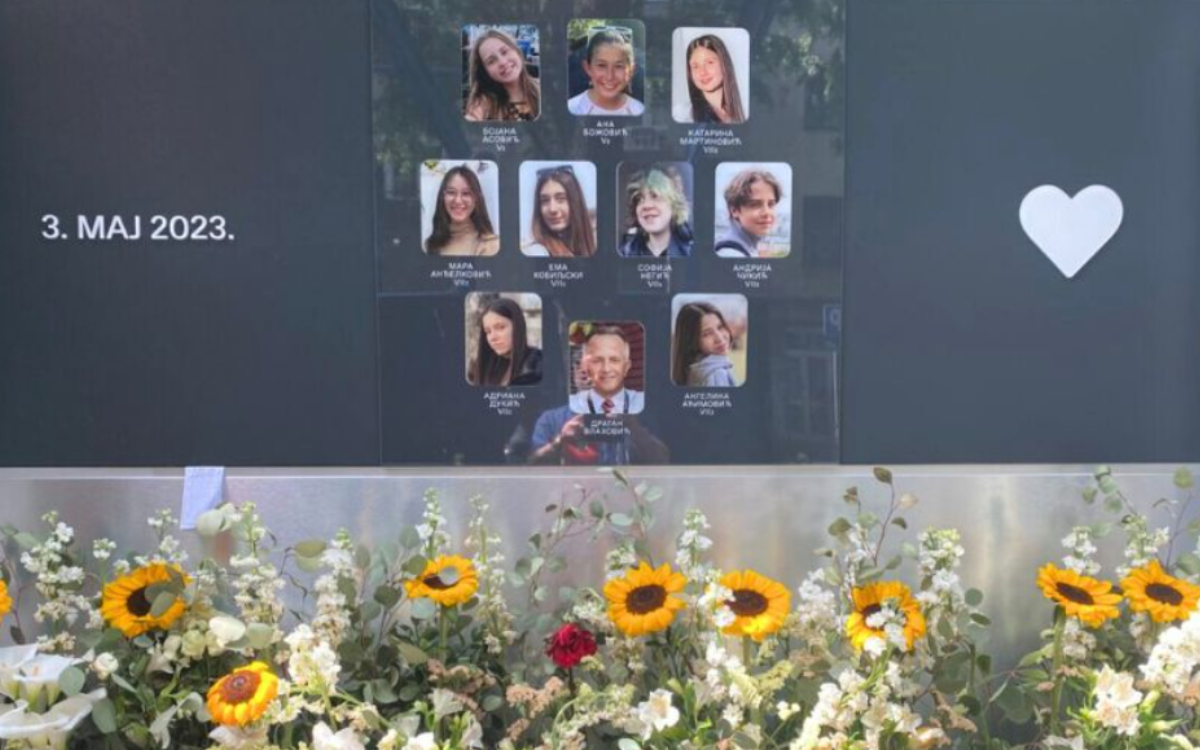
We fell silent and empathy was the most frequently spoken word after those days when nine children and a guard were killed in the “Vladislav Ribnikar” Elementary School on May 3, and in Dubona and Malo Orašje, villages in the Belgrade municipality of Mladenovac and near Smederevo, nine young people were killed and 12 wounded on the night between May 4 and 5.
What really happened afterward and what has been done since May 2023 is discussed for Nedeljnik by those involved in direct aid and work with the victims and their families. One is Tijana Mirović, a psychologist and psychotherapist, and the other is Veran Matić, a journalist who leads the B92 Fund and the Serbian Philanthropic Forum.
Tijana Mirović is involved in providing direct assistance within the Working Group for Mental Health and Safety of Youth of the Government of Serbia, following the tragedies at “Ribnikar” and in Malo Orašje and Dubona. She has been involved in various initiatives following traumatic events before, but she says she has never experienced the profession moving and organizing so quickly. On May 3 and for months afterward, she was called by almost all relevant clinical and educational institutions, which had never happened before, even though she has been in the “trauma story” since 1997.
How much did May 3 and 4 change us socially, psychologically, and as human beings, and did we experience a catharsis?
Unfortunately, Tijana Mirović is of the opinion that the case of little Danka clearly shows we have not changed. We followed, shared, commented, and believed “media” that evolved from metaphorical to literal vultures: we allowed parents going through hell to be accused and attacked, while we watched and judged and “cheered” as if in a gladiator arena. We consciously participated or, at best, passively supported them by not punishing them. We did not boycott, we did not say clearly and loudly “this is not right and I do not consent to this.” On the contrary.
“Perhaps I am overly critical, but I think that as a society we were not there in the right way for either the children or all those who suffer violence. Every news item about violence, a murdered woman, or a child who died by suicide or reported violence, we either relativized or loudly protested without any substantial action. Then everything quiets down until the next case, and so on in a circle.” As a society, we haven’t done much in terms of prevention, she adds. We shifted responsibility and looked for culprits, instead of everyone assessing together what must change and then changing it.
And that systematically—from our personal attitudes and reactions, through families, local communities, to the state level and laws. Also, instead of building and strengthening resources at all those levels, we took away the little that children had—we closed clubs, cut down parks, and the like.”
Veran Matić is in contact with the parents of the killed and wounded children at the “Vladislav Ribnikar” school and from Malo Orašje and Dubona, and has engaged in promoting empathy, love, and solidarity. When asked how successful he has been in this, he says he personally did not have overly high expectations. Firstly, because in his 40-year career, he has seen many situations where society was expected to react with empathy and solidarity, but such a reaction occurred only in a part of society, on the margins, and with strong obstruction by the political establishment.
“I didn’t expect much also because, in the first days after the terrible tragedies, a clear and completely unified alignment in expressing piety toward the victims, expressed clear plans toward supporting families, the wounded, survivors, and everyone affected by evil in any way, did not happen. From the very beginning, there was not even an attempt to overcome political polarizations, and every day the distancing of all important actors from the essence, from the commitment to clearly defining what happened and expressing clear plans for what and how would change in education and society, was evident.”
He began writing texts about the victims more intensively when it became clear to him that change would not happen. He wanted to remind everyone of all that was forgotten or neglected, or where there was never even an intention for it to happen—when it was clear that the media space was occupied by the characters and lives of the killers and their families, while the images of the children and Dragan could only be seen collectively on a black-and-white mini-poster at the entrance to the school where the crime occurred, and the murdered youth from Dubona and Malo Orašje were not even mentioned.
“It can often be read that birthdays and anniversaries are the hardest days for the families. I realized how important it is to mark birthdays by sharing both sadness and love with parents and families. With stories about goodness, talents, values, traits, anecdotes, with reminders of lives full of normalcy, beauty, energy, with many family details, photos, videos. How important it is for every name to get its own stories and content, so that we get to know them, because that is the only way we can remember them. In my phone contacts, I entered the names of the children and Dragan, alongside the numbers of their parents and Dragan’s sisters, wanting them to always be ‘before my eyes.’ I wanted the school, the local community, the state, to integrate these names and values into various programs. However, as time passed, it became increasingly difficult and polarization only increased,” Matić tells Nedeljnik.
The complete defeat was when he went to Dubona and Malo Orašje and realized how neglected the parents of the murdered youth were, while information about the wounded and their battle for life did not even exist.
FIND OUT MORE
“I still wonder how it is possible that the condition of every family has not been assessed by now, along with certain measures to support their existence, which would be daily systemic support for all needs, with scholarships for brothers and sisters, with health and every other support for health that is severely and permanently endangered. It is still necessary to collect donations to buy certain medicines that are not on the free list, equipment for the wounded, firewood, etc.,” says Veran Matić.
In the difficult year behind us, there were many criticisms and divisions—divisions among parents regarding whether, where, and how large the Memorial Center should be, and whether it is a school or no longer a school, to the fact that even the school itself has not changed, not even “Ribnikar” since children still go there after everything that continues to this day. Is this incredible because empathy, solidarity, and unity were expected since these (could have been) our children, or is it not strange when we analyze everything?
We are generally prone to criticism and the thesis that no one is doing anything or doesn’t know how to do it. Since we do this even when we lose in a sport, it is no wonder that this is further amplified in situations of serious stress and trauma, Tijana Mirović notes. When we are overwhelmed (very upset, scared, and hurt), we more easily (and even naturally) begin to look at things in “black-and-white” and “all-or-nothing” terms.
“In the context of social and collective trauma, divisions are both expected and understandable. They existed in Norwegian society after their tragedy, and they existed here as well. However, although understandable and universal, it should by no means stay that way. Traumas are prevented and healed through connection with others, through the safety of the group. As Judith Herman, one of the leading experts in the field of trauma, says: ‘Group solidarity provides the strongest protection against terror and despair and the strongest antidote to traumatic experience.'”
Instead of uniting and truly strengthening empathy and solidarity, we showed those characteristics only toward like-minded people, while we attacked and demonized others, thus creating additional tensions and stress, she adds.
“Instead of working on mediation and looking for a common interest, we fed differences, further pushing people into an ‘either you are with us or against us’ discourse. This was best seen in the conflicts you mention. Divisions and differences were created regarding goals or ways to reach those goals, but it was overlooked that underneath were basic human needs that are the same for all of us. We all wanted to care for and protect (our) children or the memory of them, to feel safe, to find support, to have some voice and autonomy on matters that concern us, and the like.”
She believes that if we, as a society, had created space to talk at that level, we would have found many more similarities than differences. From that position, we would have found some common solution, and more importantly, a deeper mutual understanding.
“We would have found more of the empathy and solidarity that we need so much and so often lack. Instead of being enemies, we would be resources for each other. Instead of being a source of stress for each other, we would be a source of stability. We would also be a good model for children on how to resolve conflicts of opinion through dialogue and respect, rather than force and insult. We would help everyone feel less threatened and safer, and thereby move from anger and arguments toward silence and mourning. Toward true and deep grieving for these terrible losses, toward a common search for ways to worthily commemorate and never forget, toward true care and respect for both those who are no longer alive and those who remain to live with all that pain and those wounds.”
Killed in “Ribnikar” were Ana Božović, Sofija Negić, Mara Anđelković, Andrija Čikić, Bojana Asović, Angelina Aćimović, Ema Kobiljski, Katarina Martinović, Adriana Dukić, and Dragan Vlahović.
MORE TOPICS:
NOW SHE HAS EVERY TROPHY: Tijana Bošković won the Champions League, also named MVP of the final!
Source: Nedeljnik, Photo: Javni servis.net
 Add Serbian Times as your Google source