




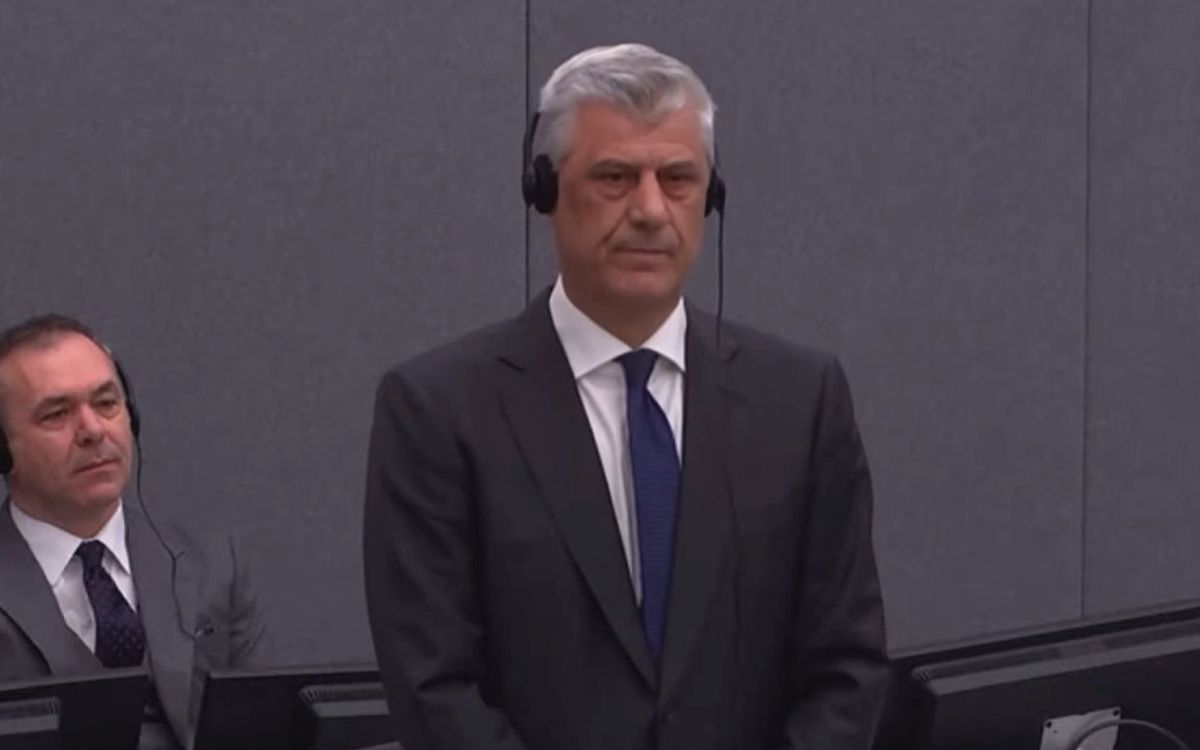
In the continuation of the trial of the former KLA leader Hashim Thaçi in the Hague, defense witness Michael Durkee stated today that Thaçi did not act as a military commander in 1999, but as a political representative of the KLA.
Durkee, then a NATO official, also claimed that the KLA was not responsible for the crimes against the Serbian and other minorities in Kosovo in the summer of 1999, but rather local avengers and bandits.
Thaçi is accused of war crimes in Kosovo and Albania, 1998-99.
The American diplomat Durkee was then the political advisor to the NATO commander in Europe, General Wesley Clark.
Durkee, as he stated, participated in a meeting between General Clark and Thaçi at NATO headquarters in Mons, Belgium, in March 1999, before the Alliance’s attack on the FR Yugoslavia.
“Thaçi did not behave as a military commander, but more as a political figure. He spoke almost exclusively about political ambitions, not military goals. He was a political leader, not a military commander,” Durkee testified.
The KLA delegation, which included Thaçi and Jakup Krasniqi, among others, asked NATO “to bomb the Serbs.”
“They were firmly committed to independence from Serbia. Our assessment was that the KLA did not have a military strategy or the capabilities to achieve that goal,” Durkee emphasized.
The goal of General Clark at that meeting was, according to Durkee, to see “to what extent the KLA could be a partner” to NATO in the “combat mission” in Kosovo that the Alliance commander foresaw at the time.
Durkee also claimed that the KLA did not organize, nor could it prevent, the violence against Serbs and other minorities after the withdrawal of Serbian forces from Kosovo in June 1999.
The witness described this violence as spontaneous “revenge” and criminal acts by local gangs.
“The KLA leaders were powerless to control and prevent that violence,” said Durkee, who, as he stated, was in Kosovo four times in 1999.
The witness assessed that Thaçi “had no motive to encourage violence,” because it would “undermine his position with international officials and endanger everything he was trying to achieve.”
Durkee, who is the sixth witness for Thaçi’s defense, continues his testimony.
Next week, General Clark will appear as the last witness for Thaçi’s defense before the court in The Hague.
The 10-count indictment charges Thaçi (56), Kadri Veselji (57), Redžep Seljimi (53), and Jakup Krasnići (74) with: persecution on political and ethnic grounds, imprisonment, illegal arrest and detention, other inhumane acts, cruel treatment, enforced disappearance, torture (two counts) and murder (two counts).
KLA members committed crimes against approximately 407 detainees, of whom at least 102 were killed, from March 1998 to September 1999, the indictment states.
The indictment identifies 75 victims – 51 Serbian, 23 Albanian, and one Roma.
Six counts of the indictment charge Thaçi (56), Veselji (57), Seljimi (53), and Krasnići (74) with crimes against humanity, and four counts with war crimes.
According to the indictment, Thaçi, Veselji, Seljimi, and Krasnići were participants in a joint criminal enterprise.
The goal of this criminal enterprise was to take control of the entire Kosovo through violence against all those whom the KLA considered “opponents.”
KLA officers Azem Sulja, Ljah Brahimaj, Fatmir Ljimaj, Sulejman Seljimi, Rustem Mustafa, Šukri Buja, Ljatif Gaši, and Sabit Geci are also listed as co-perpetrators in the criminal association in the indictment.
All the accused pleaded not guilty. They have been in custody in The Hague since their arrest in Kosovo in November 2020.
The trial of Thaçi and the co-accused began before the court in The Hague on April 3, 2023, and the prosecutors concluded their presentation of evidence on April 15 of this year.
125 prosecution witnesses testified in the Hague courtroom, and the statements of dozens of other witnesses were introduced as evidence by the prosecutors in written form.
The prosecution’s evidence material also consists of 3,000 documents in Albanian, Serbian, and English.
More than 150 victims participate in the process, who, according to the court’s rules, have the right to compensation if the accused are found guilty at the end of the process.
The Kosovo Specialist Chambers, as the court is officially called, was established in 2015 by the Assembly of Kosovo under international pressure caused by the report of the Council of Europe rapporteur Dick Marty on KLA crimes in Kosovo and Albania, published in 2011.
The court is formally part of the justice system of Kosovo but operates in The Hague. In judgments and other documents, the court found that a persistent climate of intimidation and harassment of witnesses against the accused members of the former KLA prevails in Kosovo.
MORE TOPICS:
“A MAN WHO TOUCHED HUMAN HEARTS”: Đoković revealed what he would like to be written on his monument!
BOJOVIĆ RELEASED ON BAIL: The policeman arrested in Chicago is awaiting a decision on deportation!
Source: Danas; Photo: Printscreen YouTube / Reuters
 Add Serbian Times as your Google source