




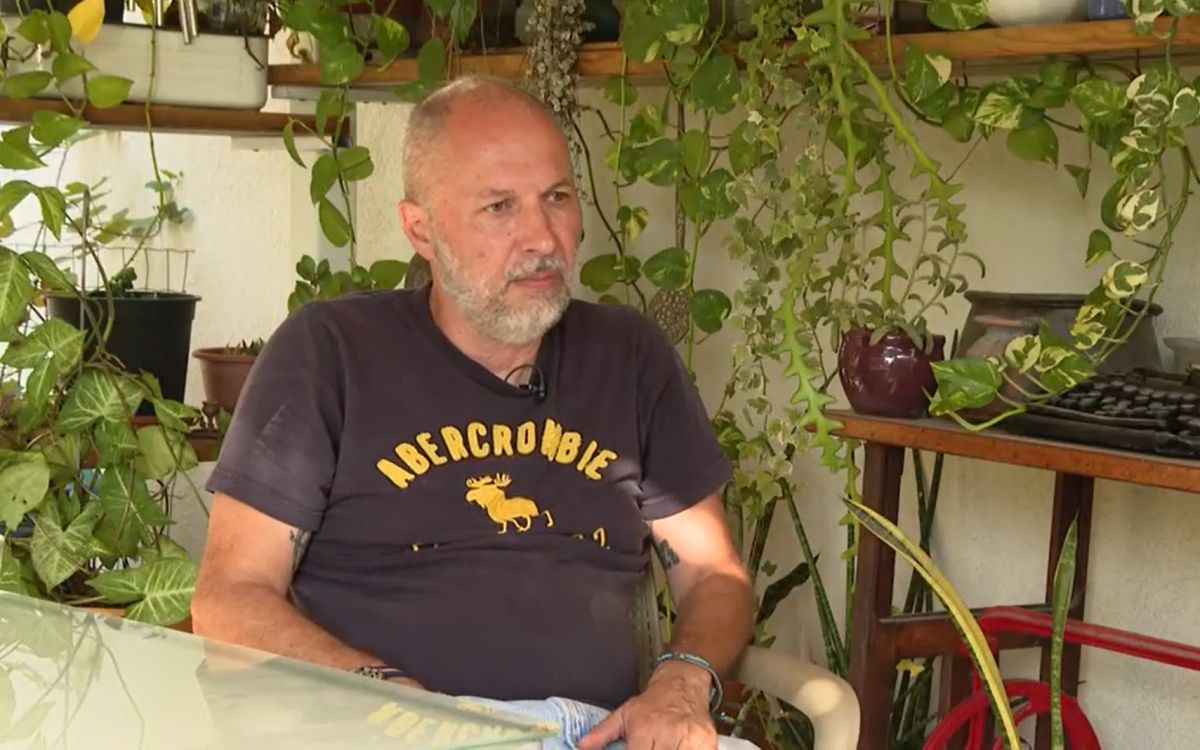
Matvej Eisenberg has lived in a kibbutz in Israel for over three decades, having arrived to escape the war in Yugoslavia. This native of Belgrade, three decades later, takes a gun along with his keys and wallet when heading to the supermarket, as his daughter currently fights in Gaza. Branislav Šovljanski discusses Israeli actions in Gaza and Lebanon, stating that it is the most difficult situation he must respond to, as he does not consider himself someone who would rush into war, yet admits that military actions by the Israeli army provide him with a certain sense of security.
Matvej recalls his last months in Belgrade in the early nineties, the military police gathering students at universities and sending them to the front, his friends from across the former Yugoslavia, the questions of identity and origin, and the feeling that the image of “peace and a perfect country began to unravel.”
“For the last two or three months in Belgrade, I lived in Banjica, but I was hiding at a friend’s place in Voždovac, who is originally American. My father was a professor at the Faculty of Applied Arts, and there was an agreement that I would escape through the window of the amphitheater, where my father’s car awaited me. The decision came quickly; after two or three weeks, my mother came and said they had bought me a ticket, and I was traveling. I had an hour to pack my things and found myself in Surčin. A family friend who was influential at the airport escorted me through security, and I found myself on a plane that took me to Israel,” Matvej reminisces about how he arrived in the country that is now his home.
With no knowledge of Hebrew, except for some phrases he did not understand, Matvej arrived in Israel as a tourist and initially lived in Jerusalem. When he decided to learn the language, he realized there were two options—either the state would pay for it as a Jew and new immigrant, or he would have to pay a large sum as a tourist. He chose the former, proving his Jewish heritage through bureaucratic procedures and thus arriving at a kibbutz where he would learn the language.
“To be honest, I wasn’t sure it was what I wanted. My thoughts were still in Belgrade,” says Eisenberg. He adds that his ten friends from all parts of the former Yugoslavia, who ended up in the same place, felt the same way. “We were living or surviving the war that was going on there, and we sat here, and no one had the patience to learn that language,” Matvej recalls, remembering how Hebrew letters looked like hieroglyphics, and the sounds felt like spitting sand.
Instead of his father’s letters about the war in the country he left, Matvej wanted to read stories about his roots, about everything his father remembered from his earliest days until the end of World War II. From those letters, which often spanned 20 or 30 typed pages, later emerged the book “Letters to Matvej,” which has been translated from Serbian into several languages and ultimately reached the Yad Vashem Memorial Center in Jerusalem.
“By coming here to Israel and with my personal war, I realized that for the second time my family was going through something that would change us, and suddenly I was scared that in my youth I hadn’t listened enough to my father and his stories, the details that make up a personality, that make up the family tree that is important,” Matvej emphasizes.
Life in the Kibbutz Before and After the War
Eisenberg describes the kibbutz as “an idyllic beautiful community where everyone is equal, a perfect communism where it doesn’t matter how much you work because it’s assumed that everyone gives as much as they can.” In the kibbutz, all houses and land belong to the community, and the houses are of equal size. Everyone contributes in ways they can, earning for the kibbutz, which in turn takes care of its residents.
In practice, this means individuals do not pay for electricity, gas, or water; the kibbutz does. Taxes and contributions are also covered by the kibbutz, not its residents. Whether someone is a dentist, electrician, or farmer, everyone receives the same imagined salary. When shopping in the kibbutz, one does not pay with money; instead, the value of goods is deducted from this imagined salary. The kibbutz takes care of the helpless and sick who can no longer work, ensuring that no one is left without food. If someone needs an expensive operation or other treatment, the kibbutz will cover the costs.
“Within the kibbutz, each individual has a safety net, a system we created to ensure everyone is secure in any situation, whether they are ill or unable to work. The kibbutz as a community takes care of them,” explains our interlocutor.
To become equal members of this community, he and his wife had to undergo psychological testing and then be on probation for a year and a half. During this time, the kibbutz assessed whether they were good workers, and they evaluated whether this was the right place for them to live.
“After that year and a half, the kibbutz members voted secretly on whether to accept us or not. Since we were accepted, we became equal to all other members,” says Matvej.
The kibbutz today is somewhat different. Matvej admits that people leave it and seek employment elsewhere to contribute more to their families. The ideal community has changed, with more people looking to keep the money they earn for themselves rather than the kibbutz.
When Hamas attacked Israel on October 7 last year, the kibbutzim in the south of the country were among the first to be targeted. He says he probably didn’t expect such an attack from the people living there.
“At the moment we entered the war, the kibbutz quickly organized itself so that everyone who could contribute in some way helped maintain normal life in a wartime situation,” Matvej recalls.
Younger members cared for older neighbors, bunkers were converted into kindergartens, and the kibbutz’s medical staff formed a field hospital. Matvej, who is an electrician, acquired a generator capable of supplying electricity to about 150 homes. Residents from areas without electricity were relocated to where power was available.
“The kibbutzim were ideologically created as military bases, the first military bases in Israel, places where the first immigrants came because it was known they would stay there, and most members were armed, and the weapons have remained to this day. We had hidden rooms at various locations where we kept various weapons known only to kibbutz members, for situations like last year,” Matvej says.
However, times have changed, and some kibbutz members also possess personal weapons. Our interlocutor is one of them. He did not part with his pistol even while speaking with reporter Branimir Šovljanski.
“Here in the kibbutz, alongside all the things we organized, we also have our civil defense, an internal unit where we are divided into those who have weapons and, in case of an attack, everyone knows exactly where to go and we fight. There’s another group involved with medicine who help if someone is injured, and those who know something, a kind of firefighters, who have some machines to clear debris,” Eisenberg explains the wartime division of tasks.
FOLLOW US ON FACEBOOK:
The Toughest Question – Is What Israel is Doing Right?
Matvej has three children, all of whom have served in the military. His daughter is currently on the front lines, which includes Gaza when necessary. Her boyfriend was killed almost a year ago in Gaza and is buried in the kibbutz.
When asked if what Israel is doing right now, the attacks on Gaza and Lebanon, is justified, Matvej candidly states that this is the most difficult question he has to answer.
As he slowly chooses his words, he tries to explain himself. He says he is neither a leftist nor a rightist, and although he carries a weapon, he is not militant, but would defend his family and friends if needed.
“But I’m not one to rush into battle. On the other hand, I believe all captives must return home immediately. I think the problem in Israel—this is my personal opinion—is that everything happening for a year is a kind of political survival for our prime minister, that he is prolonging his hold on power in a nice and very refined way,” Eisenberg says, referring to Israeli Prime Minister Benjamin Netanyahu.
On the other hand, he admits that military actions against Lebanon and Hamas provide people with a sense of security as some successes are visible.
“But when it comes to negotiations about the captives, when we talk about accountability for what has happened, you see that no one wants to take any responsibility. They say there’s time, we’ll talk when the war is over, but the war has been dragging on for a year, and as far as I can see, the war will continue,” Eisenberg expresses his pessimism.
He assesses that Hamas will not surrender easily and cannot be stopped by military force. He sees alternative political strength as the only barrier to militants. “Someone who will come instead of Hamas and hold all the political strings within Gaza,” he notes.
Speaking about his daughter who is fighting in Gaza and her boyfriend Gilad, who was killed, Matvej says they are fighting for all the captives to return home and for peace to return to the land.
“The youth in Gaza or Lebanon want to bring peace to all those citizens in those territories so they can return peacefully and walk freely. That is the desire of all these young people, in Israel, in the army, to achieve peace. No one wants war; everyone is tired of war,” concludes Matvej Eisenberg.
READ MORE:
SAD NEWS FROM CANADA: Daughter (25) of serbian rock legend dies in car accident
Source: N1
Photo: Printscreen N1
 Add Serbian Times as your Google source