




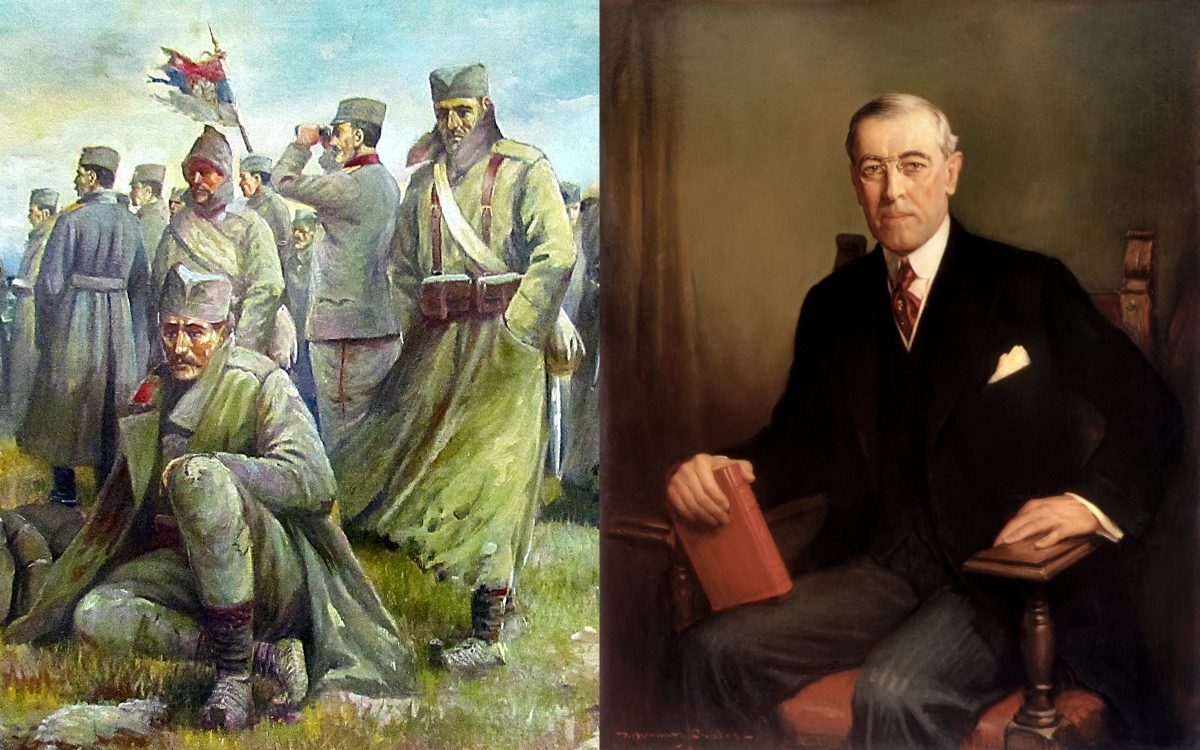
Today, more than 100 years after these events, the words of U.S. President Woodrow Wilson, spoken to the American people on July 28, 1918, about the Serbs and their hardships, sound almost unbelievable.
In 1918, World War I was still raging in Europe. After years of hesitation and public opposition, in 1917, the United States finally entered the war with a fresh and well-equipped army, ready for battle.
The Serbian army, or what remained of it, had already regrouped and, with the resilience characteristic of its people, was fighting on the Salonika Front, seeking to reclaim its occupied homeland.
Although the U.S. did not take direct part in the liberation of the Balkans, it was well aware of the suffering the Serbian people endured during the war. The American public sympathized deeply with the Serbs and understood their struggles.
A large part of this American support was due to one man—U.S. President Woodrow Wilson.
A Close Friend of Mihajlo Pupin
Thomas Woodrow Wilson assumed office as the 28th President of the United States in 1913, on the eve of the Great War. During his presidency, and especially after World War I, the U.S. emerged as a global power, largely thanks to Wilson’s leadership and policies.
Though separated by oceans and thousands of miles, Wilson was well acquainted with Serbia’s history and suffering. His scholarly nature and position as President contributed to this knowledge, but even more important was his close friendship with Mihajlo Pupin, the renowned Serbian-American scientist. Pupin was Serbia’s greatest advocate in America, tirelessly working to gather aid, raise awareness of Serbia’s wartime struggles, and secure substantial material assistance for both the army and civilians.
Wilson enthusiastically supported Pupin’s efforts. On the fourth anniversary of Austria-Hungary’s declaration of war on Serbia—July 28, 1918—Wilson proclaimed “Serbian Day.” On that day, Serbian flags were raised on all public institutions in the U.S., including the White House.
Wilson went even further, addressing the American people with a message about Serbia, which was read in churches across the U.S. and published in major newspapers.
FIND OUT MORE IN ENGLISH:
Wilson’s Message to the American People
“On Sunday, July 28, we mark the fourth anniversary of the day when the brave Serbian people, rather than submit to the cunning and unworthy persecution of a prepared enemy, were called to defend their homeland against an aggressor determined to destroy them.
The noble Serbian people responded. They stood firm and courageously resisted the military forces of a country ten times greater in population and military strength. Only after repelling the Austrians three times and after Germany and Bulgaria came to Austria’s aid, were they forced to retreat through Albania. Even though their land was devastated and their homes destroyed, the spirit of the Serbian people was not broken. Overpowered by superior forces, their love for freedom remained undiminished. Brutal force did not weaken their steadfast determination to sacrifice everything for freedom and independence.
It is fitting that the people of the United States, who are committed to the self-evident truth that all nations, both great and small, have the right to live freely and choose their own governments, remember that the principles for which Serbia has fought and suffered so valiantly are the same principles for which the United States stands. On this anniversary, we should express our sympathy for this oppressed people, who have so heroically resisted the Germanic nation’s ambition to dominate the world.
At the same time, we must not forget the kindred peoples of the great Slavic race—Poles, Czechs, and Yugoslavs—who, now under foreign rule, long for independence and national unity.
There is no more appropriate way to mark this occasion than in our churches. Therefore, I call upon the people of the United States, of all faiths and denominations, to gather in their places of worship on Sunday, July 28, to express their compassion for these oppressed people and their brethren in other lands, and to invoke the blessings of Almighty God upon them and upon the cause to which they have devoted themselves.”
Woodrow Wilson, President of the United States, The White House, July 1918.
MORE NEWS:
WHY THE BOYCOTT: Serbian and Balkan Products More Expensive in Belgrade Than in Chicago! (VIDEO)
Source: Istorijski Zabavnik
Foto: Wikimedia Creative Commons
 Add Serbian Times as your Google source