




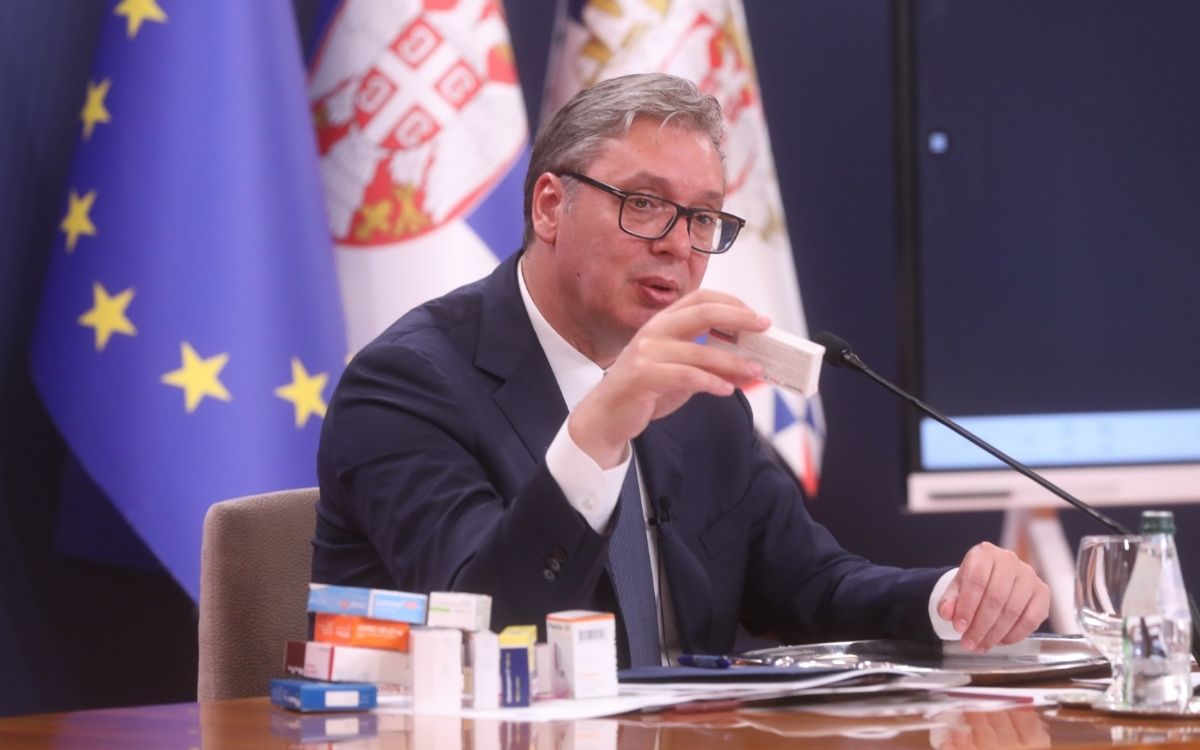
Serbian President Aleksandar Vučić caused huge confusion among citizens when he announced that numerous medicines would become several times cheaper. Pharmacists say patients are confused when they are told that some of those medicines still cost the same as before, because what has actually been reduced is the co-payment required to obtain them with a prescription.
Serbian President Aleksandar Vučić announced a package of measures at the end of June which, as he said, would significantly reduce citizens’ costs for medicines, stressing that the state would cover part of the co-payment so that therapies would become more affordable and shortages would be avoided.
Thus, as of August 17, patients in Serbia have access to 18 medicines with significantly lower co-payments, including “Forxiga”, which instead of 2,500 dinars now costs a maximum of 1,650.
And it was precisely this medicine that caused a problem for a Nova.rs reader.
“I went to the pharmacy to buy ‘Forxiga’ for my father, who has chronic kidney disease, because the president had announced a lower price. The medicine cost 2,500 dinars, and it was supposed to cost 1,650 dinars under the new price. However, the pharmacy charged me the same price as before,” he said.
What’s the catch
As the owner of a pharmacy chain explains, the state did not lower the price of medicines, but rather reduced the co-payment for medicines obtained with a prescription.
“Unfortunately, the president has complicated this whole idea so much and created a huge problem for us pharmacists because there isn’t a patient who doesn’t complain when we tell them that the medicine has not been discounted,” a pharmacist told Nova.rs, before explaining further:
“For example, the prescription medicine ‘Forxiga’ came in a package of 30 tablets, while there is also a package of 28 tablets. The 30-tablet package was available by prescription and the co-payment was, for example, 50 dinars, while those who bought it without a prescription paid the full price of the medicine, around 2,800 dinars. I receive one box at one purchase price and another at a different purchase price. I dispense the 30-tablet package by prescription, while I sell the other 28-tablet package for cash. However, prescriptions are now also issued for the 28-tablet package, but a 30 percent co-payment is charged. So not 50 dinars, but 30 percent of 2,800 dinars. And that is where the 1,650 dinars comes from.”
The same applies to one of the most popular medicines, “Nolpaza”, which helps treat heartburn.
“The president showed boxes of this medicine and said that it would cost 50 dinars. No! The medicine costs around 130 dinars at retail, and when a patient gets it by prescription, they pay 50, while the state pays us the rest. Patients call us thieves because Vučić confused people. He was talking about citizens’ co-payments for medicines they receive by prescription. In that sense, the state’s share is higher, and the difference is paid to us by the state. For example, if that medicine costs 3,000 dinars, the patient previously paid 1,000 as their co-payment, and now pays, for example, 500. The difference of those 500 dinars is paid to us by the state.”
The change has also created problems with pharmacies receiving payments for this difference.
“We are afraid that we will have to wait longer. They are already late with payments anyway,” she says.
The Fund calls on pharmacists
As employees at several pharmacies told us, they receive calls from the RFZO every day asking whether they have implemented this “Vučić measure.”
“They constantly ask us whether we have implemented it and whether the measure has come into effect. They don’t know that we don’t implement it ourselves, but that our programmers, that is, the software we use, does it automatically. The moment it comes into force, when it is published in the Official Gazette, our software, that is, everyone’s software, takes it over from the RFZO. And it is automatically applied. It’s terrible how little they know,” said one employee at a pharmacy.
Chamber of Pharmacists sends urgent letter
Following numerous misunderstandings and confusion among patients, pharmacies contacted the Chamber of Pharmacists of Serbia, which sent an urgent letter to the Ministry of Health and the Republic Health Insurance Fund, asking for more precise public information about the adjustment of prices for medicines dispensed at the expense of RFZO funds.
The letter regarding the initiative states that the public has been given the impression that medicine prices have been reduced, although the adopted changes concern exclusively the reduction of patients’ co-payments for certain groups of medicines that are prescribed and dispensed at the expense of the Republic Health Insurance Fund, that is, exclusively with a doctor’s prescription.
“As a consequence of such an interpretation, misunderstandings occur daily in pharmacies when medicines are dispensed, creating serious operational problems when dealing with patients. Patients, relying on information published in the public sphere, often expect that the prices of medicines sold freely have been reduced, which leads them to believe that pharmacies are not applying the adopted changes defined by the Regulation on the List of Medicines Prescribed and Dispensed at the Expense of Mandatory Health Insurance Funds as of August 1, 2026,” the letter states.
It adds that patients believe pharmacies are arbitrarily setting higher prices or concealing the actual discounts.
“Given the above, we believe that additional public clarification by the Ministry of Health, or the Republic Health Insurance Fund, regarding the scope and nature of the adopted measures would help eliminate confusion, ensure uniform information for citizens and enable consistent implementation of the measures in practice,” the Chamber of Pharmacists of Serbia said.
Incidentally, this is the list of medicines whose price has been reduced:
- Glucophage was 283 dinars, after the measures it costs 121 dinars
- Flavix, an anticoagulant, was 302 dinars, now costs 60 dinars
- Lorista was 176 dinars, now costs 50 dinars
- Diaprel was 265 dinars, now costs 102 dinars
- Clindamycin was 226 dinars, now costs 75 dinars
- Hemomycin was 184 dinars, now costs 92 dinars
- Levoksa was 369 dinars, now costs 92 dinars
- Saflutan was 635 dinars, now costs 181 dinars
- Nolpaza was 195 dinars, now costs 97 dinars
- Pulmicort, an asthma inhaler, was 320 dinars, now costs 91 dinars
- Panklav was 260 dinars, now costs 71 dinars
- Nebilet Plus 5 was 269 dinars, now costs 73 dinars
- Forxiga was 2,500 dinars, now costs a maximum of 1,650 dinars
MORE TOPICS:
Source: Nova.rs, Foto: L.L. / ATAImages
 Add Serbian Times as your Google source