




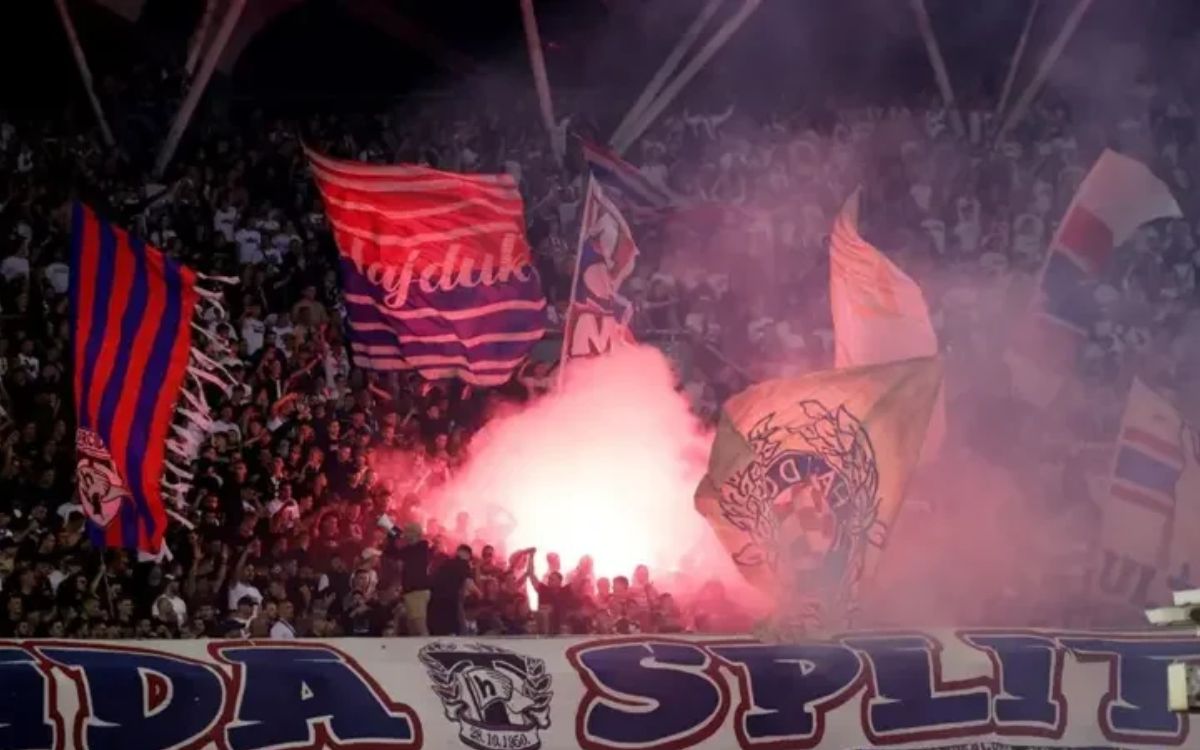
Police in Split have begun arresting people who shouted Nazi and antisemitic slogans ahead of the European Conference League match between local club Hajduk and Dutch side Ajax, Croatian media have reported.
Thousands of Hajduk fans chanted “Crush, crush, crush the Jews,” “Auschwitz, Auschwitz” (the infamous Nazi concentration camp during World War II), “Wake up, Adolf (Hitler)” and “Come on, come on, Ustaše” in the streets of Split on October 15.
Leading the procession of fans to the stadium was a yellow Volkswagen Golf with a coffin on its roof bearing the word Ajax.
The Amsterdam club has historically been associated with the Jewish community, and Ajax fans, although most are not Jewish, have used the name “Super Jews” and symbols such as the Star of David as part of their identity for decades.
This tradition also developed in response to antisemitic insults from rival club supporters.
The Croatian government “strongly condemned the unacceptable chants glorifying the Nazi regime.”
“Police are conducting a criminal investigation to identify and prosecute those who shouted punishable slogans” during the procession of fans to the stadium, the Croatian government’s account on X announced.
“Such shameful behavior is a negation of sport and the democratic values upheld by modern Croatia,” the government of the European Union member state said.
Split police confirmed that “chants displaying characteristics of punishable conduct were recorded” during the fans’ walk to the stadium and that they had begun arresting people identified as having participated in shouting messages of hate, the news portal Index.hr reported.
Hajduk have not won the Croatian league title in 20 years, and this was the Split club’s first match in the group stage of a European competition in 16 years.
Penalties for chanting hate slogans
At least 10 people have so far been identified by police as prominent members of Torcida, Hajduk’s supporters’ group. Some were already known to the judicial authorities, the Split-based newspaper Slobodna Dalmacija reported.
Under Croatia’s Criminal Code, publicly inciting violence or hatred against a group of people or a member of a group on the grounds of protected characteristics, such as nationality, religion, race, origin, sex, sexual orientation, gender identity or disability, is punishable by up to three years in prison, Slobodna Dalmacija reported.
Organizing or leading a group of at least three people for the purpose of publicly inciting hatred carries a prison sentence of six months to five years.
Anyone who participates in such a group faces a prison sentence of up to one year.
Under the same Article 325 of the Criminal Code, publicly approving, denying or grossly trivializing genocide, crimes of aggression, crimes against humanity or war crimes is punishable by up to three years in prison.
Condemnation from Picula, the opposition and the Israeli Embassy
After the match, Hajduk also issued a statement, apologizing for “the behavior of a section of our supporters, whose extensive use of pyrotechnics caused the match to be interrupted.”
“We also apologize to the competition organizers, as well as Ajax’s management and players, who witnessed scenes for which we do not want Europe to remember us,” Hajduk said.
Several opposition parties in Croatia strongly condemned the behavior of Hajduk fans and called on the police to impose the harshest possible penalties without delay on those who shouted Nazi and antisemitic messages.
“The Republic of Croatia must not tolerate such a massive outpouring of hatred and antisemitism.
“The police must act immediately, and the courts must sentence those responsible to the harshest possible penalties under the Criminal Code for publicly inciting violence and hatred,” said the Možemo party, whose representative Tomislav Tomašević is the mayor of Zagreb.
Tonino Picula, a Croatian member of the European Parliament, said these were “dangerous scenes that society and the state must respond to,” N1 reported.
He criticized the Croatian authorities for having “allowed such grotesque forms of political expression to appear on Croatian streets with unbelievable leniency.”
“These are dangerous scenes, and you must react both as a society and as a state.
“If you fail to react, it becomes a constant threat to the majority of Croatia and to what must represent resistance to such expressions of political intolerance and the glorification of fascism,” Picula, the European Parliament’s rapporteur for Serbia, emphasized.
Everyone engaging in such behavior on Croatian streets “should be reminded that, had World War II ended differently, they would hardly be shouting such slogans and nonsense in Croatian,” Picula said.
Tomislav Šuta, the mayor of Split, also condemned the Nazi chants and expressed hope that “such things will not happen again.”
“Split is sending a very bad message after the magnificent victory and the result Hajduk achieved after 16 years.
“The match was even interrupted at one point, and I was ashamed given that it was a European fixture. I apologize on behalf of the city,” Šuta said.
The Israeli Embassy in Zagreb said it was “deeply shocked by the serious antisemitic incident in Split” and condemned it in the strongest terms.
“Such incidents must be unequivocally and firmly condemned by all competent authorities at every level,” the embassy added.
Media outlets across Europe and in Israel have reported on the incidents and the Nazi and antisemitic messages in Split.
In an article titled “Croatian fans chant vile antisemitic abuse,” Britain’s Telegraph also recalled earlier similar Nazi and racist incidents in Croatian football.
The Croatian Football Federation has been sanctioned repeatedly over similar messages in previous years and decades.
The Union of European Football Associations (UEFA) recently fined the Croatian Football Federation €30,000 and ordered part of the stadium to be closed for the next match because of “racist and/or discriminatory behavior” by its supporters during the Croatia–Spain Nations League match played in Split on October 6 this year.
A banner dedicated to the Ustaše salute “For the Homeland, Ready” was displayed in the stadium’s east stand.
“For years, scandals have piled up, and Croats are fined for the salute ‘For the Homeland’; the judiciary’s practice is shameful — is our fathers’ salute the biggest problem in society?” the banner read.
The Ustaše salute “For the Homeland, Ready” and messages of hatred against Serbs can often be heard at Croatian club matches.
Eleven years ago, on June 12, 2015, ahead of a European Championship qualifying match between Croatia and Italy, a swastika was drawn on the pitch at Poljud Stadium in Split.
Stadium workers tried to partially remove it during halftime, but the outline of the symbol remained visible.
The match was played behind closed doors because of previous sanctions.
UEFA subsequently deducted one point from Croatia as punishment.
Given that Hajduk’s most passionate supporters shouted antisemitic and Nazi slogans in the city rather than inside the stadium, the question is whether UEFA can sanction the club.
However, Hajduk can certainly expect penalties for the massive use of flares that led to the match being interrupted in the second half.
The Split club was fined €56,000 this summer because of supporters’ use of flares during a match against Polish side Raków.
It now faces either another financial penalty or the closure of part of the stadium stands.
MORE TOPICS:
Source: BBC Foto: REUTERS
 Add Serbian Times as your Google source