




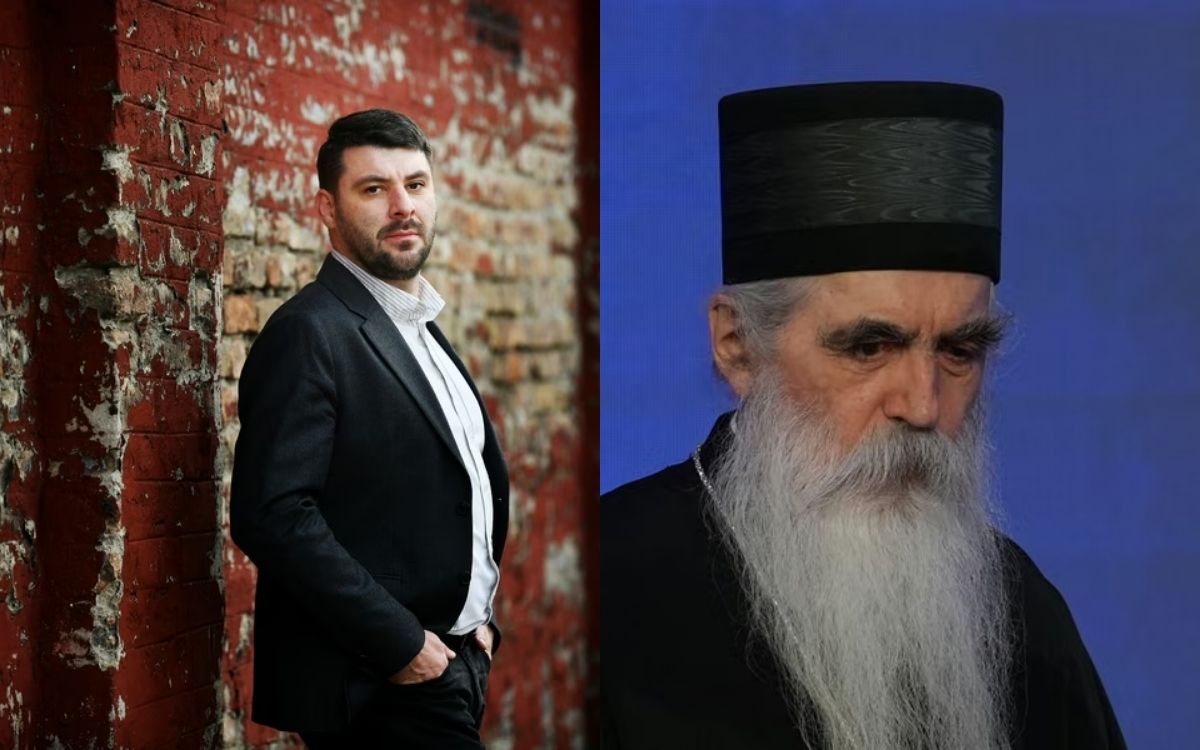
Theologian Blagoje Pantelić has requested the urgent recusal of Metropolitan Irinej Bulović of Bačka from the Grand Church Court, which is supposed to rule on his appeal against the decision to expel him from the Church community. Pantelić accuses Bulović of conducting a public campaign against him while the proceedings are still ongoing, revealing details of his private life and effectively passing judgment on him in advance, even though, precisely as president of the Grand Church Court, he should participate in deciding his appeal. Speaking to Nova.rs, he says that Church institutions are “captured and completely ruined,” while describing the metropolitan’s conduct as an attempt at his “spiritual shooting.”
In the official request submitted to the Grand Church Court, published by the specialized portal Teologija.net, Pantelić and his legal team provide detailed arguments as to why they believe Irinej Bulović can no longer participate in deciding his case.
The problem they point to is difficult to reduce merely to Church procedures — Bulović is president of the Grand Church Court and a member of the panel that should decide Pantelić’s appeal, but at the same time he has already made harsh assessments of him publicly and spoken about his expulsion from the Church while the proceedings have not yet been legally concluded.
Pantelić therefore claims that Bulović lost his impartiality long before the time came for him to rule on the appeal.
Speaking to Nova.rs, Pantelić says he submitted the request for recusal precisely because of, as he puts it, the “undisguised bias” of the Metropolitan of Bačka.
“I submitted the request for the recusal of Metropolitan Irinej Bulović, who serves as president of the Grand Church Court and is a member of the panel that will decide on my appeal, because of his undisguised bias. I expected the Church institutions themselves to react and sanction him, but they are captured and apparently completely ruined, so the protective mechanisms were not activated, and even after the May Council he remained on the court,” Pantelić tells Nova.rs.
Pantelić claims that Bulović’s role is problematic not only because of his recent public appearances, but that the metropolitan has played a significant role from the very beginning in determining how the proceedings against him would be conducted.
“The Constitution applies to everyone except the person who is to be spiritually shot”
He particularly points to the fact that he was not tried by the Church court of his home diocese.
“My Church judicial proceedings began with a decision by the Grand Church Court that I should be tried not by the Church court of my home diocese, but by a court presided over by Patriarch Porfirije. The decision was made precisely on the basis of Irinej’s interpretation of Article 25 of the Constitution of the Serbian Orthodox Church. This is the first recorded case in the history of the Serbian Orthodox Church in which an interpretation of a provision applies to everyone except the person who is to be spiritually shot,” our interlocutor emphasizes.
Pantelić thus suggests that Bulović is not merely an observer in proceedings in which he should now act as a judge, but one of the people who determined their course from the beginning.
Then came the metropolitan’s public appearances.
Pantelić points out that after an appeal was filed with the Grand Church Court, Irinej continued publicly attacking him, even though he himself is the president of the institution before which that appeal is pending.
“In the period after I appealed to the Grand Church Court, Metropolitan Irinej conducted a campaign against me, forgetting that as president of that court he must be impartial. As a private individual, he can think whatever he wants about me, but as a member of the judicial panel he must be objective. If he is unable to do that, and apparently he is not, then he must be removed from that judicial panel,” Pantelić says.
He also claims that Bulović went a step further and dragged his private life into the public confrontation.
“What he has done in recent months would make even Constitutional Court President Vladan Petrov ashamed. He even made personal judgments about my private life in the media, knowingly defaming me. He has crossed every line, and in order to preserve the integrity and reputation of the Grand Church Court, Metropolitan Irinej must be immediately suspended,” Pantelić tells our portal.
What Irinej said publicly
This is precisely where the most problematic part of the entire case lies. In his request for recusal, Pantelić documents Bulović’s media appearances in which the metropolitan spoke about “the only case in the history of the Serbian Orthodox Church in which a graduate theologian has been expelled from the Church,” while describing Pantelić’s actions as “spiritual suicide.”
The problem is that the decision to expel Pantelić has not yet gone through the appeal process before the Grand Church Court. In other words, the man who is supposed to participate in deciding whether the first-instance decision will stand had previously spoken publicly about Pantelić’s expulsion as though it were already a concluded matter. Pantelić cites precisely this as one of the key pieces of evidence that he can no longer expect an impartial decision from Bulović.
According to the allegations in the request, Bulović’s public appearances did not end there. Pantelić claims that the Metropolitan of Bačka crossed the line beyond even a fierce theological dispute and began publicly making value judgments about his upbringing and family.
According to the document, Bulović said that Pantelić came from a “non-Church environment” and had succumbed to “bad influences.” For Pantelić, this too is evidence that the man who will sit on the judicial panel no longer has merely a legal or theological position on his case, but a deeply formed personal attitude toward him.
Behind the Church-legal dispute lies a political conflict that is difficult to ignore. For years, Pantelić has been one of the more outspoken critics of the political activities of the leadership of the Serbian Orthodox Church, its closeness to the regime of Aleksandar Vučić, the lack of transparency within the Church, and the way certain bishops respond to critics of the authorities and civic protests.
In his request for recusal, he therefore also points to Bulović’s interview with the newspaper Pečat, in which the metropolitan linked support for civic protests to “the tearing apart of the Church.”
Pantelić sees precisely a double standard here: while critics of the authorities within the Church are accused of engaging in politics, one of the most powerful figures in the Serbian Orthodox Church has for years openly expressed political and geopolitical views. His thesis is that the ban on political activity is not applied equally to everyone — but depends on which political position someone advocates.
READ MORE:
How Pantelić ended up before the Church court
For years, Pantelić has openly criticized the political instrumentalization of the Church, its lack of transparency, and the attitude of certain senior Church officials toward the authorities of Aleksandar Vučić. In particular, he pointed out that the leadership of the Serbian Orthodox Church was turning into an ideological and propaganda service for the ruling party, while at the same time remaining completely silent about systemic corruption, violence in society and the erosion of institutions.
One of the key reasons he became a target was also his work exposing autocracy within the Church structures themselves. Pantelić spoke about the way every freedom of thought in the Serbian Orthodox Church is being suppressed, from placing the Orthodox Theological Faculty under the complete control of the Synod and withdrawing the blessing from unwanted professors, to the selective application of the canons. He argued that the Church judiciary is being used as a weapon to settle scores with dissenters, while for privileged individuals within the hierarchy, the laws and Constitution of the Serbian Orthodox Church are simply suspended.
Because of his public statements, Church judicial proceedings were subsequently initiated against him, which ended in late December 2025 with a first-instance decision to permanently expel him from the Church community. Pantelić appealed the decision.
Who is Irinej Bulović
Irinej Bulović is not just any bishop of the Serbian Orthodox Church. For decades, the Metropolitan of Bačka has been regarded as one of the most influential and powerful figures within the Serbian Orthodox Church, with influence extending far beyond the borders of his diocese. In Church and political circles, he has long carried the epithet of the Patriarchate’s “gray eminence,” precisely because of the key role he plays in the decision-making of the Church leadership, legal maneuvering, personnel policy and public positioning of the Serbian Orthodox Church.
What particularly distinguishes Bulović is his political instinct and his ability to remain a favored bishop and key associate of every government for decades — from the 1990s and Milošević’s regime, through the DOS administrations, all the way to today’s SNS-led government. Through all the political upheavals and changes of regime, the Metropolitan of Bačka managed to secure for himself and his circle the status of an indispensable political-Church interlocutor.
Regarding Blagoje Pantelić’s request for recusal and the serious accusations against Metropolitan Irinej Bulović, the editorial office of Nova.rs sent official questions to the Information Service of the Diocese of Bačka.
Among other things, we asked the Diocese of Bačka how it comments on the request for recusal, which points to an apparent violation of the principle of impartiality, and whether Metropolitan Bulović, through public statements in which he called Pantelić’s case “spiritual suicide,” prejudged the final decision of the Grand Church Court. We also asked whether the Metropolitan of Bačka would voluntarily withdraw from the judicial panel in order to preserve the integrity of the proceedings, as well as how they respond to accusations that Church institutions are being abused to settle scores with critics of the Serbian Orthodox Church leadership.
By the time this article was published, no response from the Diocese of Bačka had arrived at our address.
His influence reached its peak with the enthronement of the current Patriarch Porfirije, for whom Bulović had been a longtime professor, spiritual mentor and political mentor. This strong connection enabled him to manage key processes in the Patriarchate from the shadows, while at the same time openly placing himself in the service of defending the current regime. During the mass civic and student protests, Bulović was one of the most aggressive voices within the Serbian Orthodox Church leadership and harshly attacked and called out young people and students in the streets, accusing them of unrest, “tearing apart the Church” and acting at the behest of Western centers of power.
In his media appearances, the Metropolitan of Bačka claimed that “the ideology of the neoliberals, with its dying hand, through its protagonists in the West and here, has grabbed part of our youth, as well as part of the educated population, by the throat and led them astray.” He did not stop there, but went a step further by accusing clergy and theologians who had expressed support for the people in the streets of lacking “priestly consciousness and conscience” and directly “tearing apart the Church.”
The culmination of this ideological and political servility came during a visit to Moscow, when the Church leadership, headed by Porfirije and Bulović, officially promoted before Russian President Vladimir Putin the government’s narrative that what was happening in Serbia was not a citizens’ uprising against corruption and injustice, but a staged “color revolution.”
MORE TOPICS:
Source: Nova ; Foto: Vesna Lalić/Radar, Antonio Ahel/ATAImages
 Add Serbian Times as your Google source