




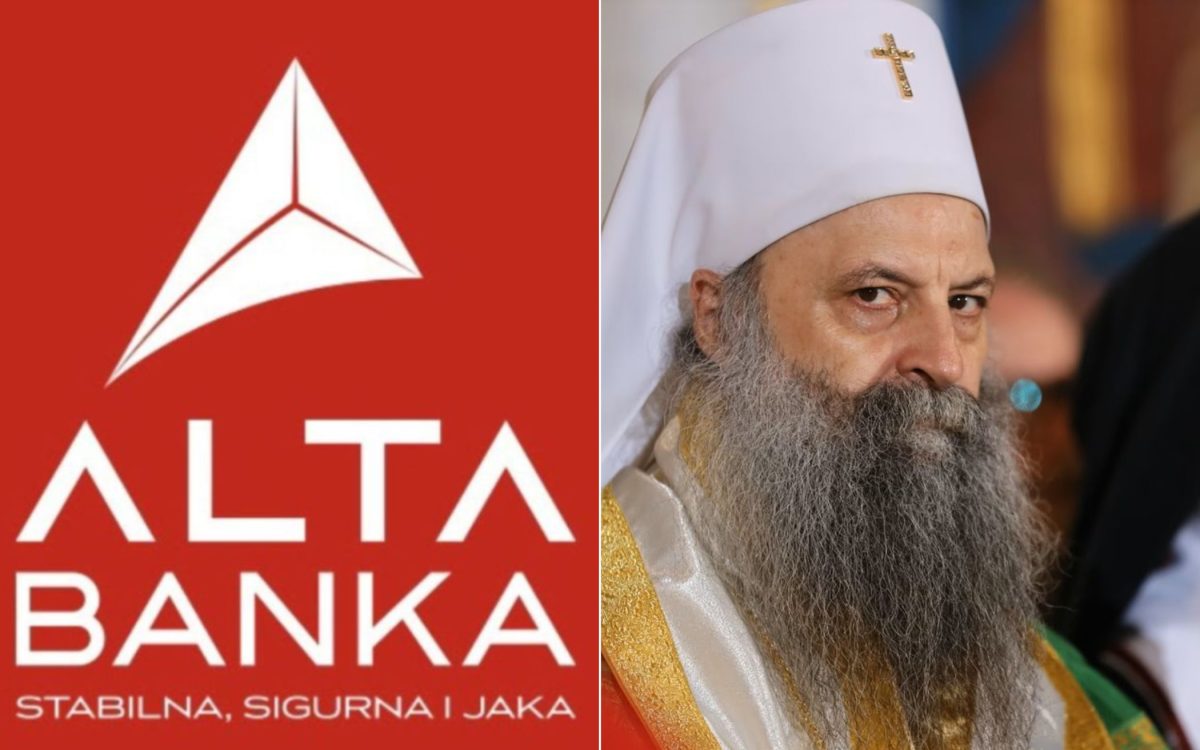
Macura took €383 million from Alta Banka and was then arrested. The most difficult task of untangling Aleksandar Vučić’s financial web has fallen to Serbian prosecutors, but investigators in Montenegro and Bosnia and Herzegovina will face no smaller burden, judging by the extensive political and business connections Macura established across the region in a short period of time. The Serbian Orthodox Church (SPC) had as many as 22 accounts at Alta Banka, four of them opened just a few months before the bank was shut down.
Davor Macura, owner of Alta Banka, was arrested yesterday in Belgrade after it was established that he had removed more than €380 million from the bank’s vault over the course of several days. His arrest was preceded by searches of the bank and his home that lasted almost 40 hours. The collapse of Alta Banka came after the parliamentary elections in Serbia on October 25, in which Aleksandar Vučić, an unchallenged autocrat who had held power for decades, lost control of the government. During Vučić’s rule, Macura went from owning a modest currency exchange office to becoming the owner of a bank, several major companies in Serbia and the region, and real estate properties… Alta Banka received huge state contracts without tenders, such as the exclusive arrangement for paying electricity bills through that bank, as well as contracts with Belgrade’s Parking Servis. Meanwhile, Serbian institutions never responded to numerous pieces of evidence of obvious state and political patronage.
M portal has written on several occasions about Alta Banka and Davor Macura, his ties to regional businessmen, the Montenegrin government and local companies. Credit arrangements that Alta Banka negotiated with Luštica Development under extremely unfavourable terms, with mandatory approval from the Montenegrin government, which owns almost 13 percent of the luxury resort; the licence to provide payment services; plans to take over Addiko Bank branches before officially obtaining a banking licence; and Davor Macura’s personal connections — none of this would have been possible without political patronage from the authorities in Montenegro, which in turn involved Aleksandar Vučić’s political backing of Montenegro’s ruling structures.
Nor would Alta Pay Group have been able to operate in the Bosnia and Herzegovina entity of Republika Srpska without the political patronage of Milorad Dodik. It was Alta Banka that provided a €22 million loan to the Republika Srpska government in February this year to repay a debt to a local private company. Macura also provided financing to the Jahorina Ski Centre while it was headed by Dejan Ljevnaić, a former BIA agent and another figure from Vučić’s circle of influential associates. After Jahorina, which he left burdened with debts of tens of millions of euros, Ljevnaić went on to become one of the directors at the Luštica resort, as M portal also reported in June this year. Ljevnaić was still among Luštica’s management when Milojko Spajić’s government approved Luštica Development’s borrowing from Alta Banka. Only after the government withdrew its approval did news emerge that Ljevnaić had been dismissed from the resort.
The Special State Prosecutor’s Office and the Basic State Prosecutor’s Office in Kotor have had anonymous criminal complaints against responsible persons at Luštica Development before them for months, concerning the company’s credit arrangements with Alta Banka, as we reported yesterday. The complaints were filed long before Prime Minister Milojko Spajić began publicly speaking about hybrid threats, and even before his first approval — followed by the subsequent withdrawal of approval — for Luštica to borrow another €15 million from Alta Banka, secured by a mortgage on the marina and promenade.
On April 17 this year, the NGO MANS asked the Supreme State Prosecutor’s Office for copies of documents and records showing how prosecutors had handled anonymous criminal complaints concerning Luštica Development and employees of the company. MANS also requested information about the actions taken, the status of the complaints and the “persons covered” by the proceedings from state institutions. However, the Supreme State Prosecutor’s Office forwarded the request to the Special State Prosecutor’s Office, which then passed it on to the Basic State Prosecutor’s Office. Both institutions refused to respond to MANS’s request for free access to information.
In its decision rejecting access, the Special State Prosecutor’s Office stated that proceedings in case Ktr-S 577/25 had “not been concluded” and that it had “established that it possesses the requested information”. In its decision rejecting access, the Basic State Prosecutor’s Office in Kotor said that disclosure would reveal “whether a case has been opened against the named person or not”. Unofficially, the criminal complaints concern reasonable suspicion that a series of economic crimes were committed in an organised manner, including document forgery and the presentation of false balance sheets and false business information. They also mention that the interest rate on loans from Davor Macura’s Alta Banka reached an astonishing 11 percent.
The responses from the Special State Prosecutor’s Office and the Basic State Prosecutor’s Office in Kotor could suggest that certain actions have already been taken in connection with the anonymous criminal complaints, but that details cannot be disclosed in the interests of the investigation.
Luštica Development opened two business accounts at Alta Banka — one foreign-currency account and one dinar account — on September 13, 2022, the same day Alta Banka approved its first long-term loan, worth €8.3 million. Luštica received approval for the loan from the Montenegrin government, which was then headed by Dritan Abazović, and a first-ranking mortgage was placed on two buildings at The Chedi Luštica Bay hotel. The cadastral information cited in the government document states that these were Building 1 on cadastral plot 1117/184 (a footprint of 1,405 square metres, three above-ground floors, 48 separate units — 31 parking spaces, eight non-residential units, three technical rooms and six commercial tourism premises, with a total area of 2,959 square metres) and Building 1 on cadastral plot 1117/21 (a footprint of 2,208 square metres, with a basement, ground floor and 15 upper floors, 49 separate units, with a total area of 3,411 square metres). Both are registered in property deed No. 732, cadastral municipality of Radovići, Municipality of Tivat.
At the end of December 2023, Luštica signed a new medium-term agreement with Alta Banka for €3.5 million in permanent working capital for the Luštica Bay project, with a repayment period of 36 months, including a 12-month grace period. Since the same Chedi buildings were already encumbered by a first-ranking mortgage from 2022, a second-ranking mortgage on the same property was requested for this second loan. On February 8, 2024, the Office of the Protector of Property and Legal Interests confirmed that this was not unlawful, while explicitly noting that the property was already encumbered by a first-ranking mortgage in favour of the same lender.
Just one month later, on January 23, 2024, Alta Pay Group, the company that owns Alta Banka, received a decision and licence from the Central Bank of Montenegro to provide payment services in Montenegro.
Another government document, from April 2025, shows that Luštica Bay and the Montenegrin government decided to refinance the loans from Alta Banka — the €8.3 million loan from 2022 and the €3.5 million loan from 2023/24 — together through CKB Bank.
In June 2026, Milojko Spajić’s government, at a telephone session, gave Luštica approval to pledge the marina and promenade (plot 1117/2, Radovići), state-owned land of almost immeasurable value, in favour of Alta Banka as security for a new €15 million loan. Exactly one month later, the government withdrew its approval without providing an explanation.
Alongside the Serbian state-owned Postal Savings Bank, Alta Banka was the only bank operating in Serbia that conducted business with Russia and accepted the Russian rouble as a means of payment. Other banks, whose capital was predominantly foreign, complied with the sanctions imposed on Russia by the EU over its aggression against Ukraine. As a result, Alta Banka was effectively the only banking channel in the region through which sanctions could be circumvented, provided that individuals and companies opened accounts there as non-residents and foreign entities. Russia was excluded from the global SWIFT payment system on February 26, 2022, six months before Luštica Development entered into its first credit arrangement with Alta Banka and opened its accounts there.
The two existing accounts belonging to Luštica Development were active on November 1 in the National Bank of Serbia’s public database, under NBS number 30244740, which had been assigned to the company as a foreign entity, despite the fact that Luštica currently has no active credit arrangements with Alta Banka. However, on November 3, there was not a single account belonging to any client linked to Alta Banka in the same database. Alta Banka was most likely removed from the database following the revocation of its licence, the initiation of bankruptcy proceedings and the looting that led to Macura’s arrest along with two associates.
Research conducted by M portal before Alta Banka was removed from the National Bank of Serbia’s public database revealed that one of the largest clients of the now-closed and looted bank was the Serbian Orthodox Church.


An analysis of the data shows that the Serbian Orthodox Church had 22 accounts at Alta Banka, only two of which had been opened back when the bank was still operating as JUBMES Bank, before Macura bought it and changed its name. Within Serbia’s banking system, the SPC has hundreds of accounts at various banks, held by different account holders. These include all levels of the Church’s structure, from the Holy Synod and dioceses to individual churches and monasteries, centres, endowments and other institutions.
From Montenegro’s perspective, it is interesting that the Diocese of Budimlje and Nikšić, also referred to as the Metropolitanate of Budimlje and Nikšić, headed today by Metropolitan Metodije, also had accounts at the bank. The accounts at Alta Banka and AIK Bank held in the name of the Diocese of Budimlje and Nikšić were opened on March 29, 2025, and Metodije was appointed to head the metropolitanate and given the title of metropolitan just a few months later. The NBS database currently contains records only of the Diocese of Budimlje and Nikšić’s accounts at AIK Bank. There is no record of the Metropolitanate of Montenegro and the Littoral holding accounts at any Serbian bank.
National Bank of Serbia data on the accounts of the Diocese of Budimlje and Nikšić show that it is registered at 5 Kralja Petra Street in Belgrade, the same address as the Serbian Orthodox Church Patriarchate. The Patriarchate itself opened as many as four accounts at the bank just four months before it was shut down.
MORE TOPICS:
Source: Mportal.me, Foto: ATA Images / Milan Maričić; Promo
 Add Serbian Times as your Google source