




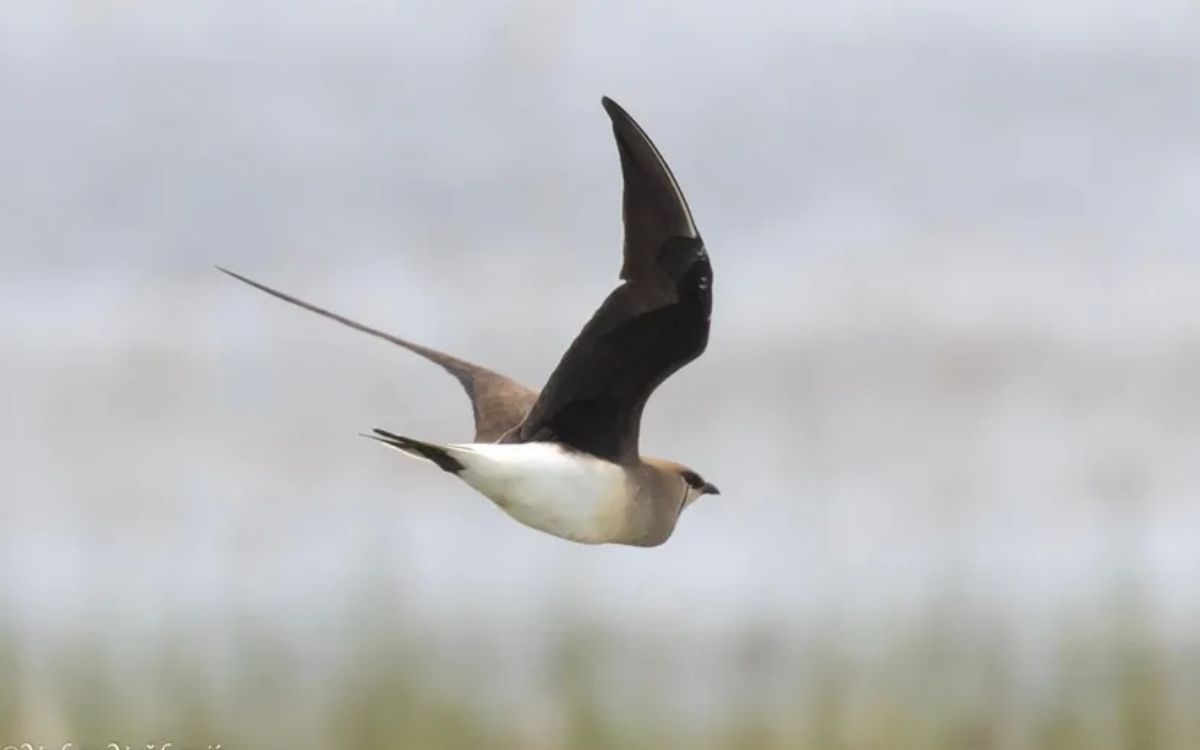
On the Sjenica-Pešter plateau, researchers recorded the black-winged pratincole (Glareola nordmanni), a bird that has been recorded in Serbia only for the third time and after almost 40 years, as announced by the Bird Protection and Study Society of Serbia.
Such an exceptional finding once again confirms the importance of the “Peštersko polje” Special Nature Reserve as a nesting area and resting place for birds, the statement said. It was pointed out that other parts of this plateau are also of exceptional importance for birds. During a tour of the accumulation lake between the villages of Karajukića Bunari and Braćak on May 2, researchers recorded dozens of different types of shorebirds.
Among them, one specimen of the pratincole was spotted, an unusual shorebird that resembles a large swift with a short, small beak and a forked black tail. Since three types of pratincoles appear in Europe, after detailed observation and photography of the bird in flight, it was established that it was the very rare black-winged pratincole. This species is one of the most rarely recorded in Serbia with only two documented findings so far: the previous time it was recorded was in 1989 near Kladovo.
Black-winged pratincoles otherwise inhabit steppes and salt lakes from the north of the Black Sea to Mongolia, and their numbers are in decline across their range. They winter in sub-Saharan Africa, so this bird strayed to Pešter during its return to the nesting grounds. In the distant past, this species was probably more numerous in passage in Serbia as well. In our country, the common pratincole (Glareola pratincola), which nested in our regions until the middle of the last century, is still a regular and very sparse migrant.
This is another in a series of interesting findings that confirm the importance of this large karst field for the migration, rest, and feeding of a large number of species, including some that are rare in our country and globally, such as the Pacific golden plover (the only findings for Serbia), Eurasian dotterel, lesser and red-footed kestrels, cinereous vultures, golden eagle, horned larks, alpine choughs, common rosefinches…
Members and associates of the DZPPS have been conducting research on the birds of the Sjenica-Pešter plateau for almost 20 years, with significant intensification in the last 10, which has led to a series of major discoveries, the statement added. Starting from 2025, the PROZHUM project was launched, which among other things aims to research the groundwater of Peštersko polje and the biodiversity along the watercourses of the Vapa and Jablanica rivers near Sjenica.
MORE TOPICS:
Source: Tanjug; Photo: Tanjug / DZPPS / Vukas Vučković
 Add Serbian Times as your Google source