




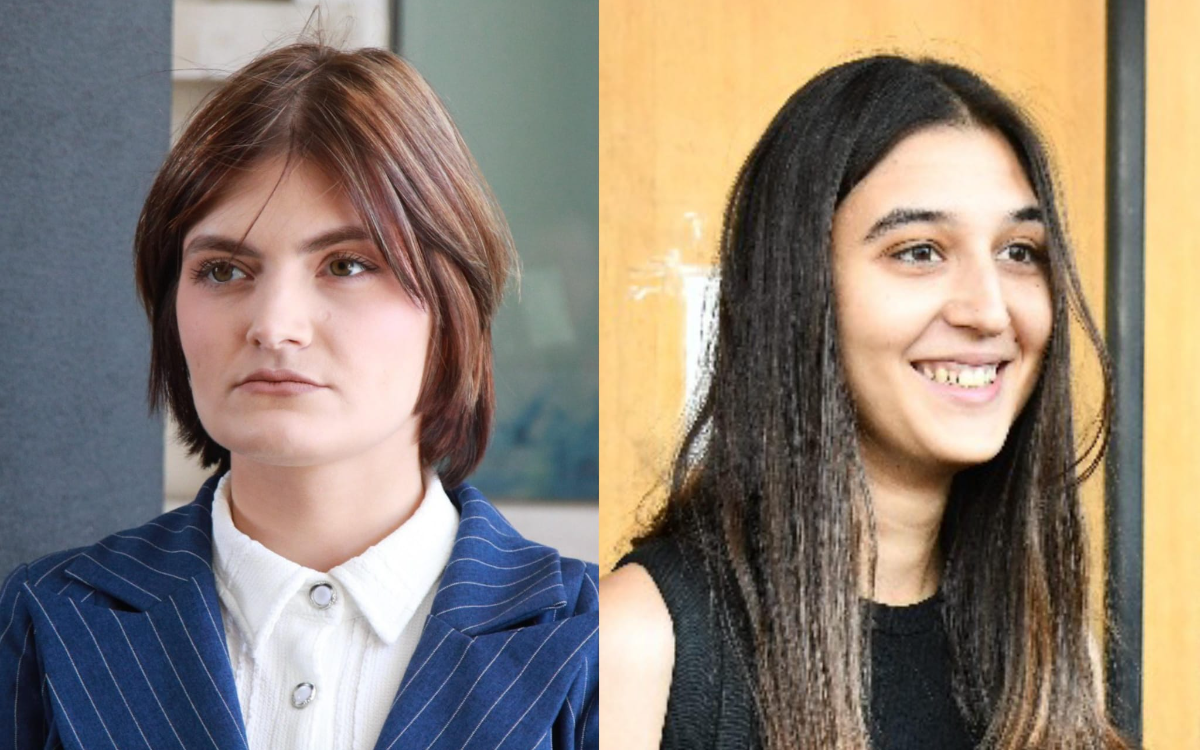
Female students, who have been particularly exposed to police violence, are at the forefront of the protests against the government in Serbia, which have not abated for almost ten months.
French newspaper Le Monde writes about the women who are under attack by the Serbian regime in a text that we are reprinting in full.
After 24 hours in detention, Teodora Gardović, a 23-year-old student, walked free from the Palace of Justice in Belgrade on a Wednesday in late August. “They are trying to intimidate us, but it’s not working,” said the petite girl with long brown hair, before confidently adding that “everyone should spend 24 hours at a police station; it’s very instructive.” After hugging her loved ones, she immediately promised to return to the protests. “Tea, Tea, Tea,” chanted dozens of supporters gathered in front of the large Yugoslav-era building in the center of the Serbian capital.
Arrested a day earlier on a bus by plainclothes police officers for, in her own words, only throwing a “water bottle” at the offices of President Aleksandar Vučić’s Serbian Progressive Party (SNS) during a demonstration, Tea has become one of the prominent figures of the anti-corruption movement that has been shaking this Balkan country for almost ten months.
The rebellion erupted after the deadly collapse of the Novi Sad railway station canopy on November 1, 2024, which had only recently been renovated. The protests soon took on enormous proportions, growing into the largest movement since the fall of former dictator Slobodan Milošević in 2000.
The Young Are Surprising
Tens of thousands of students regularly take to the streets, accusing the state of endemic corruption and holding it responsible for the disaster that killed 16 people. After initially demanding transparency from the authorities and a serious judicial investigation, since May they have been demanding snap parliamentary elections. The students are preparing to present their own list against Vučić, who has won every election since 2014, promising to lead the country toward European Union membership without giving up ties with Russia.
It is particularly noteworthy that female students have taken a prominent place in the youth movement in a country with an aging population and traditional values. They regularly lead student movements and are at the front of the columns, trying to prevent the escalating violence from the police and thugs the authorities send to break up the protests.
As the weekly magazine Vreme noted: “Videos of the protests always show macho-looking guys in black, facing women of all generations standing in the front rows.” The newspaper emphasized that it is precisely these female citizens who are “the key factor for change in our country at this moment.” The female students generally avoid nationalist and homophobic slogans. They also run the most important Instagram accounts, which are the main social media platform used by Serbian students.
“He Called Me a Whore”
Teodora’s friend, Nikolina Sinđelić, has also become one of the female faces of the movement. At 22, she made headlines after being detained on August 14 by an elite unit of the Serbian police during a protest. Nikolina claims that she was beaten and that the commander of that unit threatened to rape her. “He called me a whore and said he would fuck me,” said the short-haired brunette, a journalism and communications student, who filed a criminal complaint against the police on August 26. “Young women are particularly exposed,” she said while drinking a cappuccino in a Belgrade café.
Since she spoke publicly about police violence, the government has fiercely attacked her. The Minister of Internal Affairs did not open any investigation but called her a “liar,” while a television station close to the government tried to discredit her by publishing her nude photos that a former partner had released as “revenge porn.” Such misogynistic attacks have shocked many feminists in Serbia, who organized protests across the country in support. “By attacking Nikolina, you have declared war on all women,” the collective “Ženska solidarnost” (Women’s Solidarity) announced.
Experienced Activists
“They chose a very bad target, given her character,” noted sociologist Jovan (who did not want to reveal his last name), openly expressing admiration for Nikolina. Despite their youth, both Nikolina and Teodora have several years of experience in activism.
They participated in protests against the opening of a lithium mine in 2021 and 2022, as well as in the protests after the school massacre in 2023. In their opinion, the reason women are so strongly present in this movement lies in the fact that the Serbian university environment is highly feminized.
“I am telling you that I am ready to give my life for this country; I am not afraid of your boots,” Nikolina Sinđelić promised on Instagram, a day after her arrest.
Source: Nova.rs, Photo: ATA Images
 Add Serbian Times as your Google source