



More than 500 households in the Belgrade neighborhood of Vinča have received annotations in the cadastre that their land is located in a special purpose area of the archaeological site of Belo Brdo, residents say. The construction of commercial and tourist facilities is planned at that site, which is why the people of Vinča fear that they could be evicted from their homes in one of the oldest villages in Serbia.
The family of Mića Milićević has been distilling rakija in their yard for centuries. When a paper recently arrived from the cadastre informing him that he is now doing so in an archaeological site area, he became scared.
“The house, the plot, it’s no longer mine. I am engaged in agriculture. I automatically can’t… I have two stands in Belgrade where I sell my products – I’m a fruit farmer. I won’t be able to engage in that activity anymore. I have lost the will to work. I go to the field and just think that it will no longer be mine,” says Milorad Milićević, a farmer from Vinča.
The old-timers of Vinča gather at Milićević’s and compare the papers they received. They were always listed as a third zone, designated for housing, and now they have suddenly become part of the site.
It all started in 2017, when this area was defined by a Special Purpose Spatial Plan – the same as, for example, Belgrade Waterfront. In July 2022, the Ministry of Tourism requested and received consent for the site to officially become a tourist area. The following year, the then-prime minister came to Vinča with the American ambassador, who announced the reconstruction of the landslide on Belo Brdo, but spoke about real estate prices.
“When we were coming here, I was thinking that the land, the property in this stretch in Vinča, in the Belgrade municipality of Grocka, that the value of that land and that property, those houses, would increase between 25 and 30 percent, conservatively,” stated Ana Brnabić, the then-Prime Minister of Serbia on October 12, 2023.
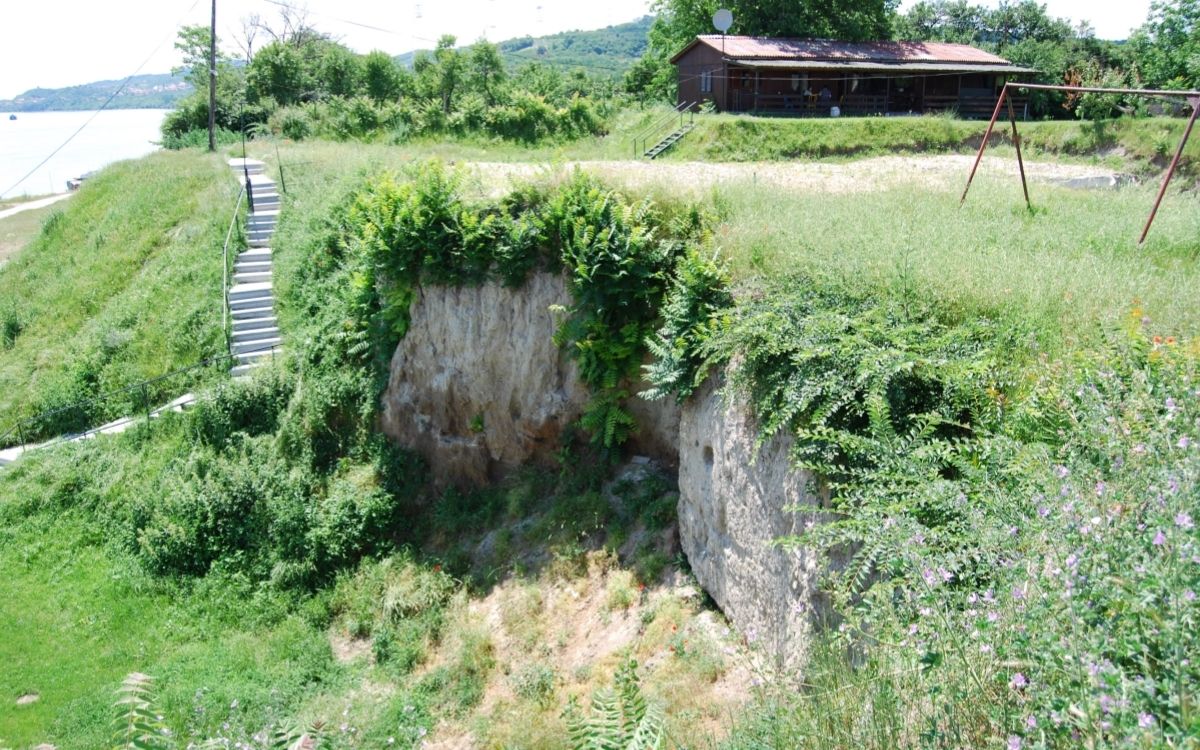
The job of landslide remediation was given to firms close to the authorities – Jadran, Millennium Team, and Novkol, for over 140 million dinars. Earlier, Brnabić announced that the American ambassador’s fund would pay for these works. Today, the Vinča quay looks like this – a concrete fence, a bench or two, and wires for some future lighting.
Tomorrow, it could look completely different, after the Spatial Plan was quietly changed last year, which turns the excavations into a project that generates profit.
“Locations have been defined for a scientific-research center, a visitor center, an archeo park where visitors will be able to actively participate as part of a permanent outdoor exhibition, the development of accompanying tourist infrastructure to support the logistics of the site itself, and the planning of new transport and infrastructure surfaces.”
And what else is planned on the new infrastructure surfaces?
The Strategic Master Plan first foresees land expropriation, and then the construction of 20 “glamping” facilities, worth 1.3 million euros. An adrenaline park will also be built, which the state plans to pay as much as 2.5 million euros for. An international port will also be built on the Vinča quay.
The ministry says that they are not authorized to comment on whether this is related to the annotations on the farmers’ property, but they emphasize – their goal is for the archaeological site to become a well-organized tourist destination.
“By preserving the authentic remains of the archaeological site, their programmatic revival, as well as accompanying tourist facilities and infrastructural equipment, it is necessary to satisfy both the current and future needs of the site for research and attracting visitors, as well as the needs of the local community’s development through the coexistence of tourism and the preservation of cultural values,” the Ministry of Tourism and Youth announced.
In the immediate vicinity of the site itself, no one has been living for a few years now.
The houses are located in the very center of the village, right next to the bank of the Danube. Today they are empty because their owners decided to give up the fight and hand over their land.
No one has officially addressed the people of Vinča. Two years ago, immediately after Ana Brnabić’s visit, more than a hundred of them self-organized and entered the building of the municipality of Grocka when they heard that a more prominent person would be there. They were met by the director of the Belgrade Parking Service and the coordinator of the Serbian Progressive Party for Grocka, Andrija Čupković. They say he calmed them down at the time.
“Primarily, that Čupković held the meeting. Those who were sitting there told them that we would “sing with joy,” almost,” says Milorad Milićević, a farmer from Vinča.
According to the law, the decision on expropriation is made by the Government of Serbia, which has no answer to the question of whether a public interest for taking property has been established in the area of the site.
The Ministry of Construction also did not provide answers to clarify its intentions regarding the property of the farmers who received the annotations.
MORE TOPICS:
DRAMATIC CHASE IN AUSTRIA: Teenagers drove wild on the highway, among them 17-year-olds from Serbia!
Source: N1; Foto: Wikimedia Creative Commons
 Add Serbian Times as your Google source