




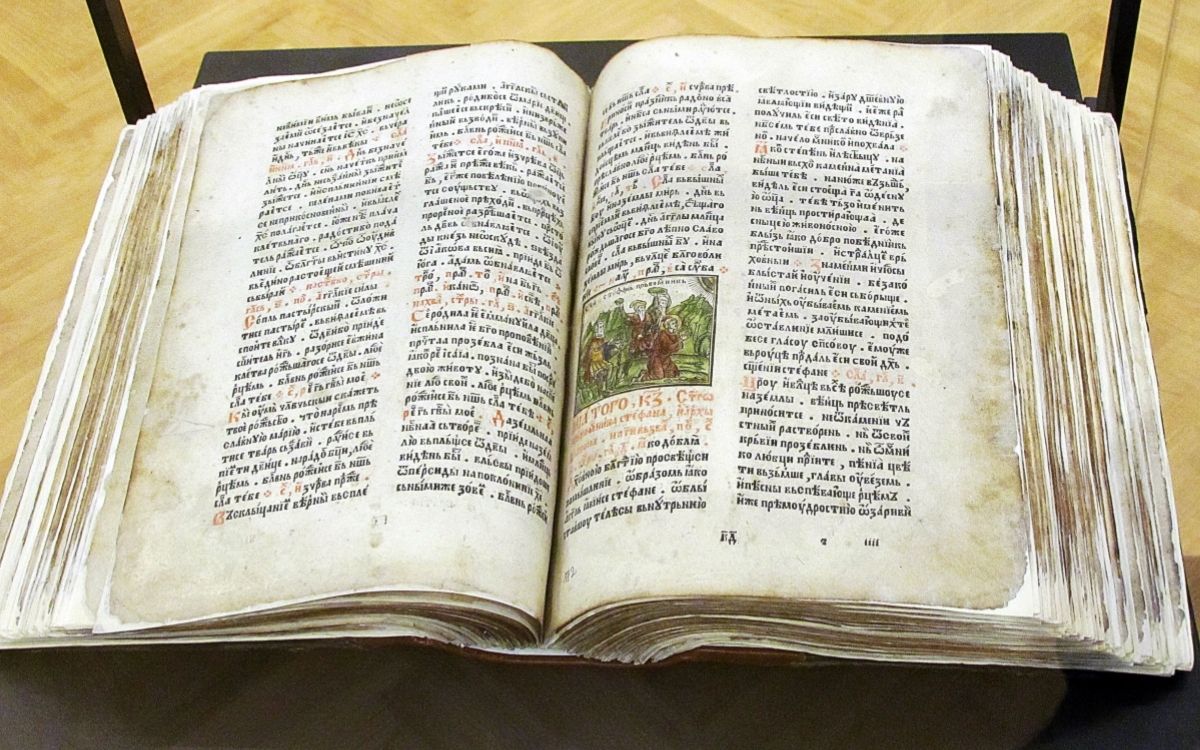
The term “srbulje,” promoted by Vuk Karadžić, refers to all our manuscript and printed books in the Serbian Church Slavonic language and Cyrillic script, from the beginning of literacy until the first half of the 18th century, when Serbian Church Slavonic was replaced by Russian Church Slavonic.
By content, they are most often ecclesiastical or theological, hagiographic, and legal; the majority of srbulje are manuscripts, reaching back to the Miroslavljevo jevanđelje and written on parchment until the end of the 14th century, although paper had already become dominant by the middle of that century.

In this text, however, we will focus on printed srbulje, which were produced from 1494 (when Đurađ Crnojević founded a printing house in Cetinje and published the “Oktoih osmoglasnik,” of which 105 copies have survived to this day, and then three more books over the next two years) until the end of the 17th century, and mostly during the 16th.
Printed Cyrillic was shaped according to the model of manuscript uncial script, and artistically designed within the Orthodox tradition but under strong influence of Venetian graphics, since most were printed precisely in Venice, and even when that was not the case, the printing craft was learned there and presses were acquired there.
The most significant in Venice was the printing house of Božidar Vuković, and his son and successor Vićenco Vuković, which “sealed” Serbian Church Slavonic Cyrillic books from 1519 to 1638, changing owners but not its mission. Their first in 1519/1520 was the “Liturgijar” (Russian Church Slavonic imposed the form “Služabnik”); the printer was hieromonk Pahomije. The seventh in order and Božidar’s last was the “Molitvenik” in 1539.
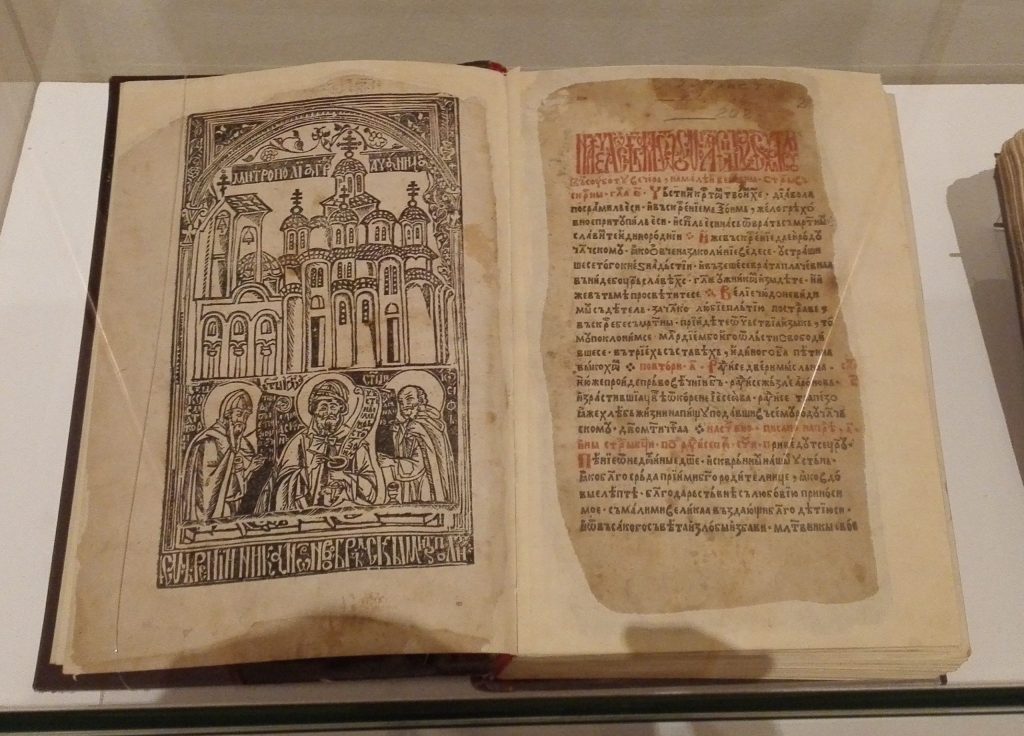
In Venice there also operated the printing house of the Kotor native Jerolim Zagurović, who, although Catholic, printed Cyrillic books in Serbian Church Slavonic. He began with the “Psalter” in 1569 and printed until his death in 1580; the printing house was then taken over by his printer Jakov from Kamena Reka, and then in 1597 by Bartolomeo Ginami. The last srbulja of this printing house was a reprint of the “Psalter” in 1638.
A series of our printing houses emerged very early within the Ottoman territorial milieu. The first was the Goražde Printing House, which Božidar Goraždanin founded in Venice in 1519 and then moved to the village of Sopotnica near Goražde, around the Church of St. George; his printers were his sons Đurađ and Teodor. Its first in 1519 was also the “Služabnik” (they call it “Liturgija”), followed by the “Psalter with follow-up” (1521) and the “Molitvenik” (1523).
The Rujan Printing House, the first in present-day Serbia, produced the “Rujan Four Gospels,” printed by monk Teodosije (whose monument can be seen in the Rujan Monastery). The only completely preserved copy is located in the National Library in Prague, and another, partially damaged, in Saint Petersburg. The copy once held by our National Library was destroyed in 1941 in a fire caused by bombing; Serbian Academy of Sciences and Arts possesses a fragment of 92 leaves.
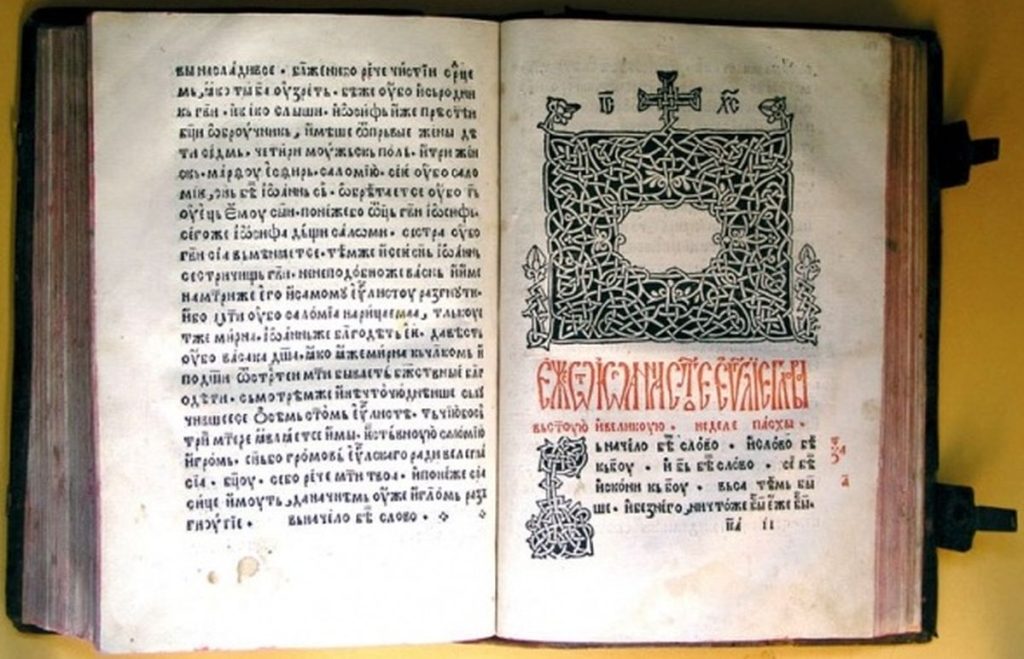
In the Gračanica Printing House, monk Dimitrije in 1539 printed the “Oktoih petoglasnik,” by order of Metropolitan Nikanor of Novo Brdo (today in the Museum of the Serbian Orthodox Church), while the Mileševa Printing House published the “Psalter” in 1544, the “Trebnik” in 1545, and again the “Psalter” in 1557, thanks to Božidar Vuković, who visited Mileševa and reached an agreement with the monastery, after which his son Vićenco and Teodor Ljubavić (who had previously worked in the Goražde Printing House) brought the press in 1543.
The Belgrade Printing House of Prince Radiša Dmitrović and later the Dubrovnik native Trojan Gundulić produced only the “Belgrade Four Gospels,” on August 4, 1552 (around 40 copies survive, 14 of which are in Belgrade, and the best preserved in the Museum of the City of Belgrade).
After the closure of that printing house, the presses were taken over by hieromonk Mardarije, illustrator of that srbulja, who transported them to an unnamed village near Mrkšina crkva, whose location is a matter of debate, where in 1562 he published the “Four Gospels” (five surviving copies are kept in monasteries in Montenegro, two of which in the Cetinje Monastery), and then the “Triod cvetni” in 1566. The Turks already in 1567 burned the church, burned the village, and burned the house with the printing house.
As for srbulje that came out of Romanian printing houses, mention should be made of the “Triod cvetni” from 1649, printed in Târgoviște by hieromonk Jovan Svetogorac, by order of Princess Jelena, wife of Wallachian voivode Matei Basarab.
Today the largest collection of srbulje is held by the Matica srpska Library, which possesses 30 editions of Serbian printing houses in 143 copies and one bound volume, as well as two Romanian editions in three copies. Numerous srbulje, however, are scattered far and wide, often outside the borders of Serbia and Montenegro; who knows how many are in private collections, often obtained through illegal channels.
When one considers the high artistic value of printed srbulje created at the end of the 15th and during the 16th century, and when one takes into account that our lands were under the Turks and culture almost deprived of noble patronage, so crucial for cultural development, it is no exaggeration to say that our cultural production at the time still managed to be at the very top of European culture.
MORE TOPICS:
Source: kcns.org.rs; Naslovna fotografija: Praznični minej iz štamparije Božidara Vukovića iz 1538. (Venecija); Foto: Wikimedia Creative Commons
 Add Serbian Times as your Google source