



A mysterious rock with words carved in an as-yet unknown language was accidentally found on Gradište hill near Kruševac and has been a mystery for almost half a century. What is written on the rock has never been deciphered.
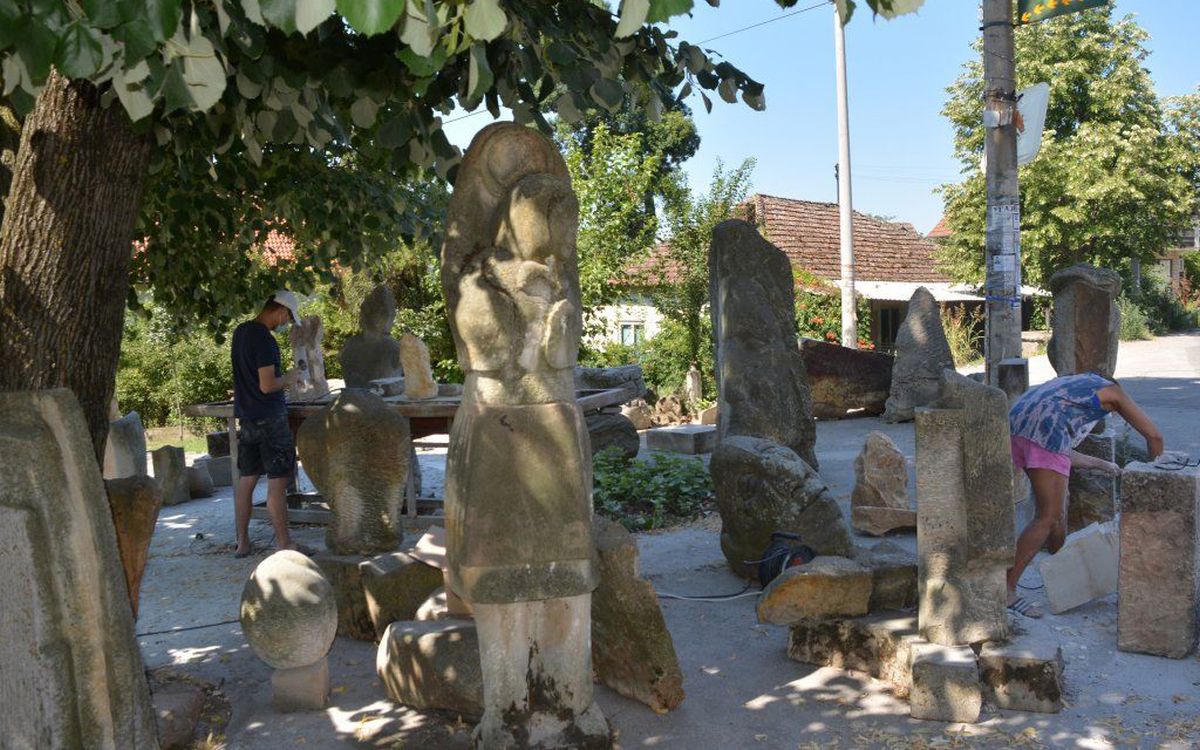
This stone was at the foot of Gradište from 1978 to 1988, after which it was moved to a special place where it is kept today, in the Museum of Stonecutting and Sculpture in Bela Voda. It weighs about 300 kilograms. Interviewees from this place, famous for its sandstone, state that the prominent scientist Prof. Dr. Radivoje Pešić once estimated the age of this unique artifact to be about 30,000 BCE, and that after several years of research, it is likely that the sculpture is 15,000 years younger.
One part of the stone resembles an animal’s head, mostly an ox, so it is assumed that the stone had a cult function. It is interesting that the somewhat pagan character of the stone sculpture is “carved” into the gift of subsequent masters in the previous two centuries in Bela Voda.
Specific decorations in the creation of various objects are known: carved and sculpted fairies, beasts, birds, depictions from life, plants, fruits. Only with more recent dates was carving done with reliance on Christian tradition, with angels and crosses.
“We were never in favor of the idea of moving the sculpture out of the village, because it should represent the historical legitimacy of the soil itself,” said Prof. Dr. Veroljub Lazarević, writer and tireless history researcher. “On several occasions, I encountered accidental finds. There were traces that there were landmarks with similar carvings in that area, but they were destroyed over time. I also found a tile measuring 30 by 30 centimeters with an engraved sign similar to those on the sculpture, but later I no longer saw it.”
The sculpture, or perhaps a part of it, was named “Belovodska Pismenica” (Bela Voda Literacy). Much more famous than the mysterious rock with the undeciphered language is the village itself – Bela Voda. Its fame is owed to the stone, the so-called sandstone, which has been exploited for more than 600 years. Bela Voda stone has been incorporated into numerous famous churches (Drenča, Kalenić, Veluće, Lazarica, Ljubostinja, Rudenica, Naupare). Significant buildings in the capital were also built from sandstone, such as Branko’s Bridge, the French Cultural Center building, Mortgage Bank, Beograd Palace, and St. Mark’s Church.
Every July, a unique event, the Bela Voda Rosette, is held in the village, featuring a mosaic and sculpture colony.
“Stonecutting skills were taught in a special school in Bela Voda from 1910 to 1923,” explains Dr. Veroljub Lazarević. “By 1997, on the territory of the village, about 400 old and new quarries were counted, from which white sandstone was taken.”
MORE TOPICS:
“ORTHODOXY CHANGED MY LIFE”: Dutchman found salvation in the Serbian Orthodox Church, in Spain!
“ULTIMATUM LEADS TO WAR”: Medvedev warned Donald Trump not to “go the way of Sleepy Joe”!
Source: Novosti; Photo: Novosti, S. Babović
 Add Serbian Times as your Google source