




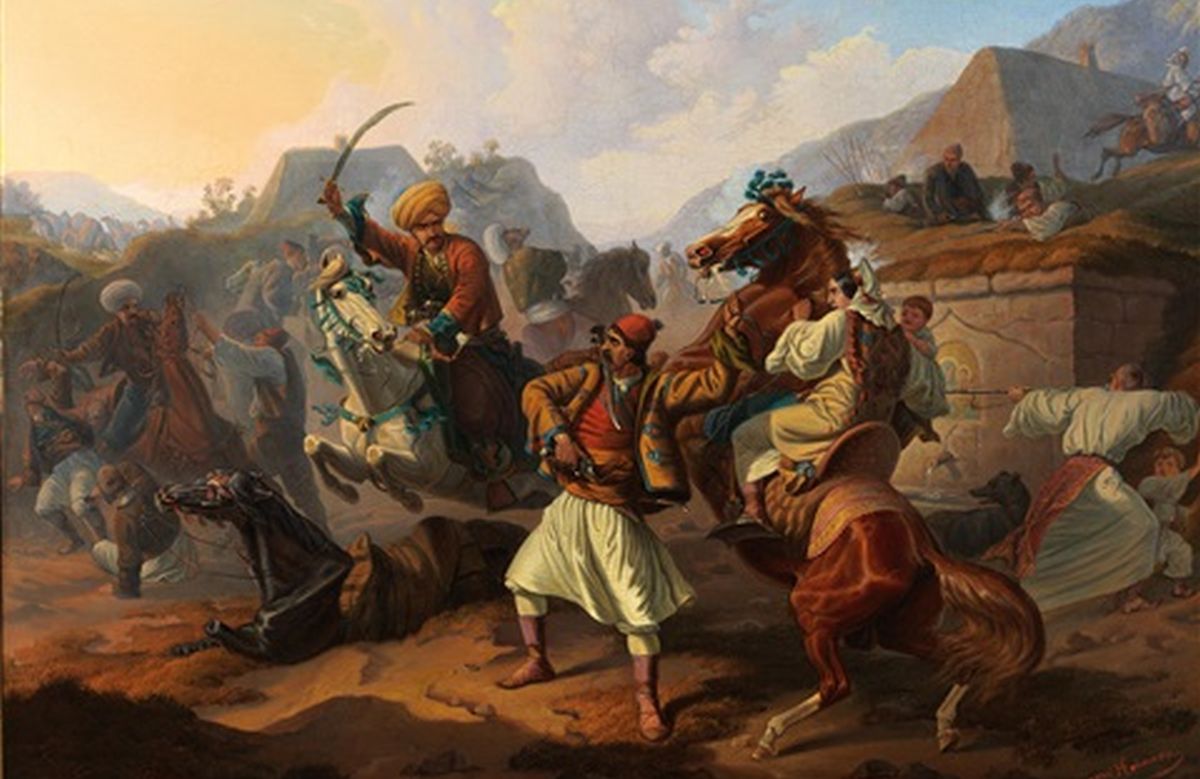
From a wound sustained in an ambush attack on June 26, 1527, near Senta, the last Serbian emperor died. His name was neither Dušan nor Uroš, but Jovan Nenad, and he ruled a small, self-proclaimed state that stretched across the territory of today’s Vojvodina with its center in Subotica.
Historians today do not agree on who he was or where he came from, and his name today is more a part of legend than official Serbian history. They say that he was born in the “year of the beast” and that he had a huge black mark that stretched across his entire right side of his body.
And yet, maybe he was just dark-skinned, which is why he got his nickname. Still, as strange as it sounds, his empire was real – it stretched across the territory of today’s Bačka, parts of Srem and Banat or the area we know today as – Vojvodina.
But this is just the end of the story…

Mysterious “Black Man”
The army of Suleiman the Magnificent defeated the Hungarian army in the famous Battle of Mohács in 1526. After that, the territory was divided between the Turkish Empire and the Habsburg Monarchy, and the surviving nobles sided with two leaders – King Ivan Zapolja and King Ferdinand.
It was at this time that Jovan Nenad, the mysterious and today almost fairy-tale leader of the Serbs, took the stage.
Historians today do not agree on who Jovan Nenad was or where he came from. He claimed to be a descendant of Serbian rulers, even Byzantine emperors, but there were also those who considered him to be of low birth.
Be that as it may, Jovan Nenad proved to be a very good commander, who with a detachment of Serbs, immediately after the Battle of Mohács, expelled the Turks from Bačka and took control of this area as well as parts of Banat and Srem.
FIND OUT MORE IN ENGLISH:
Small between the great powers, it seems that he did not lack megalomaniacal dreams – he declared his independent state a Serbian empire, and himself an emperor. He chose Subotica as the seat of his “empire”.
“Even for that time, the new ruler was a mysterious man. His subjects called him Emperor Jovan Nenad, and outside the Serbian communities he was most often referred to as the ‘Black Man’ because of the black stripe one finger wide that stretched from his right temple all the way to his feet,” historian Dobrica Jovičić points out and adds that the only document that has remained to us from this unusual man is signed as “Jovan, emperor sent by God”.
This was not the only peculiarity of the new ruler. Jovan Nenad lived ascetically – the story says that he slept only two hours, and spent an hour in prayer. He preached and prophesied and many came to him as a holy man. According to the testimony of one of his contemporaries, “Serbs flocked to him as a new saint and a prophet himself”.
“Few of his prophecies have survived to this day, but the most famous is certainly the one about the Turks perishing. Jovan Nenad wanted to present himself as God’s weapon and, in an atmosphere of collapse and despair, impose the fight against the Turks as the only option,” explains Jovičić.
Folk legends and belief in the new magnate were fueled by the tradition that he was born in the “year of the beast” – 1492, since when the end of the world could happen at any moment.

The people loved him, but not the other warlords
With Jovan Nenad, the other Serbian nobles and despots mostly did not want to have anything to do with him, and it is interesting that there is no mention of this man in the chronicles of that time.
“It was a time when a large number of despots fought for supremacy. Most of them were completely unimportant. The Hungarians used them for their personal gain, and they in turn cared only about their personal gain. The appearance of Jovan Nenad therefore bothered some of them more than the enemies because in a situation where everyone cared only about themselves, suddenly a man appeared who spoke of common resistance and unification,” says Jovičić and adds that there are indications that Jovan Nenad took the title of emperor precisely to distinguish himself from these other, greedy despots.
Jovan Nenad proved to be a good military leader. He oscillated between Zapolja and Ferdinand and used them at least as much as they used him – in the fight against the stronger Turks whose “empire” was the first to be attacked.
From the moment Jovan Nenad sided with Ferdinand, Zapolja sent one army after another against him, but the “emperor” defeated them all, albeit with heavy losses.
On the way to Ferdinand, with whose army he was supposed to unite, Jovan Nenad was mortally wounded by a Zapolja supporter. This was the end of his small state, and for many years the dream of liberating the Serbs from Turkish rule.

The beginning of Serbian Vojvodina
Today, Emperor Jovan Nenad is more a part of legend than history. Still, there are those who consider his “Serbian empire” the beginning of what we know today as Vojvodina.
“Calling Jovan Nenad the “father of Vojvodina” is certainly a bit of an exaggeration, but it is true that his state stretched precisely across the territory of this Serbian province. He was the first to come up with the idea of creating a separate Slavic state in the territories of southern Hungary. This idea will later be taken over by all Serbian Vojvodina leaders, although none of them will mention Jovan Nenad as a predecessor,” concludes the historian.
To testify and remind of this unusual historical figure, a monument was erected to Jovan Nenad in Subotica on two occasions – the first was demolished by the Hungarian occupiers in 1941, and the second, erected in 1991, still stands on the city square. It reads: “Your thought has won”.
MORE TOPICS:
TRANSFERRED BY THE SERBIAN ARMY: Twelve injured in the Kočani fire arrive in Belgrade for treatment!
LEST WE FORGET: The March pogrom in Kosovo was deadly for many Serbs, while thousands got expelled!
DUE TO THE UNPRECEDENTED TRAGEDY IN KOČANI: North Macedonia declares seven days of mourning!
Source: Opanak.rs, Foto: Wikimedia Creative Commons
 Add Serbian Times as your Google source