




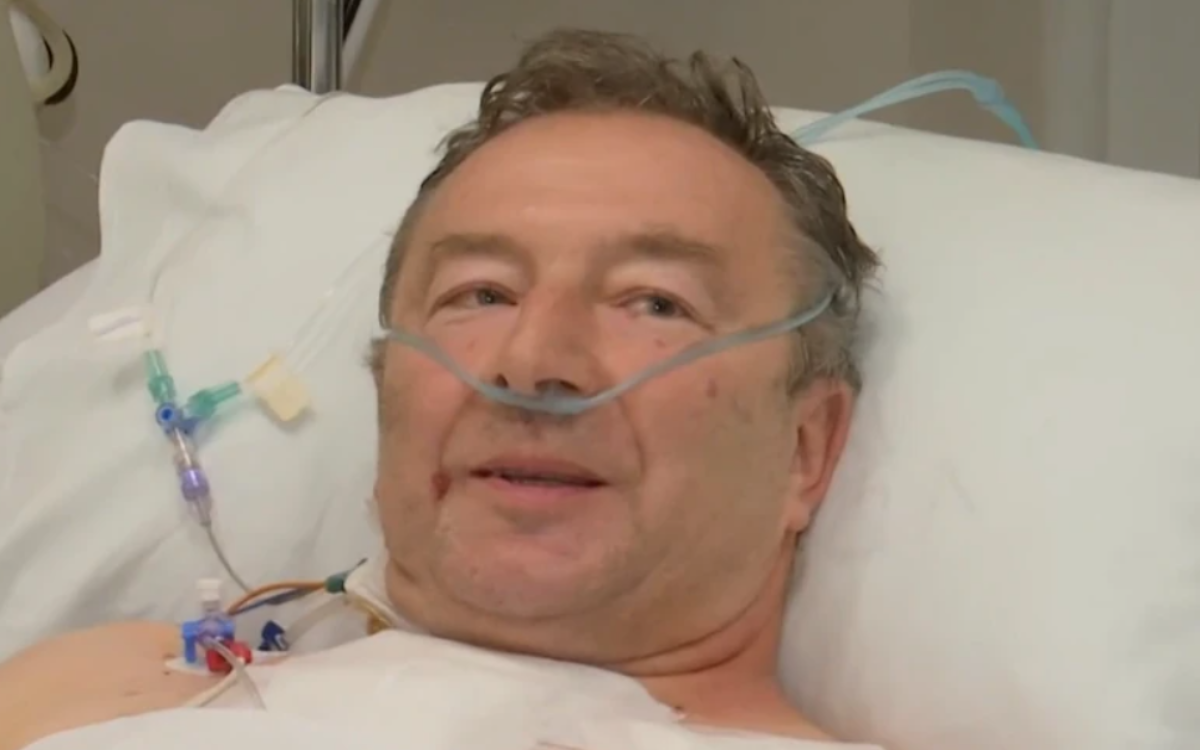
In the Clinical Center of Serbia, four transplants were performed in the previous days – a heart, liver, and two kidneys were transplanted, and all patients are doing well and the postoperative course is satisfactory.
Goran Đorđević is 56 years old and received a new heart on the night between January 8th and 9th. He was lucky not to wait long for the organ, he was on the list for about half a year.
“I had a severe heart function disorder. Now I’m fine. I would like to thank the donor’s family, thank them immensely, without them nothing would be possible. And of course, thank you to the medical team at the Clinical Center of Serbia,” Đorđević told RTS.
He received the life-changing call while celebrating the happiest holiday – Christmas – with his family at home.
“My wife and sons are waiting for me at home. Thank you to them for their support. When the call came, you couldn’t tell who was happier. We were all overjoyed and excited, truly indescribable. Now it’s easier to plan for the future, a second life, a different direction,” Goran said with a bright face.
The surgical team was led by Prof. Dr. Svetozar Putnik, director of the Clinic for Cardiovascular Surgery at KCS.
“A whole team of experts participated in Goran’s treatment. Each member of that team participates equally. And that’s the case from the moment when he was diagnosed with heart failure, to the moment when he repeatedly comes here to us, because he has these episodes of worsening heart failure, where you first try to help him with medication, and then finally this moment that both he and all of us together have reached, and that is to perform a heart transplant for him,” Prof. Dr. Putnik told RTS.
Recovery is going according to plan
The first heart transplant this year was performed on the night between January 8th and 9th. The intervention itself went without any problems. Early postoperative recovery is going as planned.
“Of course, with the great care of the nurses in the ward and the entire team of cardiologists, anesthesiologists. Everything is going as it should. He gets up, eats well. So, early rehabilitation has started. In the later recovery, that is, in the next few days, we expect rehabilitation to intensify. Then comes a biopsy. Repeated ultrasound of the heart. If that’s all right, within the next month he should be discharged. That’s the real joy. Only then do people really understand what happened here. Because this is still, for patients who have a heart transplant, their families and their closest environment, actually a shock. Only when they go home, and when they start with normal daily activities, recover from that initial procedure, only then do they see what the result is,” explained Prof. Dr. Svetozar Putnik.
A well-coordinated team has been working for 11 years
The heart transplant team at the Clinical Center of Serbia is a well-coordinated team.
“You know, we’ve been here for over 11 years. It’s one team, a small group of people who are constant, we get some new members, but most of us have been here from the very beginning of the transplant program at the University Clinical Center and 365 days a year, so, you know, calculate how long that is for 10-11 years. We are on standby, i.e., we wait to be called when we receive a call, the entire team is called, the entire team is alerted, and then we gather at the hospital, countless times, unfortunately, it is not realized, and then we go home so dissatisfied and sad. We have to be ready, regardless of whether consent exists or not. And then, unfortunately, you go home with an unrealized, unfulfilled business result, but when you do something like this, then it’s clear,” Prof. Dr. Putnik is sincere.
Last year, four heart transplants were performed here in the clinic for cardiovascular surgery, while in these 11 years, since the transplant team has existed, 60 hearts have been transplanted.
“The number of procedures is absolutely insufficient and that is something we are constantly trying to work on in various ways, including you, the media, and society as a whole. Essentially, only an increase in the number of procedures, an increase in experience will bring us better results,” says Prof. Dr. Svetozar Putnik.
MORE TOPICS:
INTERVIEW, HUSA: How Džej (Jay) prevented bloodshed on Belgrade’s streets in the 1990s (VIDEO)
Source: Blic, Photo: Printscreen RTS
 Add Serbian Times as your Google source