




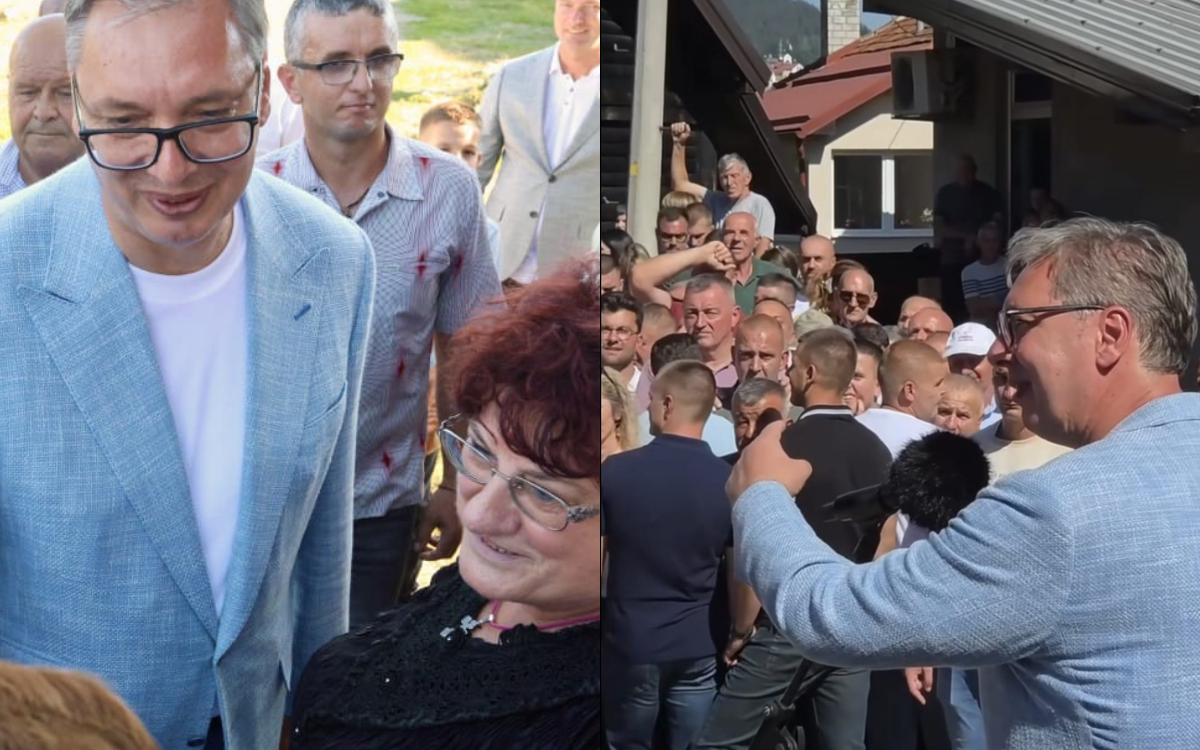
The British “Times” published an extensive article about Serbian President Aleksandar Vučić, his balancing act between Moscow and Brussels, as well as the increasingly powerful student protest movement, which according to opinion polls has greater support than the government.
“Like a medieval king receiving petitions, Aleksandar Vučić, president of Serbia, stood in the main square of a small town in the southwest of the country as local residents loudly voiced their problems,” the Times begins its article, referring to Vučić’s visit to Nova Varoš in the first half of August this year.
The newspaper writes that citizens were asking for jobs for their relatives, while one elderly man complained that his son could not find employment despite attending “all the rallies” of the ruling Serbian Progressive Party.
“I am not a jukebox that fulfills everyone’s personal requests. I am not going to haggle with you over a kilometer of road to your house or 80 meters to your gate. That makes no sense,” Vučić snapped at the citizens.
Discontent in Nova Varoš is far from an isolated case, and Vučić knows it – the newspaper points out.
The Times writes that public dissatisfaction over corruption and rising living costs has developed into a protest movement that now, according to polls, has greater support than the president.
Commenting on Vučić’s announcements that he would resign and his speculation about the dates of elections, the British newspaper writes that this resembles moves made by Russian President Vladimir Putin.
About Expo
Times journalist Jack Adamović Davies also writes about Expo, which he describes as “Vučić’s grandiose project.”
“About 160 kilometers farther north, construction workers are busy working on what could easily be his £1.1 billion swan song: a vast exhibition hall on the outskirts of Belgrade, due to host next year’s Specialised Expo,” the newspaper writes.
It also writes about how subcontractors have made “huge profits.”
“The identities of those receiving the money are a state secret, since a new law exempts Expo from public procurement regulations. Under the cloak of confidentiality, subcontractors linked to the ruling elite – including at least one company charged with allegedly bribing a deputy minister – have made huge profits,” the Times writes.
“The EU is afraid of pushing Vučić toward Russia”
It states that skepticism toward the Serbian president is growing within the EU, mentions a European Parliament resolution, but also notes that “the Western diplomatic corps in Belgrade is reluctant to take a tougher stance toward Vučić for fear of pushing him further into Russia’s arms.”
“The nature of this dictatorship is directly connected to what the EU expects from Serbia. It is an autocracy that is perfectly adapted to remain on the EU’s good side,” political scientist Nikola Burazer said.
As voters’ appetite for Vučić’s brand of demagoguery weakens, the Times writes, so too is Moscow and Brussels running out of patience with his attempts to turn them against each other.
Chameleon routine
Long before he began associating with Putin and the EU elite, the Times writes, Vučić was perfecting his “chameleon routine” behind the front lines in war-torn Bosnia.
The Times spoke to journalist Predrag Popović, who interviewed Vučić in 1993 and now describes him as a rising star of the neo-fascist Serbian Radical Party. He recalled a master manipulator who, as Popović told the Times, was “servile” toward his superiors and sadistically “aggressive” toward his subordinates.
“He hasn’t changed at all,” Popović said, “but now everyone can see who he is.”
Several days after the massacre of 8,000 Bosnian Muslims in Srebrenica in 1995, the Times recalls the words Vučić uttered in the Serbian Parliament.
“You kill one Serb,” Vučić said, “and we will kill 100 Muslims.”
This was a direct echo of the Nazi occupation of Serbia, the Times writes, during which the Wehrmacht had a standing order to execute 100 Serbs for every German soldier killed by the resistance.
During the war in Kosovo, the article continues, Vučić was information minister and persecuted journalists while implementing some of Europe’s most restrictive laws on freedom of speech. Vučić’s campaign against independent media has barely lost momentum during his presidency. A report by the Committee to Protect Journalists published last month cited “record levels of physical violence against journalists, death threats and online smear campaigns,” along with “alarming levels of impunity” and “tight political control over the media environment.”
Less than a decade later, Vučić changed course, according to the British newspaper.
“The irredentist who wanted to build a ‘Greater Serbia’ from parts of neighboring countries disappeared. Purportedly reformed, Vučić left the Radical Party for the new Serbian Progressive Party, whose stated goal was EU membership,” the newspaper writes.
Western diplomats, it notes, accepted him as their “stabilocrat.” They believed he was pragmatic enough to prevent the pot of domestic and regional tensions from boiling over.
Instead, the Times writes, Serbia represents an increasing threat to Europe’s stability. Since 2022, the Serbian government has issued passports to more than 200 Russians linked to the Kremlin, giving them visa-free access to the EU.
The newspaper writes about the collapse of the canopy that sparked student protests, noting that students are the most popular political force in the country.
About Rector Đokić
The Times describes Rector Đokić as a composed man who is the opposite of Vučić in almost every respect and who is “one of the most vocal supporters of the student demonstrators.”
“Đokić has been the target of a government-sponsored smear campaign for almost two years. Vučić called him a parasite and a terrorist. Police summoned Đokić in April 2025 to give a statement as part of an investigation into alleged abuse of office,” it states.
“Three criminal complaints have been filed against me. They have not been dismissed, but nothing is being done about them. They are simply keeping all these things on the table,” he said.
At the end of March, one female student, the newspaper writes, fell from the fifth floor through a window of a university building. Graffiti began appearing around the city labeling the rector a murderer, it says. Five days later, police raided university premises, accompanied by pro-government news crews. When the raid ended, Đokić stepped onto a balcony and discovered a crowd gathered below. He delivered a speech that cemented his status as the student movement’s most likely candidate for president.
“This government is not attacking the university because we have done something wrong, but because we have done something right,” Đokić told those gathered. “We stood with the students. We stood with the truth.”
Publicly speaking out carries real danger, the British newspaper points out. Just 36 hours before Đokić spoke with the Times, his colleague, professor Stevan Filipović, was brutally beaten in the street by people he called “criminals in the service of the regime,” after he filmed them writing pro-government graffiti.
“This is a sign that this can happen to anyone who raises their voice against the regime. They cannot focus on every student, so they focus on me… I am in the position I am in and I cannot run away from here,” said Đokić, who hopes to protect his students from the worst.
The Times writes that students have achieved in recent months what no political party has managed to do during the 12 years since Vučić came to power: they have overtaken him in the polls. In a June survey by the Center for Research, Transparency and Accountability, 59 percent of respondents supported the student protests, while only 36 percent said they trusted Vučić.
In the same poll, 45 percent of decided voters said they intended to vote for the Student List, while only 36 percent said they would vote for Vučić’s Serbian Progressive Party.
The possibility of becoming a presidential candidate is “something I never dreamed of,” Đokić said.
MORE TOPICS:
Source: N1 Foto: Društvene mreže printscreen
 Add Serbian Times as your Google source