




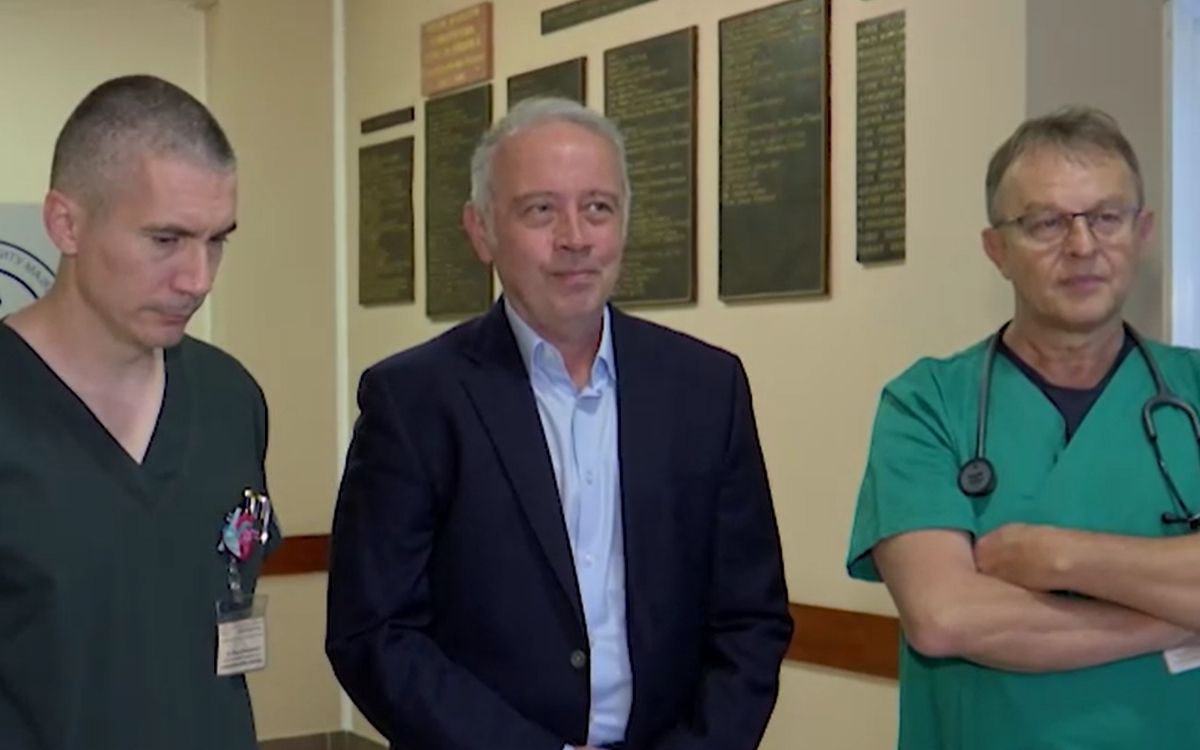
A joint team from the Dedinje Institute for Cardiovascular Diseases and the Dr Vukan Čupić Institute for Mother and Child Health Care successfully implanted a mechanical circulatory support device in a thirteen-year-old patient from Sarajevo. Doctors emphasize that this is an exceptionally complex procedure that serves as a bridge to heart transplantation and represents a new step forward in domestic pediatric cardiac surgery.
The thirteen-year-old boy, who received an artificial heart due to severe heart disease, is recovering well, and doctors say that this intervention has prolonged his life and given him the opportunity to await a heart transplant, which he urgently needs.
The procedure was jointly performed by specialists from the Dedinje Institute for Cardiovascular Diseases and the Dr Vukan Čupić Institute for Mother and Child Health Care, and according to cardiac surgeon Dr. Saša Borović, such procedures are carried out only at a small number of centers worldwide.
“We successfully implanted an artificial heart in a 13-year-old child. There are very few centers in the world that do this. We dared to push the boundaries of medicine at this institution, and thanks to teamwork and experience, we managed to achieve it,” said Borović.
He pointed out that, considering the patient’s age, this is one of the rarest procedures of its kind.
“In terms of the child’s size, this is the third such case in the world. Two smaller patients were operated on in the United States, at top medical centers, and the third has now been performed in Serbia,” Borović stated.
An achievement accomplished by only a handful of centers worldwide
Although the team from the Dedinje Institute has extensive experience in implanting mechanical circulatory support devices in adult patients, performing the operation on a child presented numerous unique challenges.
“Technically, this was a major surgical challenge because we had to fit a device that is not particularly small into the chest cavity of a thirteen-year-old child. It was necessary to find the optimal surgical approach and then adapt the anesthesia and intensive care treatment,” Borović explained.
Cardiac surgeon Dr. Ivan Dizdarević from the Institute for Mother and Child Health Care said that the size of the device was the greatest unknown factor.
“There was no fear. Dr. Borović is one of the most experienced experts in this field, and we trusted his assessment. What concerned us most was whether the device would even fit into such a small chest cavity,” said Dizdarević.
As he explained, the doctors spent days searching for the best solution.
“For three days we fought together to make everything fit technically. In the end, everything fell perfectly into place. The boy is recovering, and we are all satisfied with how the postoperative course is progressing so far. When you work with a good team, there is not much room for fear,” Dizdarević said.
He recalled that shortly before the operation, the patient experienced a sudden deterioration of his condition and went into cardiogenic shock, which made emergency connection to an ECMO system necessary, further complicating the entire procedure.
Teamwork the key to success – mechanical support as a bridge to transplantation
The director of the Dr Vukan Čupić Institute for Mother and Child Health Care, Professor Dr. Vladislav Vukomanović, emphasized that the institution has for decades been a regional center for the treatment of congenital heart defects and heart failure in children, and that cooperation with the Dedinje Institute opens a new chapter in pediatric cardiac surgery.
“Thanks to our colleagues from Dedinje, primarily Professor Borović, we are raising pediatric healthcare to the highest level. The implantation of such devices, that is, mechanical circulatory support, is something entirely new in this region and the surrounding area,” Vukomanović stressed.
He reminded that the patient is from Sarajevo and that the institution has for many years helped not only children from Serbia but also patients from across the region.
“The team is the most important factor. Teamwork is what allows us to progress and provide children with increasingly better healthcare. We need to continue developing the system, from ECMO support to the implantation of mechanical circulatory support devices, but we already have significant experience and I believe we are on the right path,” said Vukomanović.
Doctors emphasize that the artificial heart is not a final solution but rather a “bridge” to transplantation, which will be necessary once a suitable donor becomes available.
“It is very important that mechanical support was provided in time. It can last from several months to several years, so we hope that our young patient will successfully live long enough to receive a heart transplant,” Vukomanović pointed out.
In addition to cardiac surgeons and cardiologists, anesthesiologists, intensive care physicians and nurses participated in this complex undertaking, and according to the doctors, their role was of crucial importance.
The most important news, doctors say, is that the boy is currently recovering well and that, thanks to the joint efforts and expertise of domestic specialists, he has been given a new chance at life.
MORE TOPICS:
TWO GREAT TRAGEDIES ON THE VELIKA MORAVA: First a girl (13) drowned, and then two boys aged 15!
THE PETER’S FAST BEGINS TODAY: Here is how long it lasts and what should be observed!
Source: RTS; Foto: Printscreen RTS