




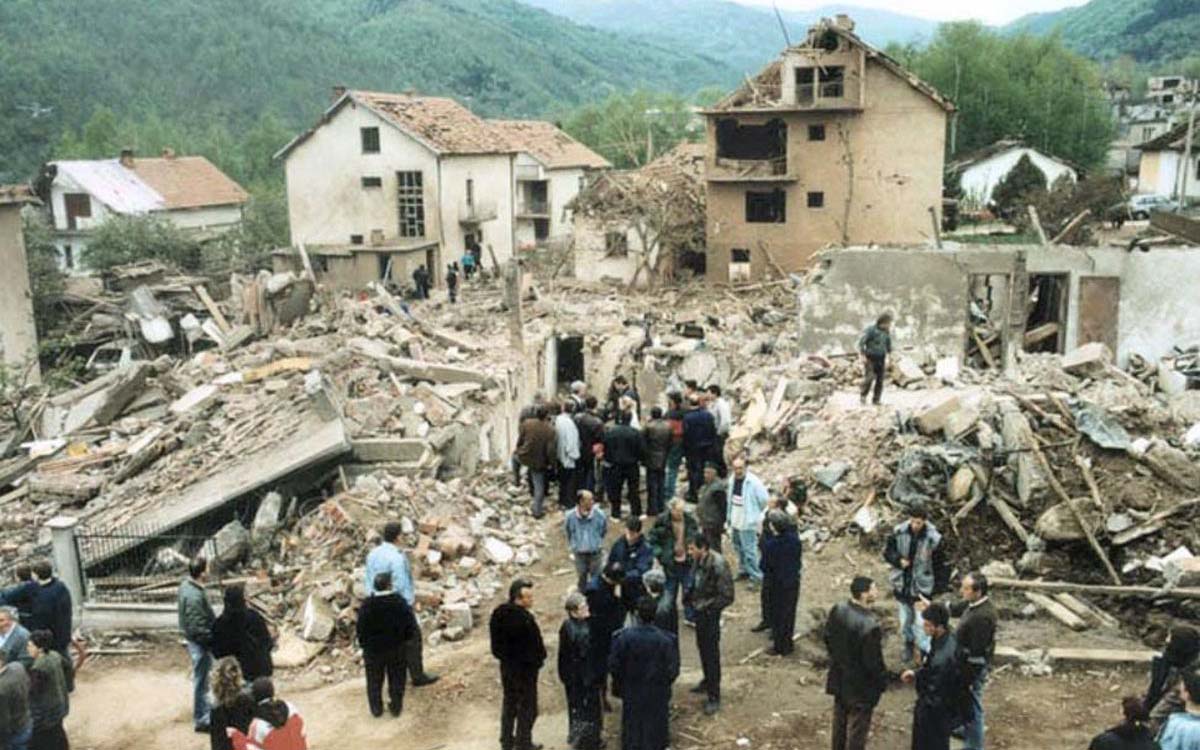
On this day in 1999, the United Nations Security Council adopted Resolution 1244, while NATO’s military campaign against Serbia, then part of the Federal Republic of Yugoslavia, was also brought to an end. The last projectiles struck near the village of Kololeč, close to Kosovska Kamenica, at 1:30 p.m. that day, as well as a military barracks in Uroševac at 7:35 p.m.
UN Security Council Resolution 1244 envisaged the return of a certain number of personnel from the Federal Republic of Yugoslavia and Serbia, a provision that was never implemented.
According to Resolution 1244, adopted on June 10, 1999, Kosovo remained an integral part of the Federal Republic of Yugoslavia, whose sole legal successor is Serbia.
The NATO campaign began on March 24, 1999, without authorization from the United Nations Security Council and ended following the signing of the Kumanovo Agreement.
Then-NATO Secretary General Javier Solana issued the order to halt military operations against the Federal Republic of Yugoslavia on June 10, 1999.
The Military-Technical Agreement was signed in Kumanovo after five difficult days of negotiations, late on the night of June 9, at a military airfield near Kumanovo.
The agreement was signed on behalf of NATO by Mike Jackson (1944–2024), a British general who later became commander of KFOR, the international peacekeeping force in Kosovo and Metohija.
Representing the Federal Republic of Yugoslavia were Svetozar Marjanović (1944–2022) and Obrad Stevanović (1953–2025).
The agreement set an 11-day deadline for the withdrawal of the Yugoslav Army and Serbian Police from Kosovo and Metohija.
READ MORE:
KFOR’s Entry into Kosovo and Metohija
Following the agreement, KFOR troops, primarily from NATO member states, entered Kosovo and Metohija.
A key condition set by representatives of the Federal Republic of Yugoslavia was that the international security presence in Kosovo and Metohija operate exclusively under the mandate of the United Nations, in accordance with a prior decision of the Serbian Parliament and a corresponding declaration by the Yugoslav government.
Due to concerns regarding the activities of the extremist Kosovo Liberation Army (KLA), Yugoslav representatives insisted that the withdrawal of Yugoslav Army and Serbian Police forces be synchronized with the arrival of international security forces in order to avoid, as much as possible, a security vacuum.
This was intended to provide basic security for all residents of Kosovo and Metohija, though subsequent events showed those expectations were not fully realized.
The Military-Technical Agreement signed in Kumanovo was based on a 10-point political document adopted during negotiations in Belgrade between Slobodan Milošević (1941–2006) and representatives of the international community, including Martti Ahtisaari (1937–2023) and Viktor Chernomyrdin (1938–2010), who served as Russian President Boris Yeltsin’s special envoy.
Ahtisaari brought the peace proposal of the United States, the European Union, and Russia to Belgrade. Acceptance of the document was a precondition for ending NATO’s military campaign.
Faced with threats of an even more extensive NATO operation, Slobodan Milošević accepted the 10-point peace proposal on June 3, 1999.
On the same day, the Serbian Parliament adopted the peace plan during an extraordinary session, after which it was approved by the government of the Federal Republic of Yugoslavia.
Main Provisions of the Kumanovo Agreement
The Military-Technical Agreement signed on June 9, 1999, included:
- A cessation of hostilities between NATO and the forces of the Federal Republic of Yugoslavia, including the Yugoslav Army and Serbian Police.
- The withdrawal of Yugoslav forces from Kosovo and Metohija within 11 days.
- The establishment of a Ground Safety Zone and an Air Safety Zone along the administrative boundary with Kosovo and Metohija, extending into central Serbia and Montenegro.
- A commitment by KFOR to disarm the Kosovo Liberation Army (KLA).
- Authorization for international forces to take all necessary measures to establish and maintain a secure environment for all citizens.
The withdrawal of Yugoslav military and police forces began on June 12, 1999.
They were replaced by KFOR personnel operating under the United Nations mandate, numbering approximately 37,200 troops from 36 countries.
By order of Russian President Vladimir Putin, the Russian peacekeeping contingent, numbering around 50 personnel at that time, was withdrawn from Kosovo and Metohija during June and July 2003.
KFOR’s mandate included maintaining peace, stability, and security for all communities, as well as enabling the safe return of displaced persons.
However, following the withdrawal of Serbian and Yugoslav forces, Serbs in Kosovo and Metohija, along with their property and religious and cultural heritage, were frequently subjected to attacks, crimes, and episodes of violence.
In addition to KFOR, the European Union’s civilian mission, EULEX, has been present in Kosovo since December 2008, following a decision by the EU Council of Ministers earlier that year, with the goal of strengthening the rule of law.
The return of Yugoslav Army forces to the Ground Safety Zone was permitted in 2001, while the Air Safety Zone was abolished in 2015.
In February 2008, the Assembly in Pristina unilaterally declared Kosovo’s independence, a move that was quickly recognized by many Western countries that had participated in the 1999 NATO intervention against Serbia and the Federal Republic of Yugoslavia.
MORE TOPICS:
TWO GREAT TRAGEDIES ON THE VELIKA MORAVA: First a girl (13) drowned, and then two boys aged 15!
THE PETER’S FAST BEGINS TODAY: Here is how long it lasts and what should be observed!
Source:: Euronews; Foto: Vesti.rs
 Add Serbian Times as your Google source