




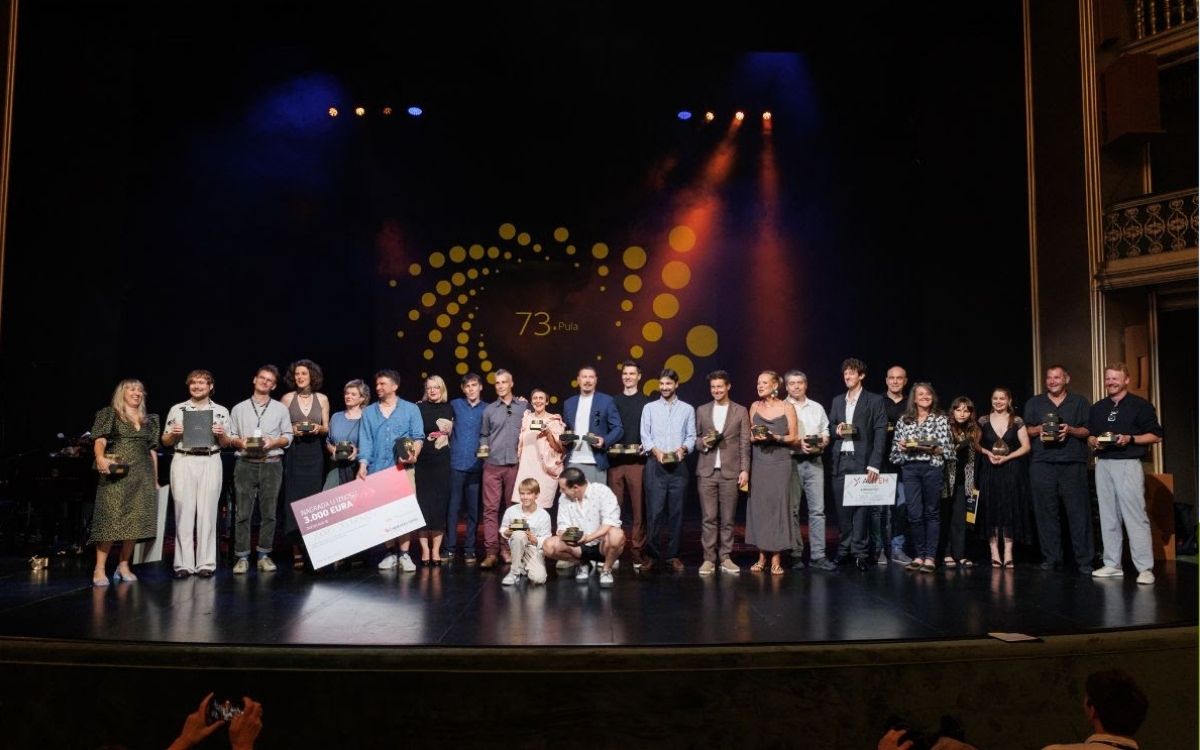
The Golden Arena for Best Film at the 73rd Pula Film Festival in the Croatian Minority Co-production program was awarded to “Wind, Talk to Me”, directed by Serbian filmmaker Stefan Đorđević. The film also received the Golden Arena for Best Cinematography, awarded to Marko Brdar.
This year’s Pula Festival also saw the triumph of the drama “Three Weeks Later”. Director Miroslav Terzić won the Golden Arena for Best Director, while Vladimir Arsenijević, Bojan Vuletić, and Terzić jointly received the Golden Arena for Best Screenplay. Marko Ferković was awarded the Golden Arena for Best Editing.
Accepting the award to a standing ovation, Arsenijević said he was extremely proud and noted that work on the film had lasted a full ten years.
“We felt a profound need to speak through the language of film about this tragic story—peer violence that ends in the suicide of the child being abused—so that people understand how serious this problem is in our society. I dedicate this award to children and to all those who unjustly suffer violence.”
“I am especially happy to receive this award in Pula, my hometown, the best small, great city in the world,” said Arsenijević, who himself became the victim of violence just three days before the film’s premiere, when he was beaten in Belgrade by young pro-government hooligans.
As a reminder, the Pula Film Festival stood by Arsenijević, condemning the attack and calling on audiences to show their support by attending the premiere of “Three Weeks Later,” a call that many residents of Pula answered.
The film arrived in Pula directly from the Karlovy Vary International Film Festival, where it won the prestigious Europa Cinemas Label Award for Best European Film. Branislav Trifunović stars as a teacher in the film and, more importantly, also serves as its producer.
“Every award makes me happy because it draws attention to the issue of peer violence, something we must keep talking about. I hope these Golden Arenas we received in Pula will help our society finally begin addressing this problem,” Trifunović told Danas just minutes after the awards ceremony.
“I also hope the Golden Arenas won by our other films will help change the situation. We promote our country, yet the authorities prevent us from doing so. This is already the second year that funding for new film productions has been suspended,” Trifunović added.
The Golden Arena for Best Leading Actor went to Vučić Perović for his performance in “Our Father,” directed and written by Goran Stanković, who accepted the award on Perović’s behalf because the actor was unable to attend the festival.
In addition to the award-winning productions, the competition also featured Serbian films “Yugo Florida” by Vladimir Tagić, which received one of the highest ratings from 13 regional film critics covering the festival, “Lines of Desire” by Dane Komljen, and the documentary “Yugo Goes to America” by Filip Grujić.
The jury deciding the winners in the Main Competition (Croatian Film and Croatian Minority Co-productions) consisted of director and screenwriter Vinko Brešan, editor Hrvoslava Brkušić, producer Tina Hajon, production designer Tanja Lacko, and director and curator Ivan Ramljak.
A total of 18 films competed for 28 Golden Arenas—14 feature films, three documentaries, and one animated film—while the Croatian Film section featured 11 productions.
The Grand Golden Arena for Best Film was awarded to the family drama “Koke,” the feature debut of director Igor Jelinović, who also won the Golden Arena for Best Screenplay.
“Koke” also earned Snježana Sinovčić Šiškov the Golden Arena for Best Leading Actress and Serbian actress Aleksandra Janković the Golden Arena for Best Supporting Actress.
“I’m incredibly emotional. This is the first time I’ve acted in a Croatian film, the first time I’ve filmed in the language of my birth, and the first time I’ve attended the Pula Festival. I never even imagined I could win a Golden Arena, and I can’t find the words to describe what I’m feeling right now,” said Janković.
The most memorable moment of the closing ceremony at the Istrian National Theatre came when actor Dado Ćosić accepted the Golden Arena for Best Leading Actor for his role as Lovro in “Beautiful Evening, Beautiful Day,” directed by Ivona Juka.
While accepting the award, Ćosić dedicated his speech to filmmakers in Serbia and the current state of the Serbian film industry, drawing thunderous applause and enthusiastic support from the packed audience.
Referring to the fact that Serbia’s Film Center has not held a funding competition for domestic or minority co-productions for nearly two years, effectively bringing the country’s film industry to a standstill, Ćosić called for solidarity.
“Without Serbian films, our Minority Co-productions program at this festival will be significantly poorer, and our own films will lose very important co-production partners. Serbian cinema is important not only to us but to all of Europe, and we must not allow this suspension of funding competitions to continue. Let’s support our colleagues and organize a public initiative for them,” Ćosić said.
His appeal for solidarity was echoed by Dragana Jovović, producer of the festival-winning Serbian film “Wind, Talk to Me.”
“The situation in Serbian cinema will change when the students win,” Jovović said, prompting the loudest applause and chants in support of Serbian students heard throughout the ceremony.
The Golden Arena for Best Director was also awarded to Srđan Kovačević for “What Must Be Done,” while the film also received the Golden Arena for Best Editing, awarded to Klara Šovagović and Damir Čučić.
The hit comedy “Wedding” by Igor Šeregi, the most-watched Croatian film in cinemas this year and the opening film of the 73rd Pula Festival, won four Golden Arenas.
The awards went to director Igor Šeregi for Best Casting, Ivan Kelava and Marko Jocić for Best Production, Roko Sikavica for Best Supporting Actor, while Linda Begonja received a Special Golden Arena for Outstanding Contribution by an Acting Ensemble for her role as Marija.
A Special Golden Arena for Contribution to Croatian Animation was presented to director and producer Arsen Anton Ostojić for the animated film “Crystal Planet.”
In the Regional Program, the Golden Arena went to the Slovenian film “Ida, Who Sang So Badly That Even the Dead Rose and Sang With Her,” directed by Ester Ivakič, while the winner of the Student Film Program was “Rahlo,” directed by Joza Schmu.
The awards ceremony at the Istrian National Theatre featured an extensive entertainment program directed by Petra Radin, including musical performances by Martin Kosovec and Nika Ivančić, orchestral performances conducted by Filip Gjuda, a choir performance by the Husar & Tomčić singing school, while the hosts were Borko Perić, Ana Begić Tahiri, and Csilla Barath Bastaić.
Part of the program was dedicated to remembering filmmakers who passed away between the two festivals, and in a particularly emotional tribute, the 73rd Pula Festival also bid farewell at its closing ceremony to acclaimed Croatian director Zrinko Ogresta, one of the region’s most significant filmmakers, who died just days before the festival opened.
The festival’s award winners also greeted the audience in the Arena after the ceremony, followed by a screening of Vinko Brešan’s “How the War Started on My Island,” the film that triumphed at the Pula Festival thirty years ago.
MORE TOPICS:
Source: Danas.rs, Foto: Promo Pulski filmski festival
 Add Serbian Times as your Google source