




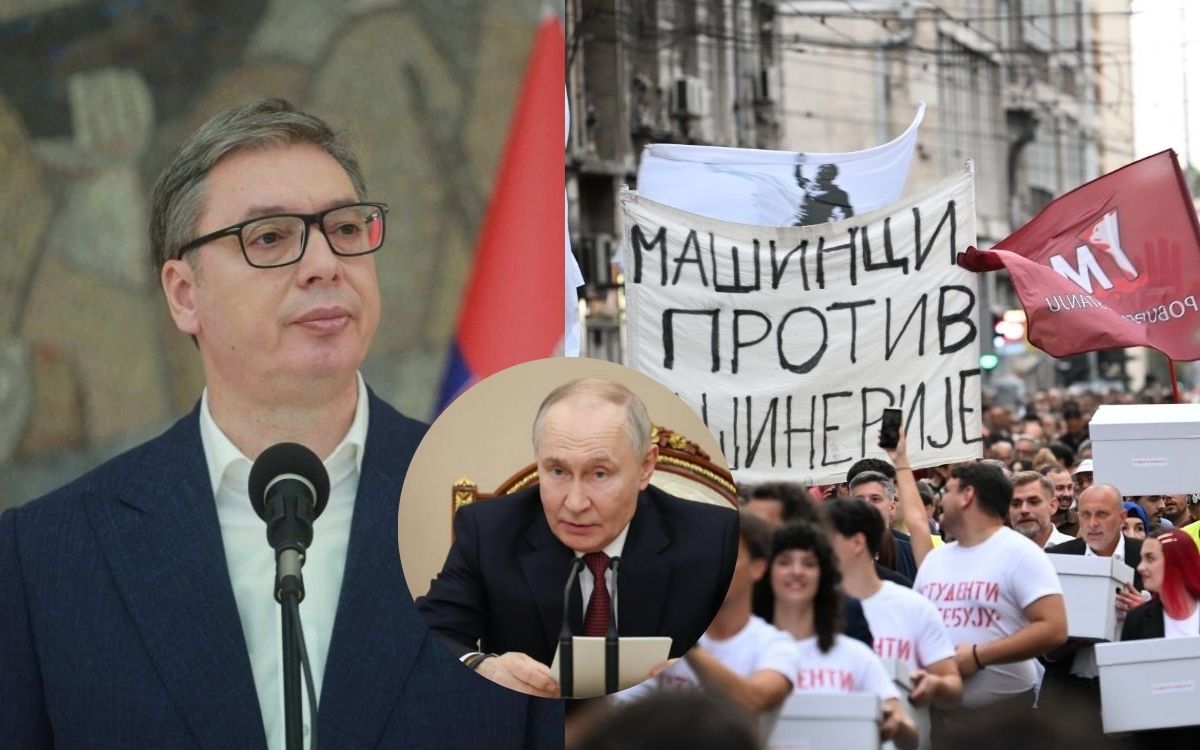
The British newspaper The Times has published an extensive report from Belgrade warning that the parliamentary elections in Serbia, scheduled for October 25, could trigger a new escalation of violence regardless of the outcome. The paper writes that President Aleksandar Vučić relies on media control, a political machine, groups of violent enforcers and the support of Russian President Vladimir Putin to remain in power, while the student movement represents the greatest challenge to his long-standing rule.
In an article titled “Hired thugs, Gen Z fury and Putin’s strongman clinging desperately to power,” journalist Tom Kington describes an atmosphere of fear and uncertainty in Serbia ahead of the elections.
According to the report, opinion polls point to a close election race, while pro-government media have published around 1,500 reports in recent weeks warning of possible violence on election day.
Thirty-year-old Valentina Stanić, who participates in anti-government protests, told The Times that she fears the regime’s reaction if the opposition wins.
“We know we are the majority, but if we win, the authorities will deny it. They won’t leave easily,” she said.
“I am really afraid there will be violence, but I will be out on the streets protesting. I have no choice, because I love my country,” she added.
Thugs, tents and allegations of organized violence
The Times recalls that the student protests began after the collapse of the canopy at the Novi Sad Railway Station, which killed 16 people, and grew into the biggest challenge to Vučić’s rule since 2014.
The British newspaper pays particular attention to claims made by Momčilo Marjanović, a security guard turned whistleblower who spoke to Balkan Insight about the organization of groups of thugs to target demonstrators.
According to his claims, during the major protest in Belgrade last March, when around 300,000 people gathered, approximately 100 armed men ready to shoot were hidden in the tent encampment near the National Assembly.
Marjanović also said that over a two-year period he had paid up to €400,000 to people hired for violent operations, claiming that the money came through an executive at a municipal heating company.
According to his testimony, these groups not only attacked demonstrators but also provoked clashes with the police in order to shift the blame onto students.
The Times notes that these allegations have further intensified fears of possible incidents on election day.
CRTA: Vučić does not want witnesses at polling stations
Raša Nedeljkov of the CRTA election-monitoring organization warned The Times that several scenarios could lead to post-election violence.
In his assessment, if the Student List takes the lead, Vučić could claim that electoral irregularities had occurred and demand a rerun. If the result is close, he could simply declare victory.
“Both scenarios would trigger protests, and he would send in the police and infiltrators to incite violence so that he could claim Serbia was under attack by foreign-funded forces,” Nedeljkov said.
He believes the authorities have been laying the groundwork for such a development for months by claiming that foreign intelligence services are organizing a “color revolution.”
“I am simply reading their own scenario. Vučić and officials from his party have been claiming for months that foreign intelligence services are preparing a color revolution. I fear that October 25 will only deepen the crisis,” he said.
Nedeljkov said CRTA had been subjected to police raids and surveillance but would nevertheless send hundreds of observers to polling stations.
“Our observers have been attacked before, while the police did nothing. We believe the same method will be used again. We are witnesses at polling stations, and Vučić does not want witnesses,” he said.
Student List and allegations of vote-buying
The British newspaper writes that the Student List is made up largely of university professors, has no single prominent leader, and is primarily focused on restoring the rule of law.
One of its candidates, Oliver Tošković, a professor at the Faculty of Philosophy in Belgrade, rejected the authorities’ claims that students were responsible for violence.
“I cannot believe they are accusing us of being violent when they have the police, the army and paramilitary thugs,” Tošković said, adding that he hoped the European Union would closely monitor the elections.
Meanwhile, government supporters continue to repeat allegations that the student movement is funded by foreign intelligence services.
Branislav Zec, a municipal employee and Vučić supporter, asked The Times journalist where the students were getting their money, naming Germany and the United Kingdom as possible sources of funding.
Ilija Srđanović, a cardiologist and professor at the University of Novi Sad who leads the Student List, claims that employees of state institutions are being forced to collect votes for the Serbian Progressive Party.
“Everyone has to collect votes, and whoever collects the most gets a reward from the party. This happens at my hospital, too,” Srđanović said.
Opposition MP Borko Stefanović described a system of voter control, claiming that masked men appear at polling stations to check photographs of ballot papers.
“It is a well-oiled machine,” Stefanović said.
The Times notes that Vučić has previously denied allegations of electoral manipulation.
The Times on N1, Nova and Zoran Kesić’s departure
In a separate section of its report, the British newspaper examines the media situation in Serbia, noting that media acquisitions by businesspeople close to Vučić have contributed to the suppression of critical reporting.
The Times also writes about changes at N1 and Nova S, which, according to the report, have come under the control of a Portuguese company linked to circles around former Hungarian Prime Minister Viktor Orbán.
The newspaper reports that employees at the Nova portal were given 48 hours this week to leave if they objected to the appointment of a new manager whom they claim had worked for a pro-government tabloid.
British war correspondent Brent Sadler, appointed to oversee the television channels, rejected allegations of censorship.
“Not a single story has been banned since I took over,” Sadler told The Times.
He also said that the departure of popular comedian Zoran Kesić from Nova S was due to financial reasons rather than political pressure.
Kesić disputed this.
“My show mocked Vučić as a liar, and our laughter made us dangerous because it exposed hypocrisy. That laughter cost me my job,” Kesić said.
The Times also addresses pressure on the investigative portal KRIK, which has spent years publishing reports about alleged links between the authorities and organized crime.
KRIK editor Stevan Dojčinović said the newsroom was facing a large number of lawsuits intended to exhaust journalists and make their work more difficult.
“I suspect the authorities have taken control of the courts dealing with the media by promising judges promotions, which is why we are now seeing some bizarre rulings,” Dojčinović said.
Putin does not want to lose Vučić
The Times devotes a substantial part of its analysis to relations between Belgrade and Moscow, arguing that Vladimir Putin does not want to lose another ally in Eastern Europe following Viktor Orbán’s departure from power in Hungary.
The British newspaper notes that Vučić, whose presidential term expires next May, is attempting to return to the post of prime minister, drawing a parallel with Putin’s earlier changes of office to preserve his grip on power.
The article also mentions Aleksandar Vulin, former director of the Security Intelligence Agency (BIA) and deputy prime minister, whom The Times describes as an important link between Serbian and Russian security structures.
The newspaper recalls that Vulin is under US sanctions over alleged links to organized crime and drug and arms trafficking.
It also highlights the possibility of adopting a foreign agents law modeled on Russian legislation, which could seriously threaten the work of organizations receiving funding from abroad.
Srećko Đukić, Serbia’s former ambassador to Belarus, said Putin wanted to preserve Vučić as a partner.
“Putin is known for not wanting to change his partners, especially if they are weak, like Vučić or Belarusian President Lukashenko,” Đukić said.
He believes Serbia represents one of Russia’s few remaining open doors to Europe.
“Vučić will, of course, try to adopt a foreign agents law if he wins. It really reminds me of Putin’s regime. If Vučić wins, we can say ‘arrivederci’ to democracy,” Đukić warned.
MORE TOPICS:
Source: Nova.rs Foto: ATA Images / VYACHESLAV PROKOFYEV / SPUTNIK
 Add Serbian Times as your Google source