




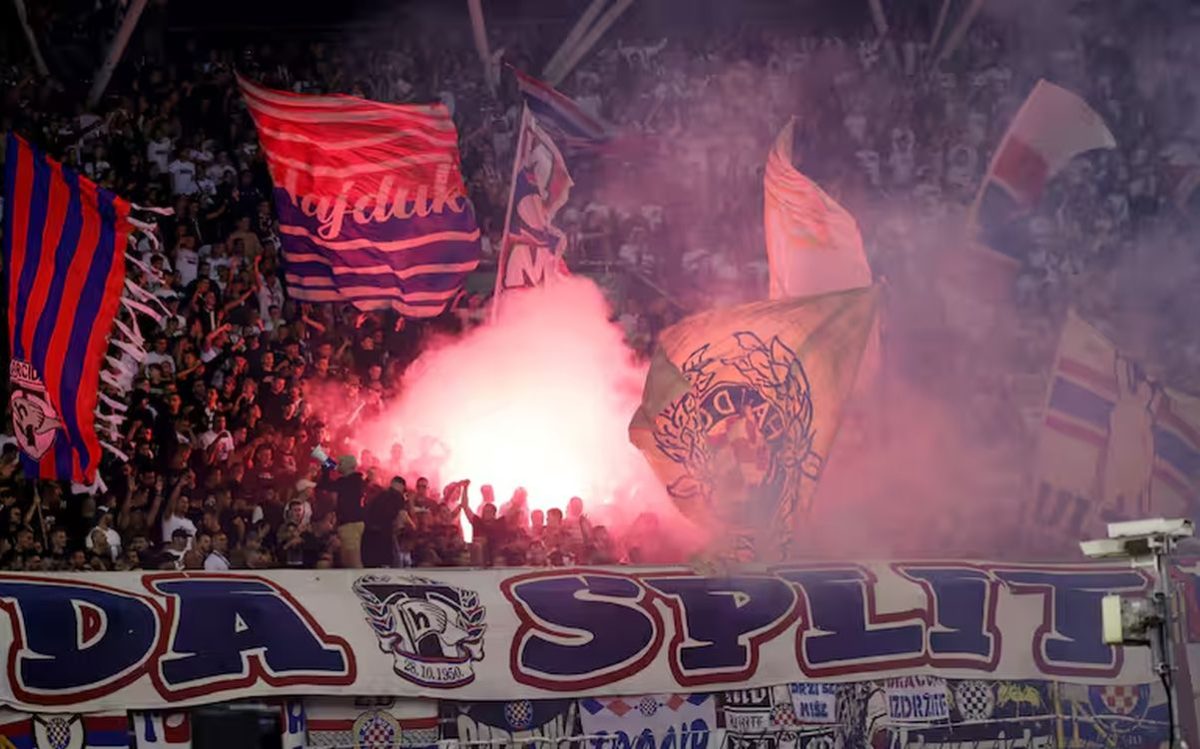
While the Croatian government pretends to be exemplary and morally superior, lecturing Montenegro over Mandić’s telegram of condolence, the fruits of long-cultivated fascism are swelling among Croatian youth. No, this is not a stylistic exaggeration: the scenes on the streets of Split before the Hajduk–Ajax match, as well as the images from Poljud Stadium, fall in every respect within the semantic scope of the term fascism.
While Europe recoils at the Torcida supporters’ rampage, with their chants invoking Hitler and Auschwitz, Croatian officials distance themselves from the incident and issue apologies, seeking to portray the scandal as an isolated incident caused by irresponsible individuals or small groups of fans. It would be good for both Croatia and its neighbors if that were the case.
Alas, the whole issue of the fascization of young people is neither so simple nor so accidental. The rampage on the streets of Split is the product of a worldview cultivated carefully over a long period, shaped by vulgar revisionism, populism, homogenization and a baseless sense of moral superiority.
A black-and-white view of history, in which “we” are always and exclusively good, noble, innocent and victims, while “they” are agents of evil against whom anything is permissible, was bound, by the laws of dialectical necessity, to blossom into an eruption of fascism. Fascism is a strange little beast, entirely unsuited to life as a household pet. While it is small, it may seem possible to tame and train it, but as soon as it grows a little, it reveals its primal nature, one that cannot be reconciled with humanity and recognizes only the law of the pack.
Decades of the Croatian government’s incessant lamenting over the supposed misfortune of Croats before the Hague Tribunal, the celebration of the largest ethnic cleansing in Europe since World War II as a glorious military victory, the constant stoking of public fear over Yugoslav, communist, Serbian, Islamic, Russian and other threats, and the toleration of Thompson’s Ustaše glorification, subtly woven into his patriotic songs — all of this amounted to more or less overt invitations to younger generations to abandon independent thought and surrender to the seductive call of homogenization.
Split police have launched an investigation into Torcida’s fascist rampage before and during the Hajduk–Ajax match, and there is little reason to doubt that, in an effort to ease European pressure on Croatia, the investigation will lead to several fan leaders who will then receive misdemeanor or suspended sentences.
Yet these frothing fans may be the most innocent parties in the entire affair. They are merely the aforementioned dialectically inevitable consequence of decades of actions by Croatian state institutions, parts of the academic community and the media, and the intimidation exerted by veterans’ associations. To uncover the real culprits behind Split’s fascist night, the investigation would have to reach back decades and examine a much broader social context, starting with Tuđman.
Unfortunately, Split police lack the capacity for such a complex investigative operation, so the public will be presented with some dim-witted scapegoat from the Poljud stands to shoulder the blame for fascism that has been encouraged and cultivated for decades. Croatia will receive praise from Europe, and even Israel, for finding and punishing the culprit, and tomorrow Croatian youth will gather somewhere else to roar “Za dom spremni” along with Thompson. Because, as already stated, fascism cannot be tamed.
MORE TOPICS:
Source: Elis Bektaš / Žurnal me Foto: Rojters
 Add Serbian Times as your Google source