




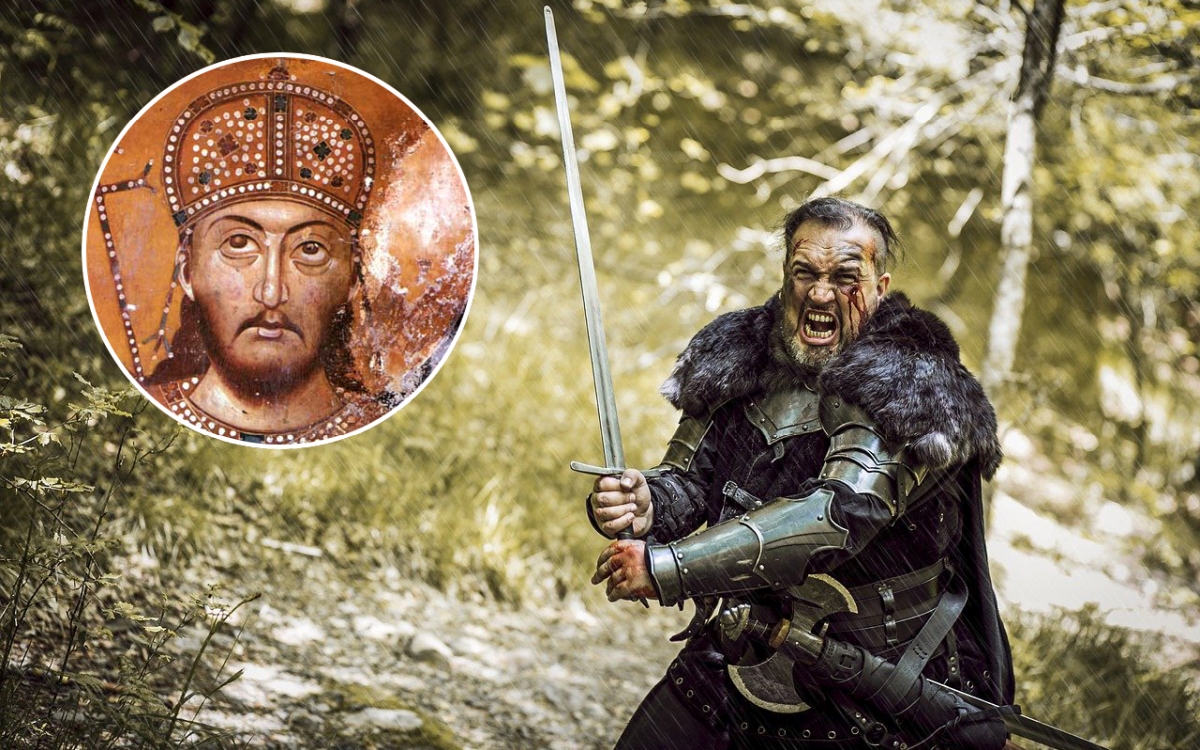
During the time of the greatest rise of medieval Serbia, under the rule of Stefan Uroš IV, better known as Emperor Dušan, the state reached its largest borders – from the Danube to the Gulf of Corinth – and was one of the strongest powers in Europe. Behind this success, alongside capable politics, stood an exceptionally organized army.
The Serbian medieval army possessed a heavy cavalry known as the Black Knights.
Their role was to charge into the heart of the battle, straight toward the standard of the opposing commander, where the outcome of the conflict was decided. Their steel breastplates, made from a single piece (plastrons or cuirasses), often covered with brocade weaving and burnished for protection against corrosion, struck fear into enemies. The attacks of the Black Armored Knights were fast, devastating, and precise, and their combination of strength and tactics made them famous throughout Europe.

In addition to the domestic heavy cavalry, the backbone of Dušan’s military force consisted of an elite mercenary unit known as the “Alemanic Guard,” composed mainly of warriors from the territory of present-day Germany. His personal guard numbered about 300 knights, carefully chosen according to strict criteria – they were of exceptional physical build, often over two meters tall, and proven winners of knightly tournaments.
Equipped with heavy armor and on powerful horses, they represented a terrifying force on the battlefield, and Palman Bracht from Styria was Emperor Dušan’s right hand, his closest associate and military advisor, as well as the executor of many diplomatic tasks.
The reconstruction of Emperor Dušan’s armor from the time of the Battle of Velbužd in 1330 was created by architect Stevan Stevanović based on depictions from the hagiographic icon of Stefan Dečanski in the Dečani monastery, while the reconstruction of the sword based on the fresco from the Monastery of Saint George in Polog was crafted by master sword-smith Slobodan Marinić. The armor is partly covered with fine brocade woven cloth with authentic motifs, and the sword and armor contain gilded decorations and an inscription in Old Church Slavonic: “In Christ the Pious Stefan the Emperor.”

The Banner of Emperor Dušan has been kept by Hilandar for centuries
In Hilandar, a banner has been kept for centuries which folk tradition links to Emperor Dušan. This flag in the shape of a right-angled triangle, measuring about 240 cm in height and 275 cm in width, is made of thin silk, with green, yellow, and orange colors and a sewn-in cross. Its size and purpose testify to Dušan’s power and imposing figure – in tradition, he was depicted as a giant capable of carrying such a standard before the army.
Interestingly, not far from Hilandar are parts of Emperor Dušan’s cross, which according to tradition was carried before him during his stay on Mount Athos. The memorial site with parts of the Imperial Cross is located in the thick shade of a cypress forest planted in perfect order and arrangement, precisely in honor of his armored knights who stood there many centuries ago.

THE IMPERIAL CROSS: The place where Emperor Dušan’s armored knights were lined up near Hilandar
The banner was a symbol of force and authority, a sign under which the army set out on campaigns and often a psychological weapon that caused cities to surrender without a fight. According to legend, the banner was also blessed on Mount Athos, representing protection in battle and divine favor for the Emperor and his army.

KEEPS DUŠAN’S BANNER: Hilandar Monastery on Mount Athos
These units and symbols, from the Black Armored Knights to the Alemanic Guard and the magnificent banner, ensured that Dušan could quickly and efficiently expand and maintain power. After his death in 1355, the army no longer relied on these elite structures, which, according to many historians, contributed to the rapid weakening of the Nemanjić state power. Nevertheless, the story of the Black Armored Knights, the Alemanic Guard, the armor, the sword, and the imperial flag remains a testimony to a time when Serbia was an empire and its ruler a figure of almost mythical proportions, a symbol of strength, discipline, and military art.
MORE TOPICS:
Author: Ognjan Veselinović Photo: Hilandar.org, Nikana.gr