




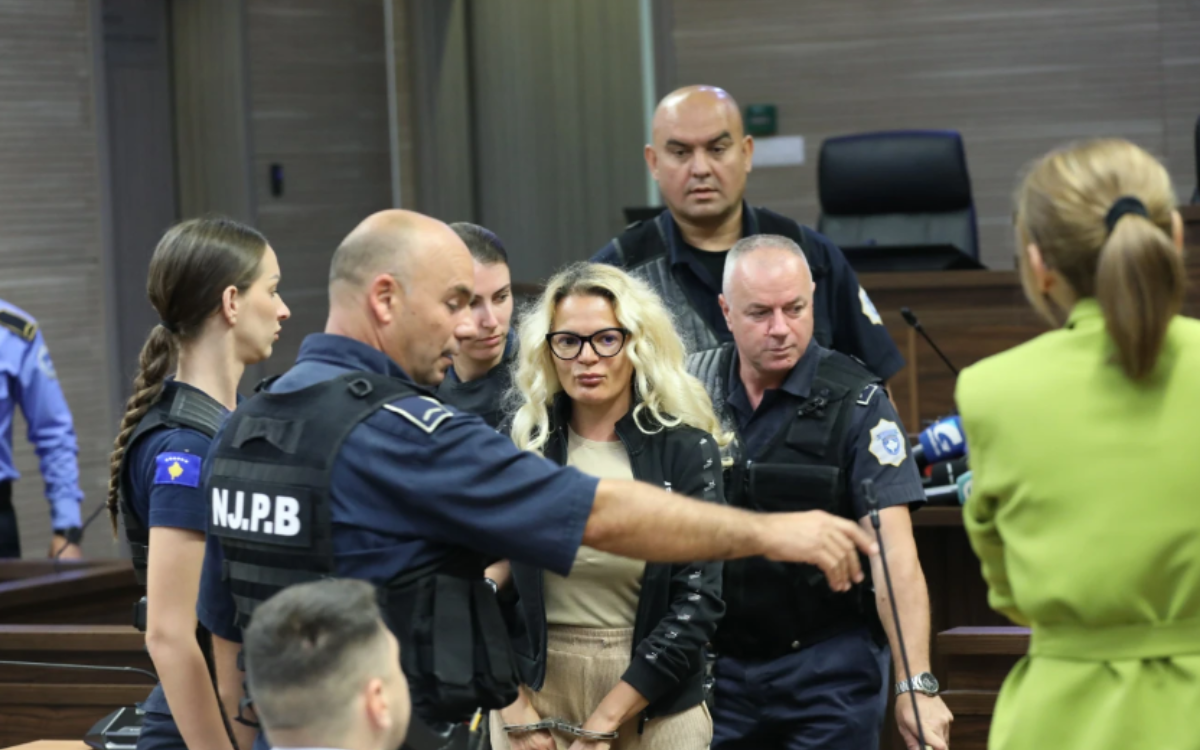
Today, the trial of J.Đ., a Serb woman employed at the OSCE Mission in Kosovo, accused of espionage, began at the Basic Court in Pristina. As Koha reports from the hearing – she pleaded not guilty.
The prosecutor, Bekim Kodraliu, read the indictment, stating that J.Đ. is charged with knowingly transmitting data, documents, and sensitive information to the Security-Information Agency of Serbia (BIA), acquired during her official duties within the activities of the OSCE in Kosovo.
At the same time, she is also charged with influencing OSCE reports, contributing to “the creation of a hostile narrative towards security institutions.”
Kodraliu stated that through these actions, J.Đ. “seriously jeopardized the constitutional order and national security and put the life and security of state officials, citizens of the country, as well as the international staff of the OSCE Mission in Kosovo, in serious danger.”
Lawyer Predrag Miljković, Koha reports, called on the court to consider house arrest, stating that all material evidence has already been provided to the prosecution, Kossev reports.
The prosecution, however, pointed out that circumstances still exist that justify detention, including the risk of flight or reoffending. The president of the judicial panel, Rrahman Beqiri, announced that the decision on detention will be made outside of the main hearing.
J.Đ. was arrested in February of this year.
Arrests for espionage
There are an increasing number of proceedings in Kosovo being conducted for espionage, allegedly in favor of Serbia.
One of them is being conducted against former Kosovo Police member Aleksandar Vlajić, who previously worked as a warehouse manager in the Serbian Ministry of Internal Affairs in Mitrovica. In June, he became the first person to be convicted of espionage by the Kosovo authorities. Media and court documents describe him as a BIA agent.
Furthermore, by concluding a plea agreement, he was sentenced to five years in prison for the criminal offense of espionage, and was additionally fined – 1,000 euros – for illegal possession of a weapon. Proceedings are still being conducted against him for another criminal offense – terrorism – on suspicion of throwing a bomb at the premises of the Municipal Election Commission in North Mitrovica in 2022.
The Vlajić case opened the door for new arrests – based on the forensic analysis of even seven mobile phones he used. Among the suspects was J. Đ. from Mitrovica, an OSCE employee, whom Vlajić, according to his own admission, recruited to provide him with confidential information and documents.
According to the indictment of the Special Prosecutor’s Office, Vlajić communicated with J.Đ. through seven different phone numbers that he regularly changed. He allegedly received sensitive data from her about the security and functioning of Kosovo institutions, including internal reports from meetings of the former head of the OSCE mission, Michael Davenport.
Pristina media state that he used a coded language – BIA was called “the firm,” and one message allegedly says that “at the BIA, they will get tired of reading the reports” he receives from J.Đ., adding that “he shouldn’t worry because someone is already handling it.”
The Special Prosecutor’s Office claims that Vlajić had collaborators in other international organizations as well – the OSCE, EULEX, UNMIK, and KFOR – and that they were all members of the Serbian community. Along with J.Đ. from the OSCE, the documents mention a person M. from EULEX, N.K. from UNMIK, and a person identified as N.64 from KFOR.
The indictment confirms that the information was forwarded to his superior at the BIA – a person with the initials R.G, stationed in Novi Pazar.
Uroševac: Two former customs officers among the suspects
Last year on June 5, two Albanians were arrested in Uroševac, suspected of espionage for the BIA. One of them, B. Sh, is a former police officer from the nineties, who later worked as a customs officer during the UNMIK administration.
Kosovo Customs denied his connection to the institution, stating that he was discharged from duty back in 2004 for violating the Code of Conduct.
B.Sh. and M.Q. are accused of “collecting information of state importance” and about people in public office, which they then provided to BIA agents.
At a hearing on July 15, both of them pleaded not guilty to espionage, while M.Q. admitted to illegal possession of a weapon.
Third Albanian suspected of espionage
Another arrest followed on May 6 – H.S. was arrested after a months-long investigation. The operation, as in previous cases, was led by the Kosovo Intelligence Agency in cooperation with the police and the prosecutor’s office. An indictment was filed against him on September 11 for collaboration with the BIA.
Arrest of a police officer
A new arrest for espionage occurred in mid-July. At that time, B.J. was arrested, otherwise a high-ranking Kosovo police officer of Serbian nationality, and he was employed in a border unit at the Bela Zemlja crossing, in the position of chief.
According to the police, he also sent confidential information to the Serbian Security-Information Agency. Upon his arrest, a measure of detention was ordered.
Croatian soldier and a woman from Mitrovica
The latest accusations of espionage, also allegedly in favor of official Belgrade, have caused a real stir in the region.
It’s about the arrest of a couple – a Croatian pilot, a member of KFOR, and a Serb woman from Kosovska Mitrovica. They were arrested on one of the islands of the Split archipelago.
Investigators allegedly found messages in their communication that indicated the transmission of confidential data about KFOR, Croatian media first reported.
The pilot, it is claimed, sent information for three years which A. M. forwarded to the leaders of Srpska lista and one foreign journalist.
The couple is also charged with revealing details about KFOR’s activities in Zubin Potok and the transport of former police officer Dejan Pantić.
Besides the Croatian authorities who initiated proceedings, judicial bodies in Pristina are also interested in the case.
The Kosovo Special Prosecutor’s Office recently sent an official request to the authorities in Croatia for the submission of evidence, while the Kosovo Police searched the house of the Serb woman from Kosovska Mitrovica.
What does the law on espionage say?
The criminal offense of espionage is regulated by Article 124 of the Kosovo Criminal Code and covers seven paragraphs. The prescribed penalties range from a minimum of five years in prison, and in more severe cases can reach life imprisonment.
Not all confidential data is automatically a state secret. For something to have that status, it must be so determined by law or by a decision of the competent state authority. In practice, this mainly refers to information of importance for “state security,” although seemingly harmless data can also be declared secret if it is assessed that its disclosure could harm the interests of a state.
For an act to be qualified as espionage, a person must know that they are transmitting data to a person working for a foreign state or intelligence service, local lawyer Ljubomir Pantović pointed out.
Therefore, guilt exists only if it is committed with direct intent – with awareness of the content of the data and the identity of the recipient.
MORE TOPICS:
NATO IS CONSIDERING CLOSING THE SKY OVER UKRAINE: Russia responded fiercely, “that would mean war”!
Source: Nova.rs, Foto: Koha
 Add Serbian Times as your Google source