




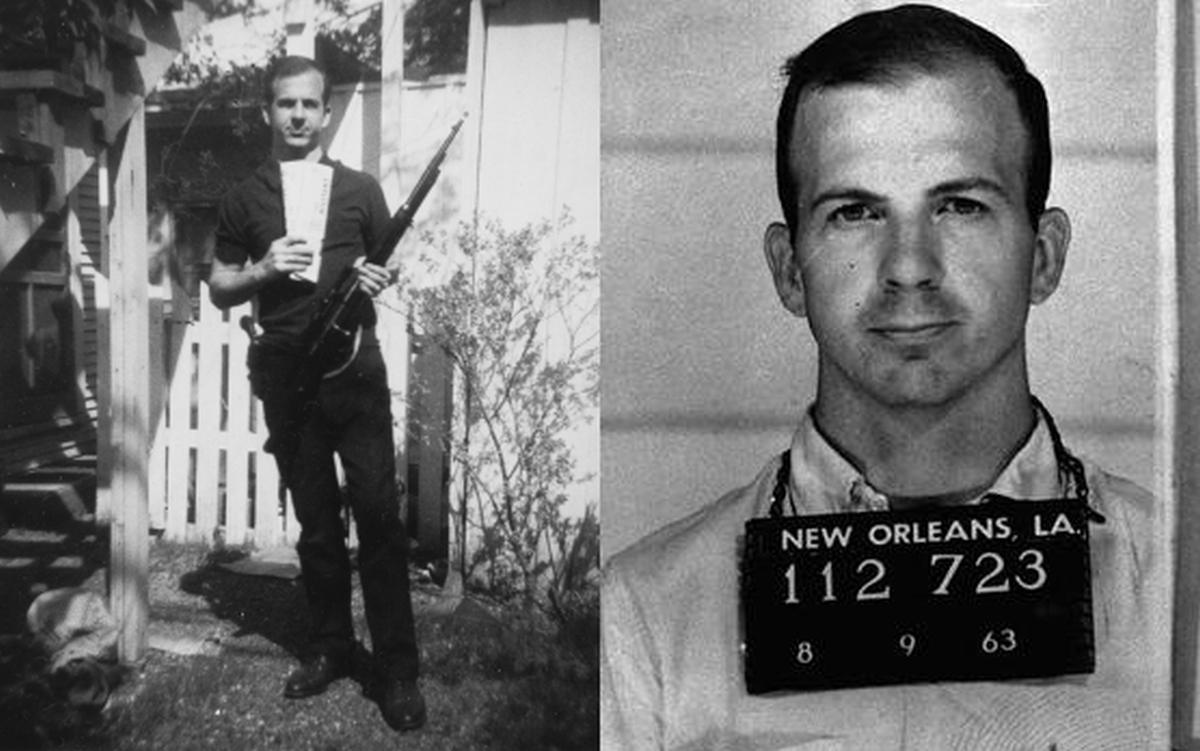
George de Mohrenschildt, a close friend of Lee Oswald, spent several months in Yugoslavia as a “geologist”. Testimony before the Warren Commission confirmed the strange relationships between the players of world politics.
Jane’s face was filled with happiness. She didn’t like public beaches, just like her fiancé George. She skillfully rowed from Miločer to Petrovac. The fairytale-like picture was completed by an almost hidden old fortress (I think it was from the Roman era), and the outline of a figure standing carelessly on it. Suddenly, they heard shots.
She realized in an instant that they were in front of an active military object. The incident happened in the summer of 1957, and we learned about it thanks to documents published during the investigation into the assassination of US President John F. Kennedy. The main characters of the described incident, Jane and George de Mohrenschildt, were close friends of Lee Harvey Oswald, the man believed to be the assassin.
What is interesting to us is the fact that de Mohrenschildt, shortly before the assassination, spent several years in Yugoslavia on mysterious missions. In his memoirs, he wrote: “I cannot say that I have never worked for the CIA. I cannot prove that. But I cannot prove that I worked for them either.”
A SPY FOR EVERYONE
It is difficult to say who George de Mohrenschildt really was. Russian, Belarusian, Pole, half-German from Estonia, Swede, Greek Catholic, American (and others as needed), whose exact date of birth in Tsarist Russia was unknown.
George was someone special – and he certainly wasn’t in Yugoslavia as a tourist. In America, he was accused of working for the Germans during World War II, while he claimed to have ties to the resistance movement in Poland and France. He was close to the FBI and the US intelligence agency, the French took him under their wing a little, he liked to socialize with Russians…
He traveled the world as if it were his backyard, always finding himself “where he needed to be”. And with whom he needed to be. He changed several women but, as he said, he guarded his friends like water in his hand.
An alleged collaborator of all possible and impossible services, after defecting to America, he held little Jacqueline Bouvier, the future wife of John F. Kennedy, on his knees! He was more than close with her parents, and the popular Jackie did not forget him even when she became the First Lady. He also befriended Kennedy himself, and they often met… Although he claimed that the Russian communists had sent him to a camp or killed half his family, he did not shy away from befriending them.
Gregory, as they called him, boasted that he never forgot their birthdays. He especially liked to please the child of Marina, the wife of Lee Harvey Oswald (“He was not a communist, but a Marxist”). He came into contact with the most famous assassin on the planet, who was more than a friend to him (he found him jobs, apartments), at the recommendation of those in charge of the CIA. Just as he spent time in the Caribbean with Aristotle Onassis, Jacqueline’s second husband.
We should not forget the friendship and joint business with Mohamed al-Fayed, the father of Princess Diana’s lover, whom he claimed was killed in a staged car accident with the woman of his dreams. Some books say that “Георгий Сергеевич Мореншильд” or Jerzy Sergius von Mohrenschildt, later George Sergius de Mohrenschildt (the German von was changed to the more suitable, allied, French de) was born on April 17, 1911, in Mozyr, in the Gomel region, a former part of the vast Russian Empire, today Belarus. Others claim that he saw the light of day in 1914, after his brother Dmitry. His father Sergei Alexandrovich was “marked” by a mixture of German, Swedish, and Russian origins, and his mother Alexandra had Polish, Russian, and Hungarian blood.
This certainly contributed to George’s excellent mastery of Russian, German, and Polish, and later easily French, Spanish, and English. Legend has it that he also knew Togo, the language of Togoland, a German protectorate in West Africa. There, he allegedly “had some business in 1958” until he “realized” that it was more interesting in Cuba, Mexico, Ghana, Nigeria, France… And in Yugoslavia, of course. He emigrated to America in 1938. He believed that he would get along well there at the start, but as soon as he arrived in the promised land, the British intelligence service informed the hosts that George, now Jerzy, was already maintaining contacts with German colleagues.
The FBI followed him for two years and determined that he also liked to see French spies. They concluded that it was smartest to put him to his vocation and knowledge. Thus, Jerzy became George. The Yugoslav secret service knew almost everything about his brother Dmitry, but it wasn’t easy to read George.
Our secret service guessed who was coming, and the American one knew why they were sending him. The Yugoslav authorities accused him of making precise plans for military fortifications. Hence the expressed passion for rowing on the Miločer-Petrovac route. Upon returning to America, he spent several days in the secret service, which wanted to find out if he had talked to the hosts about politics, or perhaps become closer to the enemy. The story of his arrival was very simply packaged.

“GEOLOGIST”
The International Cooperation Administration (ICA) signed an agreement with the Yugoslav government that provided for someone from America to come to Zagreb and work a little with local colleagues, miners, and oil workers. It was George, who had advanced from an economist to a geologist.
“There was nothing strange about it,” he later testified.
His uncle Ferdinand had once had an oil company in Baku, hence his interest in oil. The Yugoslav secret service believed him just as much as they believed his claim that he had not come to get his hands dirty.
“George Mitchell from ICA suggested that I go to Yugoslavia as an oil expert, examine how they could best use their resources, determine if we could cooperate. Tito’s government agreed to pay my expenses, and ICA allocated a salary. The contract provided for a stay of about 8-9 months. I arrived in Zagreb in February 1957 and returned in October. I wrote reports in triplicate: to the agency that sent me, to the Yugoslav government, and to Marshal’s Ministry of Mining.”
Along the way, he did what he did. Maybe Jane knew about it, but it doesn’t have to mean that. She wasn’t with her fiancé all the time, she came to visit him during her annual vacation. It all ended with minor diplomatic squabbles. The Yugoslav secret service wanted to let the Americans know that they knew why they had sent de Mohrenschildt. On the other hand, in the US, they allegedly suspected that the communists had brainwashed him. He admitted that a Slovenian had pressured him, unsuccessfully, claiming that no geologist here deals with politics.
“They mostly like to eat and drink well,” he repeated, which, between the unspoken, is very verifiable and quite true. As if, he convinced them that they were not free, they convinced him that he was. After that, they worked together in Arab countries.
A JOKE ABOUT MONTENEGRINS
Morenschildt’s Yugoslav saga would probably have been slowly forgotten had the assassination in Dallas not happened.
At the time of Kennedy’s death, he was in Haiti. He traveled to the Caribbean island 24 hours before the assassination. When he heard that the president had been killed by some Lee, he allegedly immediately said that it was certainly his friend Oswald.
Just a few weeks earlier, he had photographed him in his backyard holding a newspaper and a rifle. He provided the footage to the Warren Commission, which investigated the assassination of the US president. His testimony was the longest of all – only Oswald’s wife Marina was questioned longer. He was cleared of any suspicion of involvement in that tragic event. Everything that happened to him, CIA agents, and Oswald was labeled only as a “coincidence.” George, despite everything, did not give up.
When his friend George Bush, the future US president, became head of the CIA, he wrote him a letter.
“Do something, remove the network woven around us. My wife and I are surrounded by some kind of avengers. My phone is tapped, the FBI is following us everywhere. We are driven to madness. I may have misspoken when I said I suspect Lee killed Kennedy. You know that best. This is my last request for help, I won’t bother you anymore.”
Bush replied to him in his own handwriting that his fears were unfounded. However, half a year later, de Mohrenschildt was dead. The official version says that after a meeting with journalist Edward Jay Epstein, in the village of Manalapan, Florida, he took his own life. He was found dead in the bedroom on March 29, 1977.
There was no suicide note and no one heard a gunshot. The investigation confirmed that George had threatened to kill himself on several occasions. However, many wonder if he could have done that, given what he was like, especially since a shotgun with a 75 cm barrel was found next to him. A bit of an awkward length for a person to reach the trigger and shoot themselves
READ MORE:
JUSTICE WILL BE SERVED: UEFA to punish so-called Kosovo players for abandoning the pitch!
Text: Branka Mitrović (Serbian Newsweek)
Photo: Wikimedia Creative Commons
 Add Serbian Times as your Google source