




Today marks the 80th anniversary of when Serbs from northern Kosovo, during World War II, attacked a German column near the village of Banjska and thereby freed 11 American airmen, three British officers, and other prisoners of war.
In the autumn of 1944, American air forces stationed in southern Italy were actively involved in bombing German positions and main communication routes in the Balkans, mainly in Greece and Yugoslavia. On September 24, 1944, four American B-24 Liberator bombers, each with ten crew members, took off from the Venoza military airfield in Italy. The mission was to bomb a railway junction west of Thessaloniki in Greece. The first plane in the formation was piloted by Lieutenant Robert Ketlin, the second by Lieutenant Robert Hegman, the third by Second Lieutenant James Cameron, and the fourth by Lieutenant Charles Mincher.
The formation flew over southern Italy, across the Ionian Sea and southern Albania to northern Greece where the target was located. Immediately after dropping the bombs, the planes were attacked by German anti-aircraft defenses, which managed to hit and shoot down two of the four bombers. Hegman’s plane was hit first and soon after exploded in mid-air. Pilot Second Lieutenant Cameron maneuvered to avoid Hegman’s plane, which was burning in front of him, but in that maneuver, his plane was also hit on the side and then shot down. The remaining two planes managed to return to Italy without major consequences.
The crew of the B-24 Liberator piloted by Lieutenant Hegman consisted of co-pilot Second Lieutenant Bryson Watts, navigator Second Lieutenant Everett Latham, navigator Lieutenant Marvin Viner, bombardier Lieutenant Joe Hackler, engineer Technical Sergeant Walter Stone, radio operator Technical Sergeant Thomas White, machine gunner in the circular turret Staff Sergeant Cecil Smith, machine gunner in the upper turret Staff Sergeant Joseph Kalen, and machine gunner in the tail turret Staff Sergeant Dale Morrison. Second Lieutenant Latham was a replacement for Edgar Christian, who was part of Hegman’s regular crew but could not join this mission. This plane was the first to explode and of the ten-member crew, only Lieutenant Hackler and Staff Sergeant Morrison managed to jump out before the explosion and survive the parachute jump.
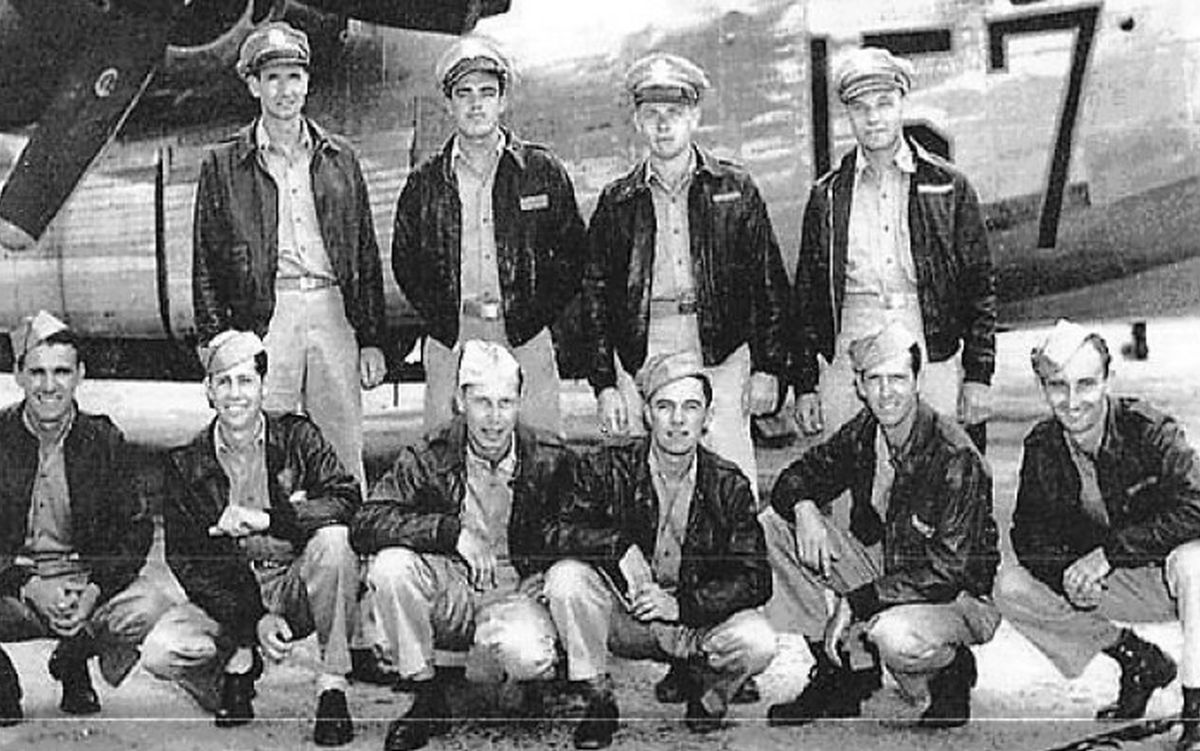
15th Air Force, 485th Bombardment Group, 829th Squadron – crew of pilot Richard Hegman
The positions of each individual in this photo have not been determined, but the crew consisted of: Richard Hegman (pilot), Bryson Watts (co-pilot), Edgar Christian, Joe Hackler, Walter Stone, Thomas White, Joseph Kalen, Dale Morrison, Edward Oliveira, and Cecil Smith. Christian was not on the mission and was replaced by Marvin Viner, who was killed, as were Hegman, Watts, Kalen, Smith, Stone, and White. Everett Latham, also flew with this crew and was killed.
In the second B-24 Liberator bomber piloted by Second Lieutenant James Cameron, the crew consisted of co-pilot Alexander Vrobleski, navigator Second Lieutenant William Mix Jr., bombardier Second Lieutenant William Maclin, engineer/machine gunner in the fuselage Staff Sergeant Robert Burling, radio operator Corporal Homer Jones, machine gunner in the upper turret Staff Sergeant Wilson Leon, machine gunner in the tail turret Corporal Reginald Lyons, machine gunner in the nose turret Corporal Orville Kingsberg, and machine gunner in the circular turret Corporal Edward Chakoci. Staff Sergeant Burling flew as a replacement for James Dixon, the engineer who was a permanent member of Cameron’s crew. All crew members managed to escape before the plane exploded, and all survived the crash landing.
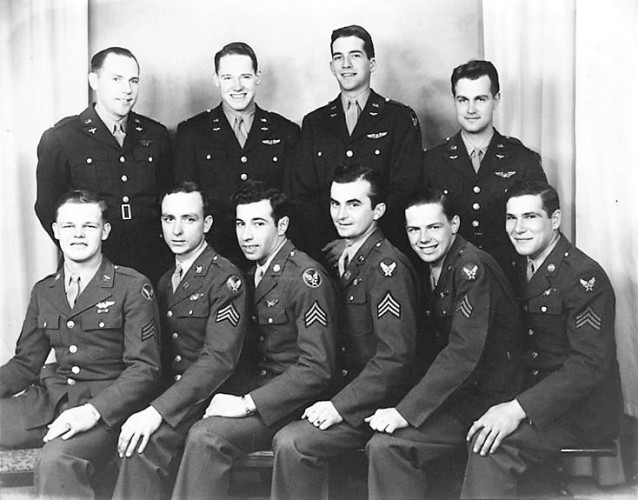
15th Air Force, 485th Bombardment Group, 829th Squadron – crew of pilot James Cameron
Front row, left to right: Wilson Leon, Homer Jones, Orville Kingsberg, Edward Chakoci, Reginald Lyons, and James Dixon, whom Robert Burling replaced on this mission. Back row, left to right: James Cameron (pilot), Alex Vrobleski (co-pilot), William Maclin, and William Mix
Pilot, Second Lieutenant Cameron, managed to avoid German capture because immediately after landing he managed to hide. Later, he made contact with the Greek resistance movement and with their help managed to return to Italy. The Germans, however, captured the remaining nine members of his crew, as well as two surviving members of Hegman’s plane, namely Lieutenant Hackler and Staff Sergeant Morrison.
Transport of captured airmen to Berlin
After being captured, the American airmen were transferred to a prison located in the German barracks in Lagadas near Thessaloniki. At least two of them were given medical attention in a military hospital because they had suffered burns during the plane explosion that needed urgent treatment.
During their short stay in that prison, the Germans first conducted a detailed search of the clothing the airmen were wearing in search of hidden weapons, maps, compasses, personal documents, and sharp objects, and then they were individually interrogated about the purpose of their mission. Based on the testimony of the airmen given to American authorities upon their return to the United States, apart from their names, ranks, and serial numbers, none of them gave the Germans any other valuable information.
Two days after their stay in the prison in Lagadas, the German High Command requested that the American airmen be urgently transferred to Berlin. The transport of these prisoners of war coincided with the beginning of the mass withdrawal of the German Army Group E from Greece through Yugoslavia. The planned main withdrawal route was the railway line that went through the Vardar-Morava valley from Thessaloniki via Skopje and further to Vranje, Leskovac, and Niš all the way to Belgrade. As part of Operation Ratwick, in early September, this strategic direction was cut by Allied bombing of the railway line and bridges near Leskovac, so the withdrawal of German forces and prisoners was redirected from Skopje through Kosovo.
American prisoners of war traveled in military transport wagons together with an unknown number of British, Russian, Italian, and Bulgarian prisoners. During the journey, they stopped several times due to interruptions in the railway line, or due to the German army’s need for wagons in which they were traveling. During the journey, they often went hungry as they were not provided with a regular supply of food.
In late October or early November 1944, this group of prisoners of war arrived in Kosovska Mitrovica, where they were imprisoned in a temporary prison made in a nearby school building. In those days, the Allies destroyed the railway bridges in the Ibar valley, so it was not possible to continue by train towards Kraljevo. Therefore, it was necessary to continue the journey on foot via the Rogozna mountain to Novi Pazar, and then further to Sjenica and Užice, where the German Army Group E later withdrew.
FIND OUT MORE:
Liberation of Americans near the village of Banjska
Throughout World War II, the Second Kosovo Corps of the Yugoslav Army in the Homeland, commanded by Major Živojin (Žika) Marković, operated in the area of Rogozna Mountain. The corps was composed of former soldiers of the Yugoslav Royal Army who managed to avoid German captivity after the capitulation of Yugoslavia in April 1941, as well as local Serbs from the surrounding areas, primarily from Ibarski Kolašin (Zubin Potok), Leposavić, Zvečan, Kosovska Mitrovica, Istok, and Peć.
A column of several dozen German soldiers, about 30-35 prisoners of war, and 60-70 horse-drawn carts with various loads set off from Kosovska Mitrovica towards Novi Pazar on November 5, 1944. After two days of walking, the column spent the night in the village of Banjska below the medieval monastery of the same name. Shortly after arriving in Banjska, local villagers informed Major Marković about a large German column with prisoners of war. Immediately upon receiving this information, Major Marković began preparations for the liberation of the prisoners.
In the early morning hours of November 8, 1944, the German column set off from Banjska towards Novi Pazar. At the beginning of the column was a German scout on a motorcycle, who would go a few hundred meters ahead of the others and then wait for the rest of the column to catch up with him.
An ambush was set up a few kilometers from Banjska towards Rudine. Major Marković gave orders that no one should fire until the entire German column entered the kilometer-long ambush set up by his fighters on both sides of the road. He also ordered that strict care be taken not to injure the prisoners of war during the attack on the Germans.
When the entire column entered the ambush, Major Marković stepped in front of the Germans and demanded their unconditional surrender. Since the Germans did not want to listen to Marković’s request, he gave the order to his fighters to attack, and a rifle barrage began from both sides of the road.
The Germans were completely surrounded and could not avoid certain death. One of them thought that they had been attacked by partisans so he asked for mercy, claiming that he was a German communist. Known for his great hatred of communists, upon hearing the pleas of the German soldier, Major Marković ordered “shoot him twice”. That German soldier was the only one buried by Marković’s fighters at the site that is still known today as “The Germans’ Grave”, while the bodies of the other killed German soldiers were simply piled up.
In this action on Rogozna, the fighters of in this action on Rogozna, the fighters of Major Marković’s Second Kosovo Corps managed to free all eleven American airmen, as well as at least three British officers, several dozen Russians (among them was at least one pilot), Italians, and Bulgarians. None of them were injured during the action. Among the British was John Alan Patrick Lodwick, a special operations officer who later became one of the most prominent British writers of war novels. In his book “Twenty East of Greenwich”, Lodwick described his liberation from German captivity by Yugoslav royalists at the end of the war in Yugoslavia.
The airmen return home
After their liberation on Rogozna, the American airmen and British officers were taken to the village of Popovce near Leposavić, where Major Marković’s main headquarters was located. They were cared for by local Serbs who fed them and ensured their safety. Until the end of November, intense fighting took place on Rogozna with members of the German Army Group E who were withdrawing through the area. In those days, the Allies also bombed Kosovska Mitrovica daily, and all other settlements in the Ibar Valley, so it was safer for the airmen to stay in Popovce than to travel home.
After the departure of the Germans from this area, Major Marković escorted the American airmen and British officers to Leposavić on November 24, 1944, where Bulgarian troops were stationed. British officer John Lodwick later wrote that Major Marković gave them two hundred thousand dinars to have at their disposal during their journey home. From Leposavić, this group of Allied soldiers first arrived in Niš, and then in Sofia, where they arrived on December 4, 1944.
In Sofia, the American airmen stayed at the American College for several weeks to wait for transport to Bari, Italy, where they arrived on Catholic Christmas, December 24, 1944. This group of 11 American airmen, who were liberated by Serbs from northern Kosovo, ended their war adventure on January 5, 1945, when they returned home to the United States.
This text is based on long-term research of historical facts related to the liberation of American pilots from German captivity near the village of Banjska on November 8, 1944. The research used archival materials of the 15th Air Force, 485th Bombardment Group of the United States, statements from rescued airmen and British officer John Lodwick, as well as memoirs of fighters of the Second Kosovo Corps of the Yugoslav Army in the Homeland. The text is published on November 8, 2023, 79 years after the liberation of the American airmen.
SIMILAR TOPICS:
Source: Kosovo Onlajn
Photo: Sajt 485. Bombarderske grupe