




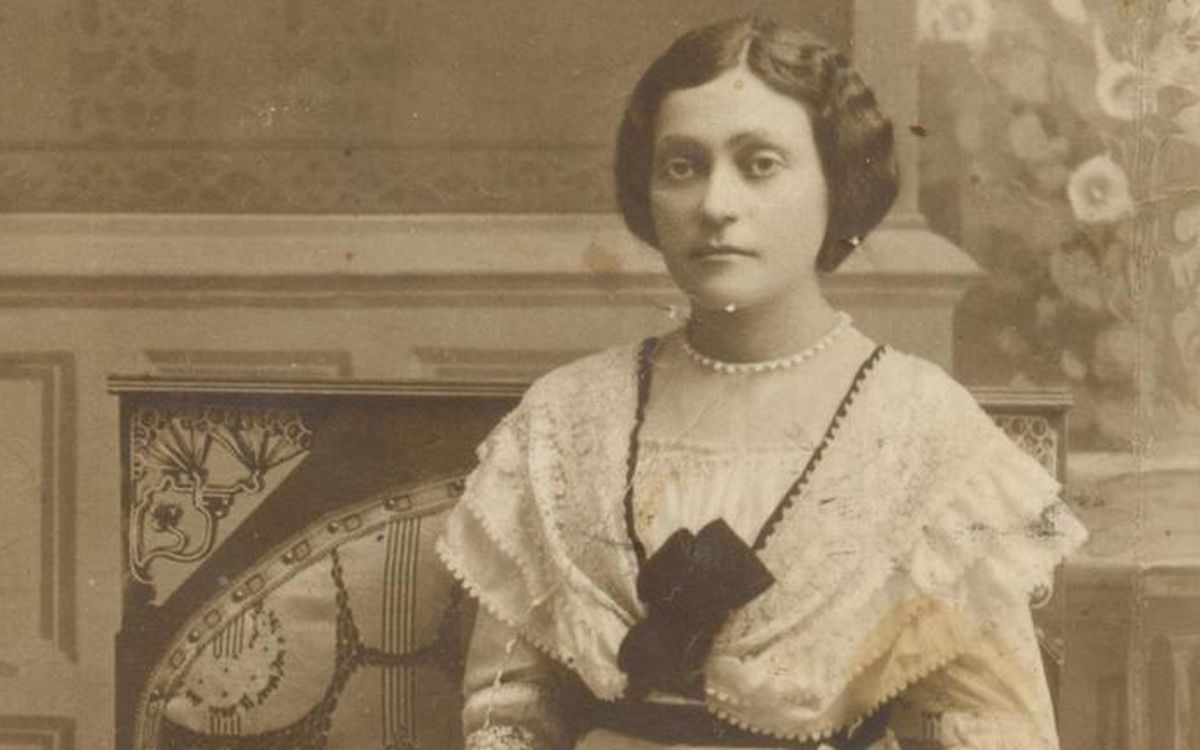
Writer, essayist, translator, and critic – Isidora Sekulić was all of these. She was distinguished by her intelligence and modesty, considering solitude and work essential for human development. Her works are marked by “profound thoughtfulness and mature literary expression.”
Isidora was born on February 16, 1877, in the village of Mošorin near Titel and died on April 5, 1958, in Belgrade. She lost her mother Ljubica early, leaving her father Danilo to care for her and her brothers Predrag and Dmitrije alone.
She attended the “Higher Girls’ School” in Novi Sad and also studied in Sombor, excelling in literature and languages, but also in natural sciences.
Her peers often teased her for this, which Isidora later recorded:
“In my school satchel, coming home, I found mocking messages, caricatures of myself, all implying that I buried my nose in books and acted important. I did not bury my nose in books, but those around me attributed importance to me that I never gave myself. On the contrary, I withdrew into myself and sought the back rows, the darkest corners. I felt that I was a nuisance, that my desire for knowledge provoked others.”
She graduated in mathematics and natural sciences in 1892 from the Pedagogical School in Budapest.
In 1900, she lost both her father and brother Dmitrije. She often visited the Orthodox cemetery in Zemun where they were buried, spending long hours there.
Gravedigger Nikola began sharing life stories of the deceased with her, which Isidora transcribed and later turned into her greatest novel, Chronicle of a Provincial Cemetery.
This novel is a collection of seven stories, the most famous being Lady Nola, a strong female character rare in Serbian literature after the heroines of Bora Stanković.
Isidora did not hesitate to infuse her female characters with courage, pride, and determination. Her first work was the short story collection Companions in 1913.

A Polyglot and World Traveler
She was a world traveler, visiting England, France, Sweden, Germany, Italy, and Norway. In Norway, she found peace, enjoying the forests and fjords, and wrote the travelogue Letters from Norway in 1914.
There, she met Dr. Emil Stremicki, whom she married, but he passed away the same year, shortly after their wedding. Isidora never remarried or had children.
The losses she endured deeply affected her, leading her to rarely form close relationships and become seemingly cold and reserved.
Writers Dragutin Stefanović and Vukašin Stanisavljević described her works as highly personal and subjective, with strong, intellectual prose characterized by deep thought, psychological introspection, and mature literary expression.
She believed that solitude, silence, and work were crucial for spiritual development, attributing these qualities to men due to her upbringing by her father, which shaped her character and creative work.
A polyglot, she earned her doctorate in Germany in 1922. Before that, she taught mathematics and later French literature in Pančevo, Šabac, and Belgrade.
Her work was often disrupted by health problems, as she suffered from tuberculosis. She lived modestly, considered afternoon rest a waste of time, and was uninterested in gossip common among other women.
Known for her exceptional intelligence, she was also very modest and empathetic.

A Woman of Knowledge and Member of SANU
She was a member of various associations and often hosted gatherings in her apartment where guests discussed literature and art.
Her works explored the human condition, thoughts, and motives for existence, introducing new themes to Serbian literature. She wrote novels, short stories, travelogues, essays, and critiques.
Considered the most educated Serbian woman of her time, she became a correspondent member of the Serbian Royal Academy of Sciences in 1939 and the first female member of the Serbian Academy of Sciences and Arts in 1950. In 1993, the Academy included her in the list of the 100 most significant Serbs.
Her literary talent shone in works like The Deacon of the Church of the Holy Virgin, Records, and Peace and Restlessness. Her patriotism, of which she was not ashamed, was evident in Records of My People, while Analytical Moments and Themes, Speech and Language: A Cultural Review of the Nation, and A Book of Deep Devotion to Njegoš represent the pinnacle of her essayistic and critical work.

Near the end of her life, she wrote:
“The noise raised around me deeply disturbed me. I asked some acquaintances, young people, to tone down any mention of me they might see, but look what they did. They invited me to an evening dedicated to me, but I declined, saying I was ill. Everyone wanted to ‘check me off the list.’ They said: she’s 80 years old, she’ll die soon, let’s write something and move on. That’s terribly insulting. I love silence, and that noise around me shook me deeply. If I am worth anything, let them say so after my death, but not even two days before I die do I want to be praised.”
She died on April 5, 1958, in Belgrade and was buried in Topčider Cemetery, in peace, as per her wish – without pomp.
An elementary school in Savski Venac, Belgrade, and a high school in Novi Sad bear her name.
READ MORE:
The Isidora Sekulić literary award has been presented by the Savski Venac municipality since 1968, and Sekulić left her personal library to the Svetozar Marković University Library, where her memorial room is also located.
In addition to her library, she left behind a collection of manuscripts, 21 artworks, her study furniture with a typewriter, and personal belongings.
MORE TOPICS:
SERB (88) KILLS HIS WIFE IN FLORIDA: Suspect tried to disguise death as suicide! (VIDEO)
Source: Danas Foto: Wikipedia
 Add Serbian Times as your Google source