



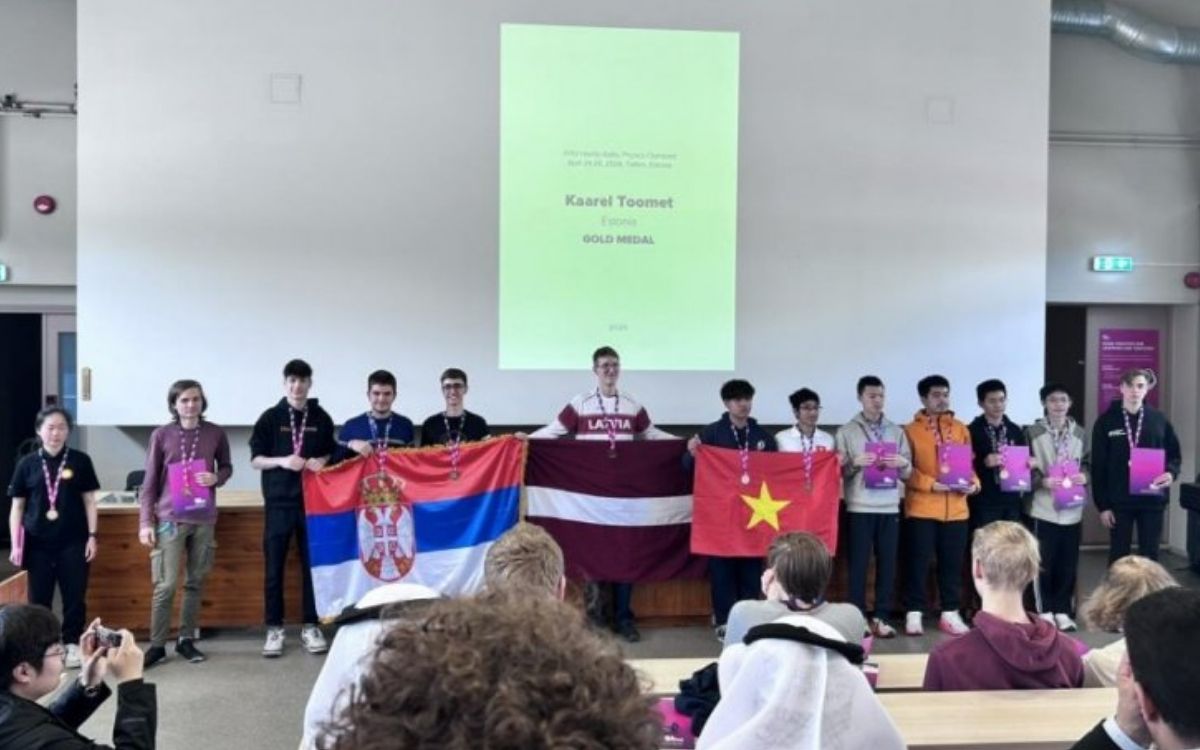
In Estonia, at the Nordic-Baltic Physics Olympiad, students of the Mathematical Grammar School won five medals – four gold and one silver, as well as the title of the best team, achieving the greatest success in the school’s history at this prestigious competition.
Gold medals went to Andrej Drobnjaković, Luka Smiljanić, Nikola Kočović, and Stefan Sekulić Derdovski, while the silver medal was won by Jovan Kulezić. The team was led by Professor Branislav Cvetković, and Serbia, sharing first place with the team from China, once again confirmed that it is at the very top of the world scientific scene.
It was not just another knowledge olympiad, but a moment in which young physicists wrote a success story that surpasses the boundaries of classrooms, competitions, and expectations. Although she knew they would return to Serbia with medals, Mirjana Katić, director of the Mathematical Grammar School, points out that the success they achieved exceeded even her expectations.
-They are truly great, this is their second major success this year – Katić emphasizes. – At the international team competition in Prague in February, Andrej, Luka, Nikola, and Jovan won first place as a team in competition with more than 300 teams from 15 countries. New challenges lie ahead for these young people. Andrej, Luka, and Jovan will represent Serbia at the International Physics Olympiad. Competitions in astronomy and chemistry also await them. Their energy and dedication inspire great confidence.
Behind these results stand not only hours of study, but also the ability to think differently. Andrej Drobnjaković, who was also on the winning podium last year, speaks about this. Unfortunately, he is soon ending his golden streak, as he is becoming a freshman at the famous MIT in the USA.
-The Nordic-Baltic Physics Olympiad is known for its harder problems and more closely resembles Asian or International Olympiads. The problems are solved over two days, and the test consists of four theoretical and one experimental question each – Andrej explains. – We have five hours for solving, which is little, considering the difficulty of the tasks. Almost no one manages to do all the tasks and win the maximum number of points. It is often about theoretical experiments; you have data that you must analyze and draw conclusions from, like a real scientist.
The biggest challenge, as they say, is not just knowledge because the problems are not “based on formulas.” Often, a completely new physical phenomenon must first be understood, and only then mathematically described. This requires patience and deep concentration. Although he was in the “dream team” in Prague, Nikola Kočović won his first gold in Estonia as an individual.
-I am very satisfied with our success, we represented the school and the country worthily – Nikola shared his impressions. – The tasks were interesting and beautiful with elegant solutions. I am very glad that I solved them. Otherwise, the organization was at a top level, and Tallinn is a beautiful city.
For Luka Smiljanić as well, this is one of the greatest competitive successes and his first most brilliant award at international competitions.
-It is a clear indicator of the work and effort I have invested – Luka points out. – My stronger side was theoretical tasks, and the whole competition left an extremely strong impression on me. As a team, we are exceptionally proud because we managed to match the strongest countries in the field of physics. We continue with preparations for upcoming competitions, motivated by this success and with hope for even better results in the future.
Precisely that ability to understand and master the unknown makes the difference between the good and the exceptional, and the young physicists showed that they belong to the latter group. However, what cannot be learned from books is a passion for science, and precisely that is felt in each of their results. These young people, who spend hours thinking about problems, do not give up when it is hard, and see an opportunity in a challenge. Their success is a story of a generation that shows that Serbia has the knowledge, potential, and talents ready to push the boundaries. And when such children grow up, even the top of the world does not seem far away, but like a completely natural place where we expect them again.
Wherever they go, they only collect medals
The Nordic-Baltic Physics Olympiad, held from April 24 to 26 at the Tallinn University of Technology, gathers countries like Estonia, Finland, Sweden, and Latvia, while Serbia participates as a guest.
Our country ranks exceptionally high in this competition and often matches or even surpasses the permanent participants, and students constantly win gold medals and have been absolute winners multiple times. Last year, they won two gold, one silver, and one bronze medal. In addition to Serbia, guest countries this year were Brazil, Georgia, Saudi Arabia, Lithuania, Vietnam, China, Norway, and Cyprus.
MORE TOPICS:
Source: Novosti; Photo: Privatna arhiva
 Add Serbian Times as your Google source