




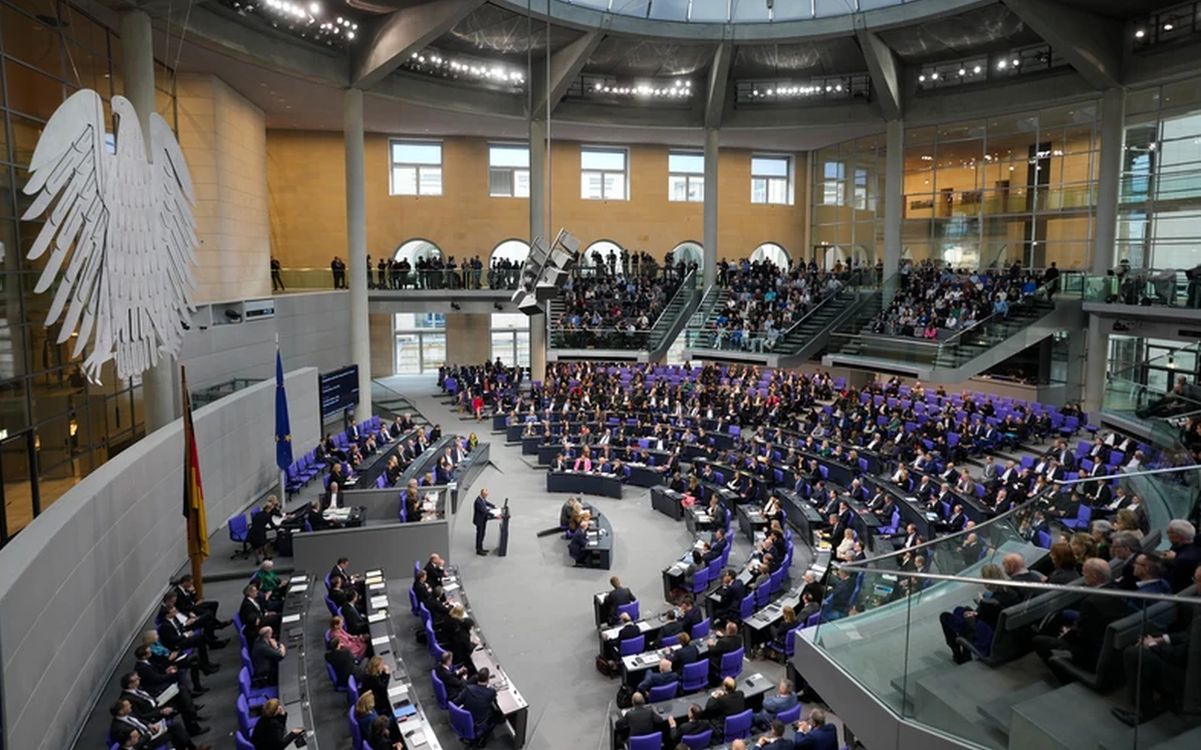
The German Parliament yesterday approved a restrictive proposal on migration and asylum put forward by the opposition Christian Democrats (CDU/CSU), despite strong opposition from Chancellor Olaf Scholz.
The proposal was adopted with the help of votes from the far-right Alternative for Germany (AfD), with 348 MPs voting in favor, 345 against, and 10 abstentions.
Although the proposal is not legally binding for the government, it will increase pressure to take action on migration, according to the Guardian. The vote also signals to opposition leader Friedrich Merz that a parliamentary majority could force the government to accept stricter policies in this area.
The proposal consists of five key points, calling for the reintroduction of permanent border controls, blocking all attempts of illegal entry into Germany, and effectively banning individuals without valid documents—even those seeking asylum.
The decision prioritizes arrests and deportations of those legally required to leave the country, allocates more resources for migration enforcement at the state level, and tightens residency restrictions for individuals awaiting deportation.
Early parliamentary elections in Germany are scheduled for February 23, following Scholz’s loss of a confidence vote in December.
MORE TOPICS:
Scholz Criticizes Merz, Traditional Coalition in Jeopardy
German Chancellor Olaf Scholz, a center-left politician, has cast doubt on the revival of a traditional coalition after declaring that he no longer trusts Friedrich Merz, leader of the conservative CDU/CSU, reports Politico.
His statement followed the Bundestag’s narrow approval of the non-binding migration measure proposed by the Christian Democrats, which allows asylum seekers to be turned away at the border.
Scholz condemned the move as a historic violation of a political taboo, arguing that the long-standing consensus against cooperating with the far right has been broken.
“Merz repeatedly assured that this would not happen. That’s why I can no longer trust him, even though I did just a week ago,” Scholz stated.
According to Politico, this marks the first time that the CDU has successfully pushed through a measure with AfD support, despite Merz’s prior promises to distance himself from the far right.
Scholz accused the CDU of knowingly accepting AfD backing to pass their migration policy in parliament.
For years, Germany’s mainstream parties have maintained a strict stance against cooperation with the far right, refusing coalitions or collaboration at any level. However, with AfD’s rising popularity and electoral victories at the local level, fractures in this position are beginning to appear, Politico notes.
Merz’s conservative CDU currently leads national polls and is considered the main contender to form a government after the February 23 election.
However, since no party is expected to secure an absolute majority, a CDU-SPD coalition—last seen under Chancellor Angela Merkel (2013-2021)—was considered a potential path to political stability.
Scholz’s harsh rhetoric now signals that such a coalition may not be possible.
“My goal now is to prevent at all costs a CDU-AfD majority,” he declared.
If Scholz remains firm on this stance, Germany could face a prolonged political deadlock lasting weeks or even months, Politico concludes.
READ MORE:
A MAJOR VICTORY FOR TRUMP: Google Maps Renames Gulf of Mexico to Gulf of America!
TUCKER CARLSON SHOCKS EVERYONE: America tried to assassinate Putin during Biden administration!
Source: Blic, Foto: Markus Schreiber / AP
 Add Serbian Times as your Google source