




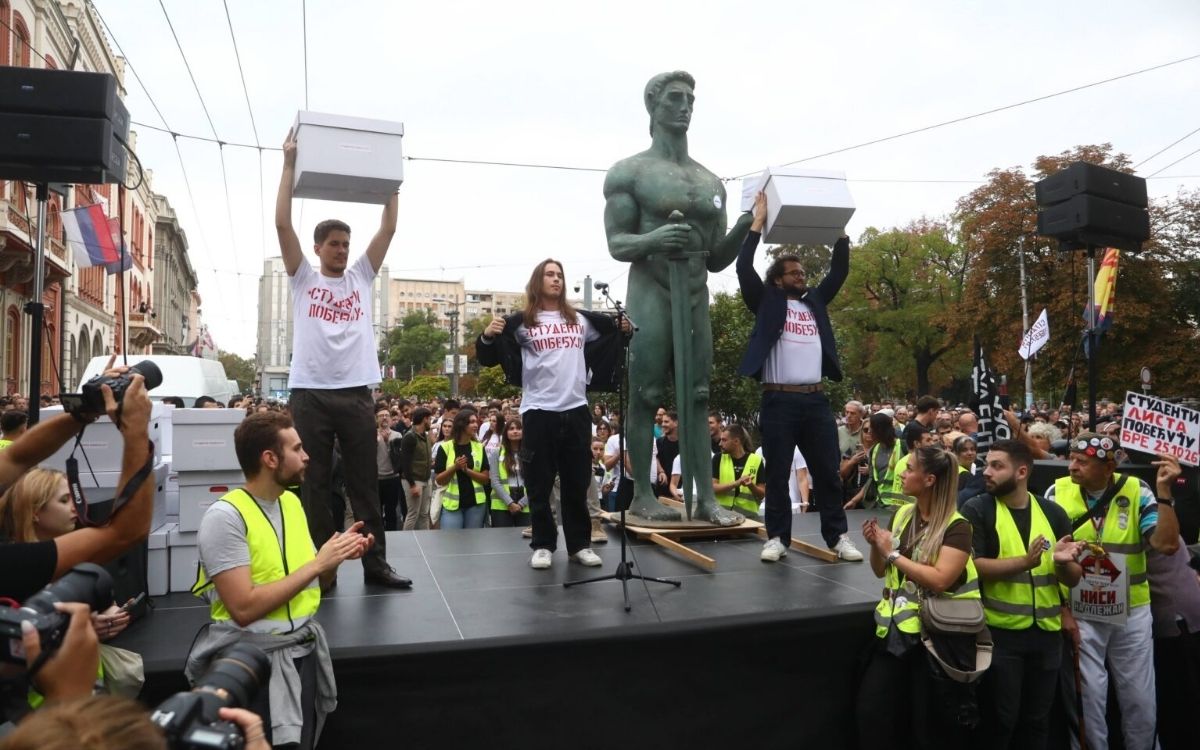
The topic of Radio Free Europe’s Most program was the media landscape in Serbia ahead of the October 25 elections. The guests were Aleksandra Krstić, a professor at the Faculty of Political Sciences in Belgrade, and Željko Bodrožić, president of the Independent Journalists’ Association of Serbia.
Omer Karabeg: How are the media in Serbia behaving ahead of the elections? How much coverage do candidates from the ruling party receive, and how much do candidates from the student movement and the opposition receive? Are there rules governing this?
Aleksandra Krstić: Rules do exist. The Law on Electronic Media and other media laws stipulate that candidates and electoral lists must be given equal treatment across all media outlets, especially on television channels with national coverage.
However, what we have been witnessing in recent months—and not just in recent months, but over the past decade or so—is the closure of national television channels to all opinions that criticize the regime.
And I have not even mentioned the fact that representatives of the Student List, as a new political actor on our scene, are being completely ignored both by the public broadcaster and by other television channels with national coverage.
Željko Bodrožić: Radio Television of Serbia and other television channels with national frequencies have so far been entirely at the service of the ruling party, or rather, of Aleksandar Vučić personally, but now there are no limits to this servility.
Vučić’s election campaign has been ongoing constantly, and it intensified particularly over the summer, when the then-president of the country visited villages across Serbia every day, receiving extensive coverage on national television channels.
Vučić accounted for a third of the airtime in RTS news bulletins, while the rest was taken up by officials from his party. The student and opposition lists are nowhere to be seen, and when they do appear, it is in a negative context.
Even that is not enough for the regime. Telekom has included Informer and other tabloid television channels that spread toxic content among terrestrial channels, in violation of the law and a decision by the REM Council. As a result, they can now be watched in every village in Serbia using an ordinary antenna.
Omer Karabeg: During these final days before the elections, we are hearing a barrage of lies from pro-regime media about the student candidates. They have gone so far as to forge documents in an attempt to damage their reputations. Will lying pay off for the ruling party?
Aleksandra Krstić: An aggressive narrative that insults and discredits candidates from the student list dominates the coverage. According to REM regulations and the laws in force, television channels must not engage in any form of discrediting or negative campaigning against any participant in the electoral race.
At the same time, there are series that pro-regime media outlets call documentaries, but which are actually propaganda against the people on the student list.
In these video productions, which are being circulated across various websites, candidates from the student list are called spies and traitors and are linked to criminal groups from Montenegro, Germany and the United Kingdom.
Violence is the main theme of the regime’s campaign.
Omer Karabeg: Is it possible that citizens believe the many lies being spread about student candidates by pro-regime media?
Željko Bodrožić: Unfortunately, it is possible. I live in a village near Kikinda—I stay there when I am not in Belgrade—and I can say that these claims get through to many people because the only television channels available to them are those controlled by the regime, meaning they have no other sources of information.
They often repeat what they hear on those television channels, mentioning various foreign powers. Croatia is mentioned most often as some kind of arch-enemy, while students and the opposition are called Ustaše.
We have reached the point where regime supporters call their fellow citizens Ustaše. This is repeated so many times in pro-regime media that they believe it.
MORE TOPICS:
Source: Danas Foto: Beta / Milan Ilić
 Add Serbian Times as your Google source