




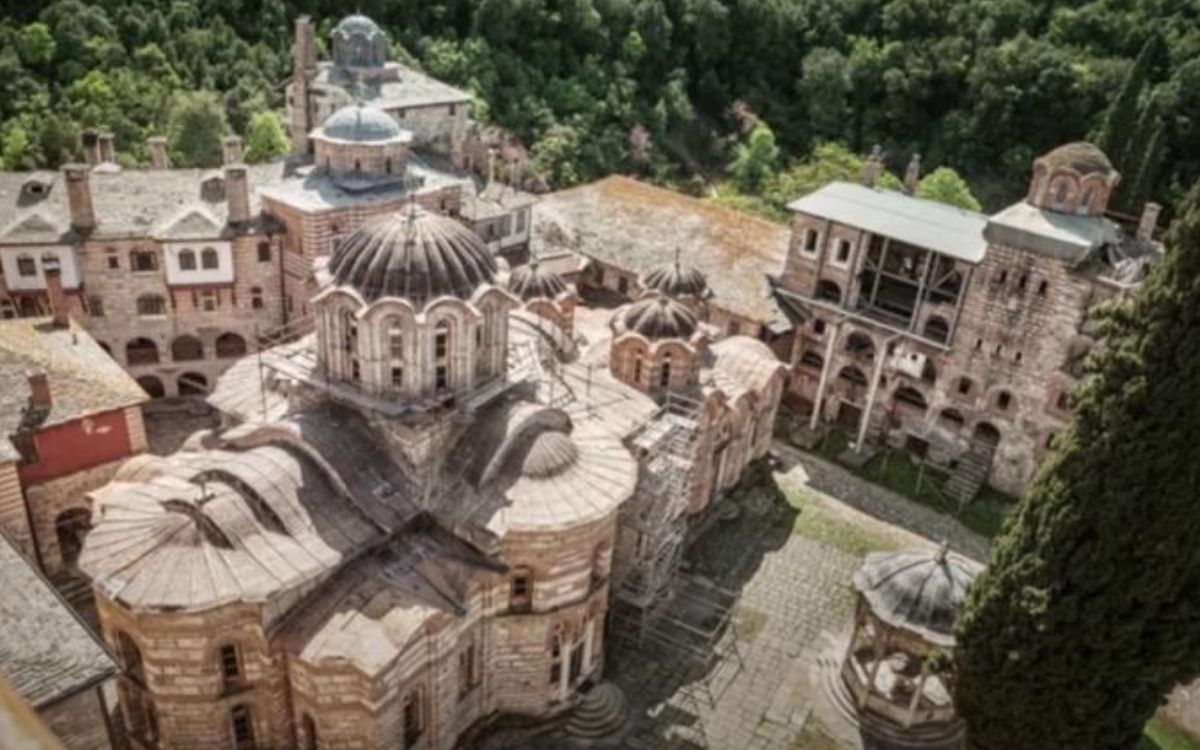
On the occasion of the exhibition dedicated to the 850th anniversary of the birth of Saint Sava, the most significant Serbian relics from the Imperial Lavra of the Hilandar Monastery on Mount Athos, which are related to the life of the first Serbian archbishop, will arrive in Belgrade tomorrow. This is thanks to the engagement of the Patriarch of the Serbian Orthodox Church, Porfirije, and the reputation that the SOC holds in friendly Greece and its most important institutions, the SOC announced today.
As stated, the relics will be welcomed at the “Nikola Tesla” Airport by the Patriarch and the highest representatives of the Serbian state, with church and state honors.
The historical exhibition simply titled “Saint Sava,” organized by the Museum of the Serbian Orthodox Church in the Gallery of the Serbian Academy of Sciences and Arts, will last from May 15th to July 19th.
This will be a completely unique and unrepeatable opportunity for the faithful people to see and venerate the mosaic icon of the Virgin Hodegetria, before which Stefan Nemanja—celebrated in monkhood as Saint Simeon the Myrrh-streaming—fell asleep in the Lord, alongside other precious works of art related to the personality and life of Saint Sava.
The icon is the work of Thessaloniki masters from the end of the 12th century and is the oldest icon preserved in the treasury of the Hilandar Monastery. As Saint Sava himself witnessed in the Life of Saint Simeon, the monk Simeon requested the icon of the Virgin on his deathbed to surrender his spirit to the Lord before it.
Visitors will also be able to see the icon of the Virgin Galaktotrophousa (Milk-giver), the relic from Saint Sava’s cell in Karyes.
According to later tradition, the icon was painted by the Holy Apostle and Evangelist Luke, and Saint Sava received it during his journey to the Holy Land at the Monastery of Saint Sabbas the Sanctified in Jerusalem, along with the staff (paterissa) of Saint Sabbas and the icon of the Virgin Trojeručica (Three-handed), according to the testament of the founder, Saint Sabbas the Sanctified, in the 6th century.
Visitors will be able to see what many consider the most beautiful icon of Christ Pantocrator, a masterpiece of Byzantine painting dated to 1260, as well as the famous 15th-century icon of Saint Sava and Saint Simeon, which iconographic details place in the 15th century.
The exhibition will also feature a replica of the Hilandar Abbot’s staff, a gift from Alexios III Angelos, originating from Constantinople in 1199, made of ebony, jasper, silver, gilding, and other precious and semi-precious stones.
Saint Sava received the Hilandar Abbot’s staff from the Byzantine Emperor Alexios III Angelos during his stay in the imperial capital in 1199, as a symbol of confirmation that the newly founded Serbian monastery and its brotherhood on Athos have the right to independently appoint subsequent, elected elders of the monastery.
For the Hilandar brotherhood, this act was of great significance, since the previous practice on Athos when appointing a new abbot of a monastery involved his departure to the court in Constantinople for confirmation by the emperor himself.
Replica of the Paterissa of Saint Sabbas the Sanctified also at the exhibition
The exhibition will also display a replica of the Paterissa of Saint Sabbas the Sanctified, which Saint Sava received at the Great Lavra of Saint Sabbas the Sanctified during his first pilgrimage to the Holy Land in 1229.
Holy tradition says that before his death, Sabbas the Sanctified designated that his staff—the paterissa—be placed by the iconostasis of the main church of his monastery and prophesied that his namesake, a monk of “imperial lineage,” would come from the West and take his staff.
Visitors at the exhibition will also be able to see the Karyes Typikon—a transcript from the first quarter of the 13th century, a founding act prescribing the rules for fasting and worship at the Cell of Saint Sava the Sanctified in Karyes, as well as a replica of the Icon of the Virgin Trojeručica, the palladium of all Serbian lands, to which the cathedral church in Skopje was once dedicated.
Holy tradition teaches us that it belonged to Saint John of Damascus, whose severed right hand was healed after praying before it.
Saint Sava brought this icon from Damascus, and later it was in the Studenica Monastery for a certain time, from where it miraculously reached Mount Athos and the Hilandar Monastery in 1661.
The icon of the Virgin Trojeručica is located in the nave of the main monastery church in a proskynetarion along the eastern side of the southwestern pillar, next to the abbot’s throne.
MORE TOPICS:
Source: Euronews; Photo: Printscreen Youtube / Srbija Global