




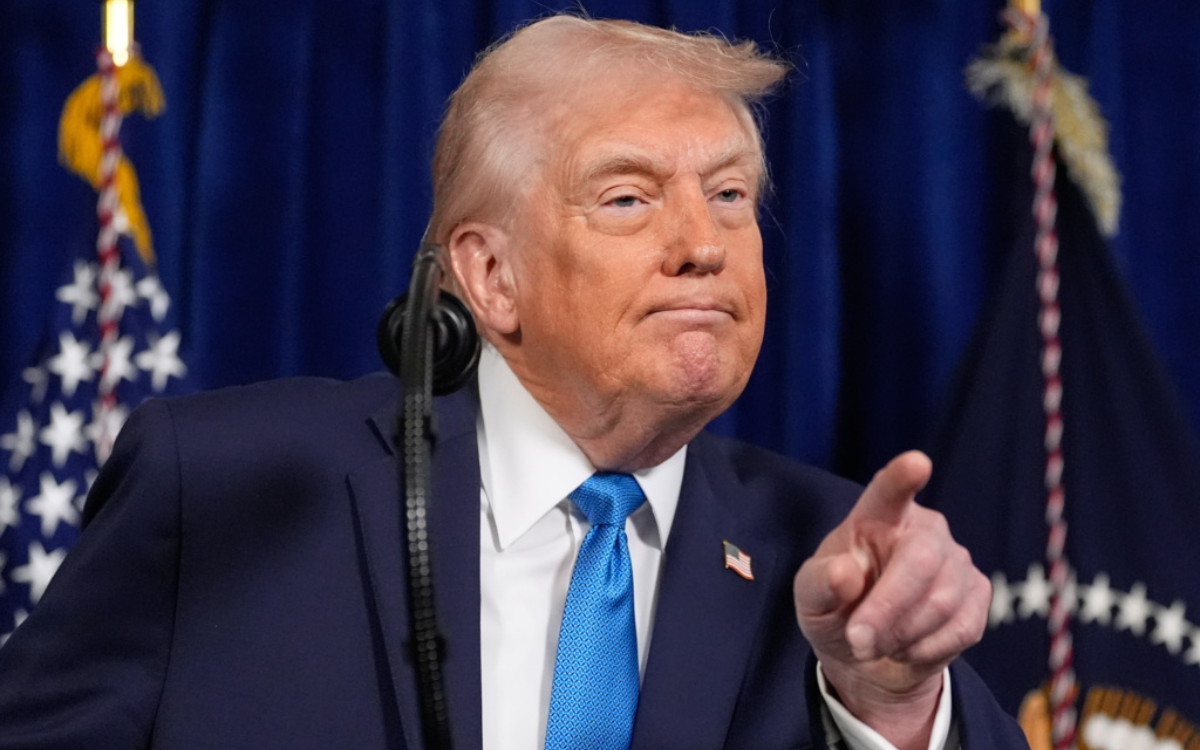
U.S. President Donald Trump is coming on an official visit to Greece to meet with Greek Prime Minister Kyriakos Mitsotakis.
U.S. President Donald Trump plans to officially visit Greece, U.S. Ambassador to Athens Kimberly Ann Guilfoyle said on Sunday, indicating Washington’s growing interest in the southeastern Mediterranean region.
Speaking at the presentation of a new documentary film about U.S. First Lady Melania Trump in Athens, Guilfoyle said she is looking forward to the visit of the American president and his wife.
“I know that the president will come and I truly look forward to the arrival of both of them, including Melania, on a visit to Greece. That would be a huge honor for the country,” Guilfoyle said.
Without dates and details of a regional tour
The ambassador did not specify when the visit might take place, nor whether Trump would also visit other countries of strategic importance to the U.S., such as Israel, Cyprus, or Turkey.
Of political importance for Southeastern Europe
The very announcement carries significant political weight for Southeastern Europe — a region where countries are facing tensions due to maritime disputes, especially between Greece and Turkey, as well as disagreements over energy resources.
Since Trump’s re-election, U.S. companies have increased investments in gas and oil exploration in the eastern Mediterranean. Guilfoyle described Greece as a “key player in Europe’s energy future.”
Unlike many U.S. partners in the European Union, Greece agrees with Trump on the need for Europe to import more liquefied natural gas (LNG) from the United States.
Athens strengthens ties with Israel and Cyprus
Meanwhile, Athens has renewed relations with Israel and Cyprus with the aim of strengthening cooperation in defense and energy. This process is being closely monitored in Ankara, where there is concern that this trio could disrupt the regional balance of power.
Thawing of relations between Greece and Turkey
Despite decades-long tensions in the Aegean Sea, there are indications that relations between Greece and Turkey could improve. Last week, the two countries launched high-level political dialogue, which is expected to lead to a meeting between Greek Prime Minister Kyriakos Mitsotakis and Turkish President Recep Tayyip Erdogan in the first half of February.
Dispute over NAVTEX notices
At the same time, Ankara issued long-term NAVTEX notices — maritime safety warnings — informing Athens of maritime activities, such as military exercises, in the area. Greece dismissed such notices as legally insignificant and assessed them as a political move aimed at exerting pressure.
“The Turks are trying to prevent the Mitsotakis–Erdogan meeting,” said Angelos Syrigos, a lawmaker from the ruling New Democracy party.
The American factor changes relations
Growing U.S. interest in the region’s energy potential could shift the balance of power and put pressure on long-standing rivals to find a political solution.
Turkey and a return to the F-35 program
Trump and Erdogan, according to analysts, share a similar view of the regional balance of power, and Turkey, unlike Greece, has joined Trump’s “Committee for Peace” initiative.
A resolution of Turkey’s request to return to the U.S. F-35 fighter jet program, from which Ankara was excluded in 2019 after purchasing the Russian S-400 system, could be on the horizon.
“I believe that these issues related to the F-35 will be resolved in the next four to six months, the relationship between the two presidents is good,” said U.S. Ambassador to Ankara Tom Barrack.
Both Greece and Israel strongly oppose Turkey receiving F-35 aircraft.
Turkey key to U.S. policy toward Syria
Turkey continues to play a central role in U.S. policy toward Syria. Trump has emphasized his close ties with Erdogan and the continuation of security cooperation in northern Syria.
Large parts of northern Syria had long been under the control of Kurdish forces opposed by Ankara, but that balance has recently shifted following offensives backed by Turkey.
MORE TOPICS:
Source: Kurir, Foto: AP