



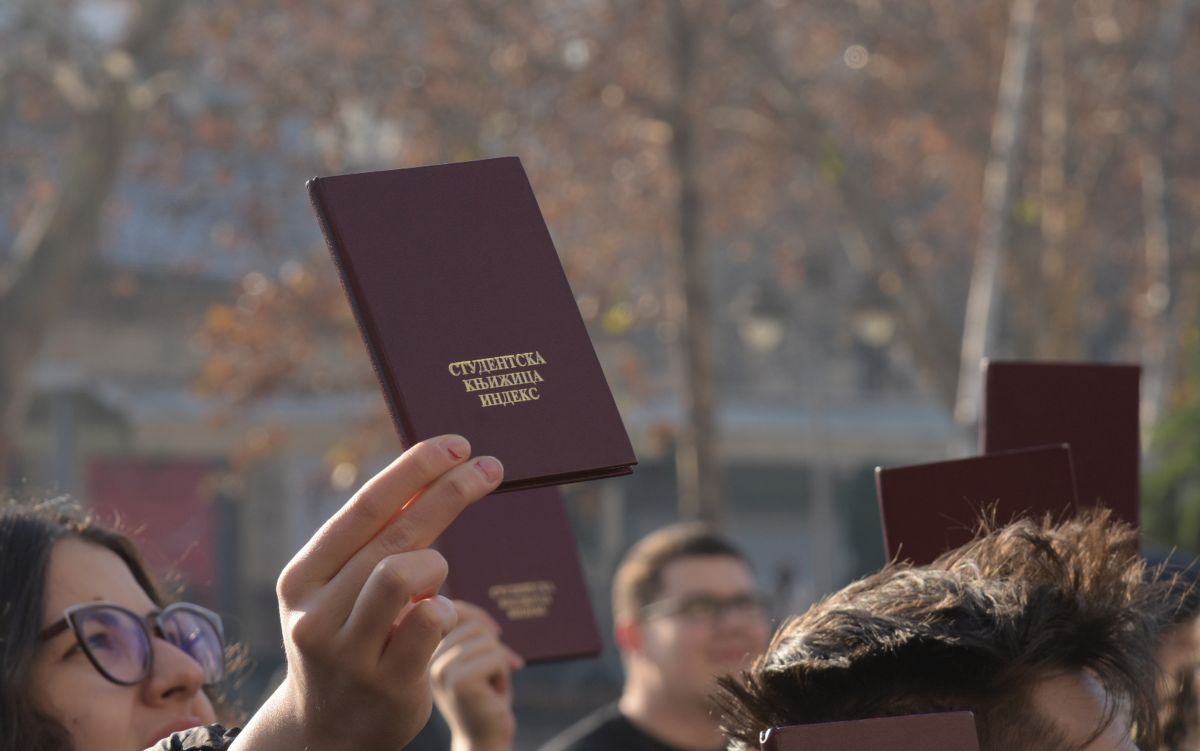
And while the government is prolonging the announcement of snap parliamentary elections – which would potentially calm the current social and political crisis – the student list is almost finished. Therefore, it is necessary to know how it is, after all, formed.
Ever since the students set the current regime a request for the announcement of early parliamentary elections, the question arose of how they will continue the fight for change, which from that moment, inevitably, moved to the political ring.
After all, the young people who started a general civil rebellion in the country at the end of last year, according to many public opinion polls, are considered the most relevant political actors in Serbia.
Simply, the rebellious people respect their words and actions the most. Therefore, their announced list for potential future elections, whether early or regular, will carry the greatest weight.
Precisely because of this, it seems necessary for the public to know how the candidates who will be on the student list were chosen, as well as the decision-making process among the students in the blockade themselves. But, perhaps what the public is most interested in, is when will it be published?
A student of the Faculty of Political Sciences, Aleksa Simić, recently stated for N1 television that the student list is 99 percent finished and that some changes are still possible depending on the agreement.
“There will be no leaders on it, we want to renounce the cult of personality that follows us,” he said.
Taking that into account, Mašina spoke with a student of the Faculty of Philosophy in Belgrade, who speaks on behalf of the plenum of that faculty, about how students from all over Serbia have been creating a list for the elections for months – the so-called student list.
At the beginning of the conversation, the interlocutor of Mašina points out that the main document – according to which the political articulation of the students in the blockade takes place – is the Directive, and that it describes the way of forming the list as well as the way of going to the elections.
As he explains, the candidates on the student list are chosen according to certain mandates for each university. Furthermore, he adds, each city in the blockade determines how it will choose its number of mandates, either through local plenums or a university working group.
“Each candidate is chosen according to the positive and negative criteria defined in the Directive document itself. For example, a candidate must be an adult citizen of the Republic of Serbia over whom parental rights have not been extended, i.e. who has not been completely deprived of legal capacity. Also, each candidate must respect the program of the list. On the other hand, a candidate must not be a student, i.e. someone who enrolled in the academic year 2024/25. or a person whose studies are on hold. It is also important to note that there is also a gender algorithm specially designed to ensure the legal representation of the less present gender on the list,” points out the interlocutor of Mašina.
As he adds, it is also necessary that the candidates have never been members of the ruling coalition, nor officials of the current parliamentary opposition parties.
“Anyone who has been sentenced to a prison sentence longer than one year or has been convicted of an offense prosecuted ex officio for which the prescribed sentence is longer than 3 years cannot be a candidate on the student list. In addition, the candidate must not be any official who would not otherwise be able to be a member of parliament. Also, the criteria state that the list must not include anyone who has been a member of the executive or legislative power on behalf of the current ruling coalition,” explains the student of the Faculty of Philosophy in Belgrade.
As he notes, after the preliminary list is compiled, the veto process follows, during which the plenums can submit evidence and arguments for the exclusion of certain candidates from the list if they do not respect the criteria or it is believed that for any other reason they would violate the integrity of the list and the ideals of the student struggle.
“The deadline for submitting arguments is seven days, with three additional days after the deadline. The deadline for declaring proposals for a veto is seven days. The veto is adopted on the principle of 50 plus one percent of all declared plenums of higher education institutions. It is important to note that there are also so-called urban internal vetoes in Novi Sad, while they do not exist in other cities,” our interlocutor points out.
According to the interlocutor of Mašina, the final list will be anonymous until the announcement of the elections and will be kept in strict secrecy from everyone, including the students themselves. He adds that the highest security measures, both digital and physical, are used so that the list is not leaked to the public.
Ideals of the list
At the level of the movement, this is currently being considered, and the plenum of the Faculty of Philosophy believes that the limitation of the mandate of deputies in the Assembly should be abolished.
“Students in the blockade are convinced that with their almost ten-month activity they have enough experience and ambition to offer a revolutionary program, by the people for the people whose implementation will require a full mandate of the executive and legislative power. Thus, we believe that we will be a definitely new option on the political sky of Serbia and that our ideas will permanently influence future politics in the direction of its greater democracy, transparency and a greater spirit of solidarity,” said the student of Philosophy in Belgrade.
Finally, he points out that the student list should achieve a system restart, so that the conditions for systemic corruption that led to the fall of the canopy in Novi Sad and the thugs who were sent to beat students are never repeated.
“In the long run, it will include a program that represents a significant elaboration of the Social Agreement, the Program Minimum and other student program documents, guided by the principles of our struggle. The spirit of solidarity, togetherness and the desire for the political awakening of the people dominates this program. Its basic principle will be not only the democratization of election results, but also of the entire society by democratizing decision-making in everyday life: in the local community and in the workplace,” the student concludes for Mašina.
MORE TOPICS:
Source: Mašina.rs; Photo: ATA Images
 Add Serbian Times as your Google source