




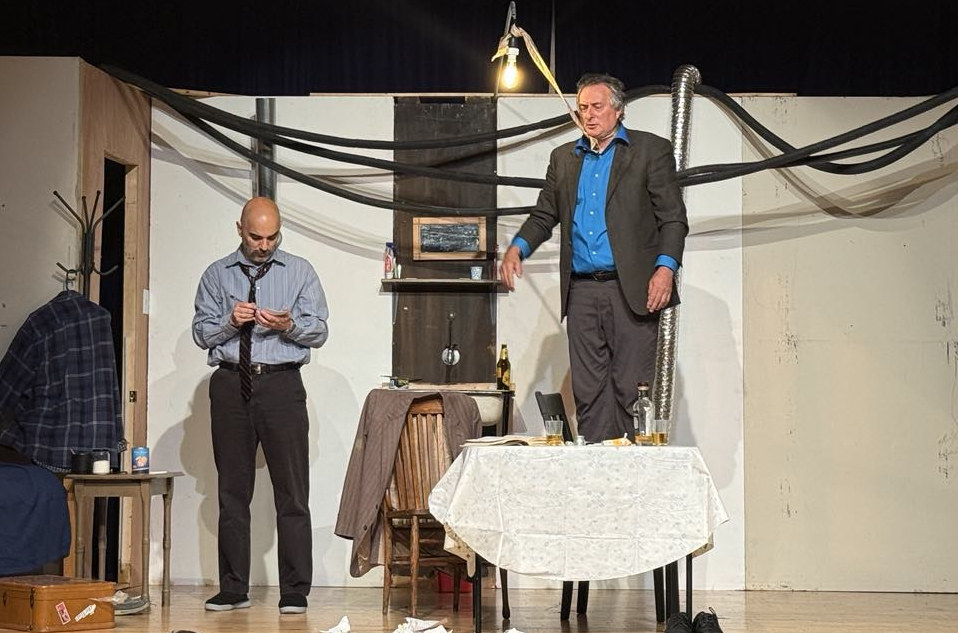
Last night in Chicago, the premiere of the play “The Emigrants” by Polish writer Sławomir Mrożek was held, performed by the Serbian Theater Chicago and adapted by the play’s authors and interpreters of the main characters, Milenko Šišarica and Vlatko Ždrale.
These two enthusiasts decided to bring back to the “boards” a play that this theater performed about 15 years ago. With good reason, it seems.
Because “The Emigrants” are still plagued by the same troubles, and their dilemmas are just as relevant today as they were 15 or 50 years ago, when Mrożek wrote this play (1974).
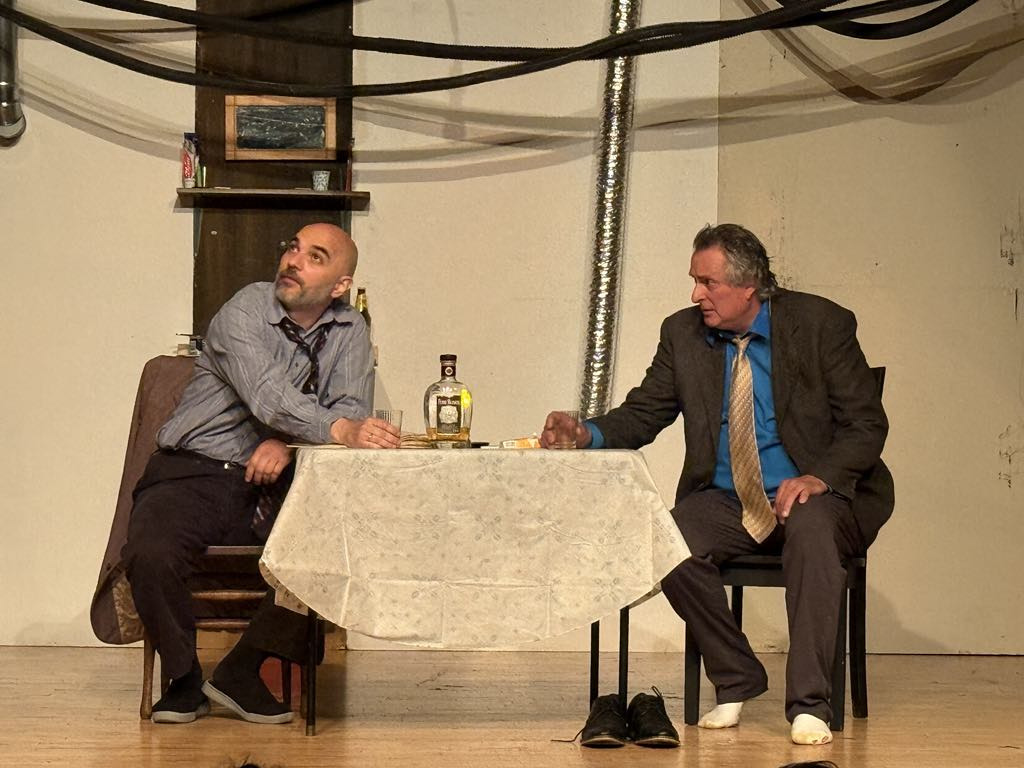
Even today, in Chicago, Berlin, or Paris, you will find characters living in squalid and damp basements, under staircases where their landlords take their dogs for daily walks, in the sewers of civilization, where they dream their dreams, which sometimes resemble nightmares.
Even today, just as among the heroes of this drama, there is a rift between intellectuals and manual laborers, political and economic diaspora, a distrust that further leads to suspicion, malicious joy, and finally to divisions, no matter how indivisible the bread they share may be.
In this situation, the task of the actors and authors of the play, Ždrale and Šišarica, was seemingly easy on one hand, but on the other, they faced a serious and difficult challenge to bring something that is close but also temporally distant closer and adapt it to this age and space. So that they wouldn’t remain mere protagonists.
And they succeeded, as evidenced by the applause with which they were sent off the stage. And it was anything but courteous, which is generally what almost everyone who goes on stage, from Japan to Pakistan, receives.
The audience knew how to reward the fact that these two, in addition to their talent, implemented a lot, but not too much and disgustingly, of their own ideas and quotes into the play, which gave the performance that much-needed injection of life and charm.
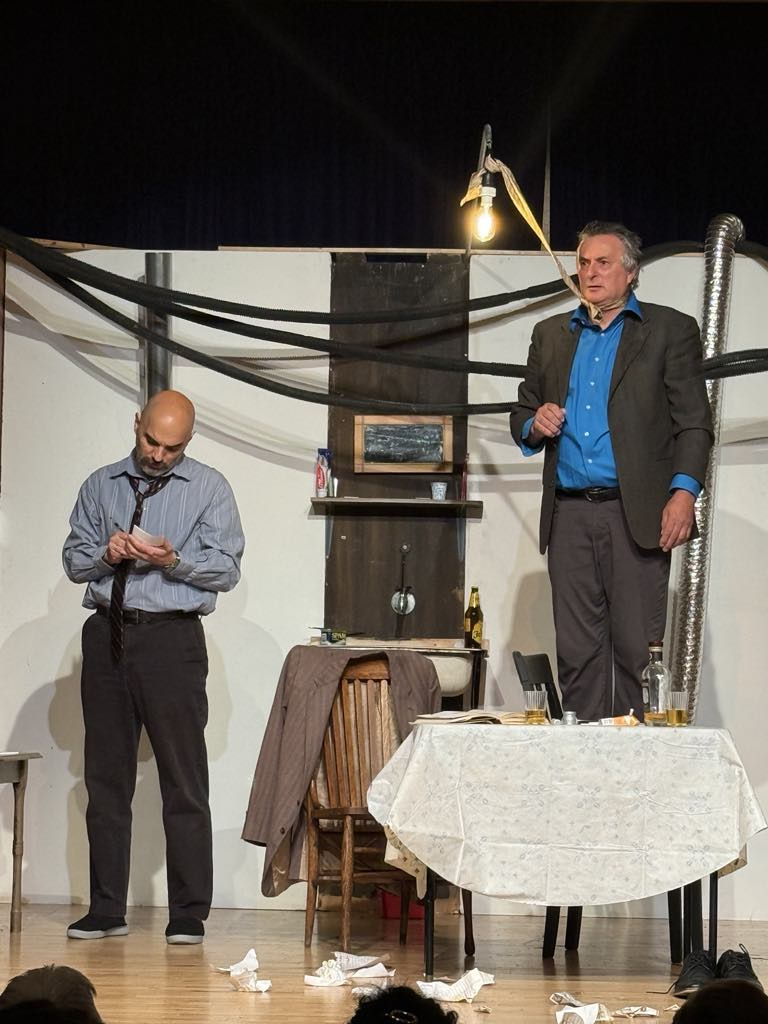
And in my applause, there was also a lot of respect for the extraordinary effort and iron will required to create a play under these immigrant and amateur conditions, in a country like America. A play that, moreover, can stand shoulder to shoulder with the repertoires of professional theaters.
I speak from experience, as I have had the opportunity to write, direct, and act in these parts. It’s beautiful, wonderful, but also extremely strenuous.
But let’s go back to the play…
Perhaps what touched me most in it was that tragicomic moment, especially that feeling of helplessness in which two immigrants, who are certainly more united than divided, use mutual weaknesses to blackmail each other while swimming in the same sewage.
So, at one point, we see a manual laborer threatening an intellectual because of his political status, only for the situation to turn upside down like a sock in the very next moment, as the asylum seeker begins to blackmail the construction worker with the same status.
And while one lives by underestimating the value of material things, the other hoards money in a plush bunny (?), dreaming of returning home. The first can do it, because he is, for heaven’s sake, at stoic heights and has neither a dog nor a cat, while the second cares, because his wife and children are waiting for him at home. A contrast that we often encounter in ordinary life, where each side has a very valid justification, and their reasons and motives are paramount and unquestionable to each.
The strangeness of “The Emigrants” lies precisely in the fact that the entire play is based on antagonisms, but ultimately, when all those minuses are erased, it produces the opposite effect, and the final result is a big PLUS, because our heroes realize that in that distant world, they are, after all, closest to each other, or rather, essential.
Which Ždrale and Šišarica authentically, in their own way, managed to convey to the audience in this duo-drama, which is itself a demanding genre and leaves the actors on stage no respite.
Let it be noted that the two of them, in addition to acting and directing, had additional duties, as one was also the set designer (Šišarica), and the other the designer and author of the poster (Ždrale).
Dalibor Tojagić put a great deal of effort into the music, which accompanies and covers not only the plot but also the deeper meaning of the work, and the lighting and sound were skillfully set and handled by the duo – Stefan Polovina and Vlado Savčić.
Until the next premiere in Chicago…
Author/Photo/Video: Antonije Kovačević
MORE TOPICS:
ĐOKOVIĆ: Wimbledon and US Open are my priority now, I don’t know if I will play other tournaments!
SOUND CANNON CASE: Serbia submitted a response to the United Nations regarding the banned weapon, here’s what it says!
 Add Serbian Times as your Google source