



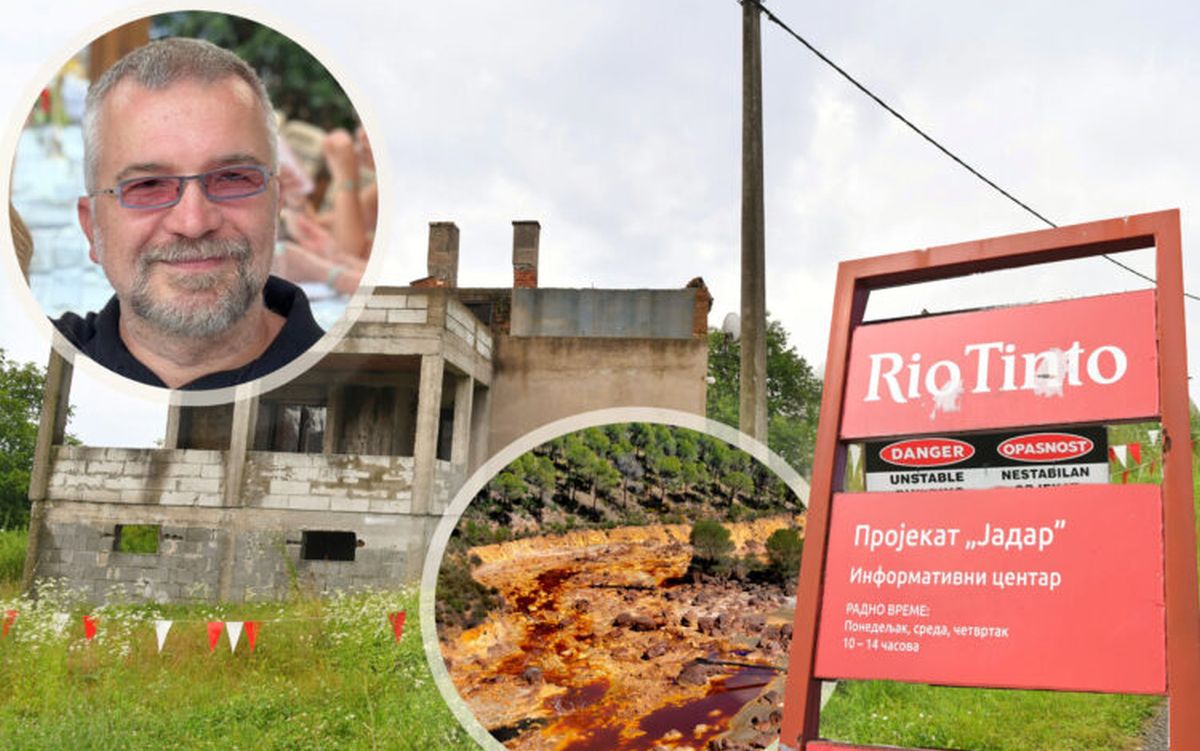
Jovan M. Tadić, a world-renowned scientist, Doctor of Chemistry, and a collaborator at Lawrence Berkeley National Laboratory in the United States, is one of the authors of a scientific study on the consequences of lithium mining in the Jadar Valley. In an interview for Nova.rs, he emphasizes that in order to approve the Jadar project, it is necessary to get “four green lights” in the areas of ecology, economics, politics, and ethics/morality, and we do not have any of them. He also states that those who support the project are paid by Rio Tinto, that they lack scientific credibility, and that he would sue the authorities who are pushing for lithium mining for high treason because their advocacy raises suspicions of non-transparent financial flows.
Our interlocutor, who is also a Doctor of Philosophy, warns of the immeasurable ecological and economic damage that our country will suffer if we allow Rio Tinto to implement the Jadar project, which is advocated by the government and, as he points out by certain scientists without credibility.
“To approve a project of this type, it is necessary to get four green lights. The first is from the field of ecology. This means that the environmental damage is acceptable in relation to the financial gain. Then there’s economics, specifically that the project makes economic sense, regardless of the environmental consequences. Then there is politics and ethics,” says Tadić.
In Serbia, however, all the traffic lights are flashing red.
“As far as ecology is concerned, the Jadar project does not have a green light because mining at that location is, first and foremost, a risk factor for drinking water sources, in an amount that, as Professor Zoran Stevanović recently pointed out, could meet the needs of three Belgrade. Water, in the light of climate change, is becoming an invaluable resource, so the mere thought that we would jeopardize water sources because of the existence of some kind of lithium mine is unacceptable,” emphasizes Tadić, who completed two postdoctoral studies, first at NASA and then at the Carnegie Institution for Global Ecology.
Poor mining rent
However, in addition to environmental destruction, the economic factor, he says, is perhaps even more important.
“In Serbia, the mining rent is 3.5 to 5%, and it is hit ad hoc. Imagine now that there are no environmental factors in this project but that it was analyzed only from the perspective of economics. This means that we would question giving a license for the exploitation of lithium or anything else in order to extract only three percent for mining rent. In Romania and Bulgaria, the rent is 12.5%, in Russia 23, in Norway 28, and in Chile over 40%. Sacrificing a mineral deposit, regardless of the environmental effects for three percent, no sane person would accept. Future generations will live after us, and the economy may change, so why are we in such a hurry to exploit it?” asks this world-renowned scientist.
Politics, however, is the most sensitive terrain.
“As a country, we are under pressure from the European Union, which seeks to be independent of China in terms of lithium sources. We have been waiting 25 years to join that Union, despite everything we have done so far. Kosovo was taken from us, where 65% of our mineral resources remained, and the EU played a role in that, and now they think they have the moral authority to ask us to give them Jadar and the deposits there. I think we don’t owe them anything and that, as a nation, we have no obligation to let them exploit our land,” emphasizes Tadić.
All four “green lights” are problematic.
“The ethical question mentioned in the ‘Journal Science’ report, which was published apropos of our work on the consequences of lithium mining, is that the population of the Jadar Valley is not at all integrated into this process, that they are not properly informed about anything. The question of ‘how much land is worth’ is also questionable, that is, whether we would sell even a piece of our land for any price?” he asks.
FIND OUT MORE:
Questionable sums of money and “quasi” scientists
If we stand in the way of lithium mining in Jadar, the government warns that we will have to pay “billions of euros”.
“The contracts with Rio Tinto have not been made public, and we cannot now comment on whether and how much money they have invested in research in Jadar. These works are not cheap at all, but Rio Tinto did everything at their own risk or on the basis of some contractual rights with the Serbian authorities, about which we know nothing. According to some estimates, they invested about 650 million euros in research, and the government mentions a figure of several billion for compensation, which is all speculation,” says our interlocutor.
He also points out that scientists who support lithium mining are paid and lack scientific credibility.
“Whenever the statements of a part of the expert public, who is in favor of the project, were discussed, the question was raised whether they were people who were involved by Rio Tinto or the Government of Serbia, and thus have a financial or other interest. I, for example, have no financial interest, nor do my colleagues with whom I conducted the study. Everything we have said and published so far is out of personal conviction. Those who accept the project are people who have been paid by Rio Tinto in the past. These so-called experts mostly do not have the scientific credibility to talk about the project. It is enough to go to ‘ResearchGate,’ type in the name of the scientist, and see in the results how many papers he has published, how many times he has been cited, and so on. When you type in the names of people who are advocates of the Jadar project, everything will be clear to you,” explains Tadić.
The problem with lithium mining in Jadar is that there is no similar mine in the world, which is why it is risky to agree to unproven methods of work.
“This would be the first time in the history of the world that lithium is extracted from jadarite, and it is a mineral unique in its composition. People from Rio Tinto were not looking for lithium when they came to Jadar, but boron. Then, they found jadarite and lithium, which suddenly became more interesting. Then, they developed a special technological process for extracting lithium from this mineral, and only in July of this year did they get a patent. However, the patent itself does not provide any guarantees that this process is not harmful,” says Tadić.
Toxic waste as a legacy for future generations
This process of lithium extraction would be used for the first time in Serbia.
“Lithium should be obtained in a unique way in the world, and the question is where they tested this process since nothing like this exists anywhere. We are now supposed to believe that the process will work as they say, to take their word for it. And what if there is an earthquake or a flood? What do we do then? Lithium tailings, or jadarite, that remain after that mine, contain high percentages of lithium, arsenic, and boron. It should be known that boron is an insecticide, which means that we will create a mountain of boron-based insecticides, but also rat poison, based on arsenic. We are creating mountains of toxic tailings, and we are supposed to believe that this landfill, as scientists who advocate the project say, will be a harmless ‘kinder egg,’ which is full of rat poison and insecticides,” emphasizes Tadić.
Quasi-experts promoted by the government, when warned about the dangerous tailings, give counterarguments that are meaningless.
“They claim that all parts of that mining and geological process and procedure are already known and used in other places. My answer to them is that the same was the case in Chornobyl. And there, parts of a certain procedure had already been used,” says the Serbian scientist from Berkeley.
He believes that authorities who encourage people to accept a project that is hazardous to health should be prosecuted.
“As a generation, we should ask ourselves what we are leaving as a legacy to future generations: insecticides, rat poison, and tailings. The knowledge economy is the future, and the story that mining is the future of Serbia is nonsense. I would sue the authorities who reached an agreement with Rio Tinto and who advocated for this project for high treason. All this is unacceptable, and their fight for the project only raises suspicions that some non-transparent financial flows are involved. What the Serbian government is doing is surrealism, which is not found even in satirical magazines,” concludes Jovan M. Tadić.
Let us recall that eight Serbian scientists published a scientific paper, “The impact of exploratory activities of a potential lithium mine on the environment in western Serbia,” in the journal Scientific Reports, which belongs to the Nature group of journals, about the consequences of mining and exploiting lithium and jadarite. They have shown in detail, through scientific evidence, the harmfulness of experimental drilling in Jadar to the environment and human health.
The scientists took soil samples around the boreholes, which Rio Tinto had dug during the exploration of the area, and based on the analyses, drew conclusions about the immeasurable harmfulness of a potential mine. Although Rio Tinto appealed to the scientific journal about the aforementioned paper, the analyses and conclusions of the Serbian scientists were confirmed, and the appeal of this international corporation was rejected.
SIMILAR TOPICS:
Source: Nova.rs
Photo: Goran Srdanov/Nova.rs/Shutterstock/Privatna arhiva