




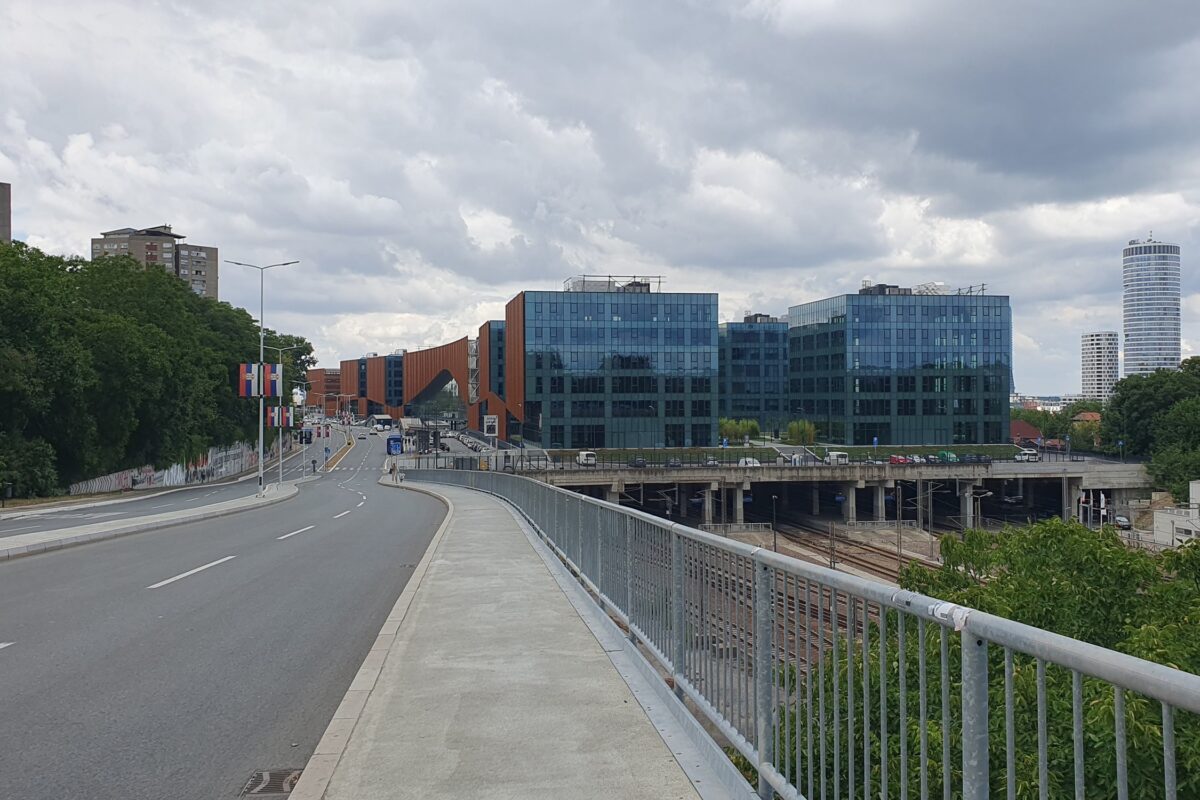
The problem with rebar at Prokop station was known 10 years ago. This is shown by the static calculation of the Traffic Institute CIP from August 2015, which was published yesterday by the editor of the Beobuild website. It was done for the needs of constructing buildings on the slab according to the conceptual design prepared by this institute, which involved the construction of a station building, a shopping center, and a garage.
However, the author of the calculation partially distances himself in the conclusion, stating that in preparing this analysis, “complete insight into the existing condition (details of geometry and reinforcement, first and foremost) was not available.”
“On the contrary, data on the existing condition existed only for a smaller number of characteristic locations in the existing structure. In order to draw a reliable conclusion, a more complete insight into the executed condition in all parts of the structure needs to be carried out,” the calculation states.
Nevertheless, the general conclusion is that there is no problem with the load-bearing capacity of the structure and that parts where a lack of reinforcement was observed can be repaired. Therefore, the assessment is that the Prokop station slab and the pillars beneath it could support the planned structures.
According to CIP’s conceptual design, a station building (in the same place as the current one) was to be built in the middle of the slab. The area from the station building to the end of the slab in the direction of Dedinje, i.e., Partizan stadium, would be occupied by a shopping center. A smaller part of that shopping center would also be built on the other side of the station building (in the direction of Senjak, i.e., the fair). The rest of the area on the slab in the direction of Senjak would be occupied by a garage.
The current station building has only one level because it was built as a covered square. CIP’s station building was supposed to be G+2, meaning it would have a ground floor and two more levels. In the same way, the shopping center was also supposed to have G+2.
Only the garage resembled the current structures. It was conceived on two levels. The first part of the garage would have G+4 (ground floor and four levels), and the second G+5.
The floor height in the shopping center and station building would be six meters, and in the garage three meters. This practically means that the roof of the shopping center and the roof of the higher part of the garage would be at almost the same height (the so-called elevation 123 or practically the height in meters from the lowest point of the building, including parts in the ground).
Another characteristic of these buildings was the planned construction technology. As stated in the document, the floors would be made using Cobiax technology from the Swiss company of the same name. This technology implies that instead of a completely reinforced concrete slab, a slab containing so-called air-filled balls would be made. As stated on the company’s website, one of the advantages of this technology is the lighter weight of the slabs.
And finally, it was envisaged that the roofs of the station building and the garage would be structures of steel and glass (station) or sheet metal (garage) instead of concrete.
What can also be seen is that the pillars of the buildings on the slab were planned to be placed exactly above the pillars supporting the slab, i.e., to be their continuation. And they were planned to have a smaller cross-section.
What CIP’s static calculation reveals is that the slab at Prokop is of different thicknesses. In the central part, and primarily above the platforms, it is 60 cm. The part above the train tracks is solved differently. There is a 25 cm slab, and beneath it are so-called ribs with a height or thickness of the remaining 35 cm. These ribs are at a distance of 91 cm. Such a solution, as can be seen from the document, was applied to reduce the weight of the slab itself.
On the other hand, at the extreme parts of the slab (where trains enter and exit the station), the slab is 80 cm thick. Likewise, its thickness above the tracks in that part is 120 cm (the slab is still 25 cm while the ribs are 95 cm thick). The total cross-section is larger there because the distance between the tracks in those parts is the largest, due to the shape of Prokop station (a gentle semicircle).
And the static calculation shows a lack of reinforcement precisely in these extreme parts of the slab. But, even there, only in certain parts of the structure. And mostly in the upper part of the slab.
And this deficit was noted in relation to the idea of building certain structures on the slab.
Also, one side of the structure was analyzed, while it was assumed that the same problem exists on the other side of the station if it is reinforced in the same way.
In addition to the extreme part of the slab and the beams in that part, the load in the central part of the station was also analyzed. It was shown there that the reinforcement meets the requirements. The load on the beams in the part below the future station building was also analyzed. “The most loaded beam satisfies. A similar conclusion can be drawn for other beams for which data on reinforcement exist,” the document states.
It should be recalled that the planned works on repairing the cracks that appeared at Prokop station are foreseen on plots in the central part of the structure, and not on the extreme parts where CIP’s calculation notes a problem.
What also needs to be kept in mind is that due to the curved shape of Prokop station, the largest distance between the pillars on the platforms is precisely in the central part (up to 21 meters), which may be the reason why cracks appeared there.
Another interesting fact from the CIP document, for those who are not thoroughly familiar with the construction method of the station, is that the Prokop slab is not a single piece of reinforced concrete. In fact, it consists of 13 parts or lamellas, as the author of the calculation calls them. Gaps of 10 centimeters were made between these parts. Below the slab, in these parts, double pillars were made, also with a 10 cm gap, which hold these lamellas. Problems with reinforcement were observed precisely in the extreme lamellas.
Likewise, it can be read that it was envisaged that the buildings on the slab would also have so-called expansion joints, i.e., that they would follow the fact that such expansion joints exist on the slab itself.
The document also describes the method of constructing the foundations of the pillars that support the slab. As can be seen, pairs of pillars on the platforms stand on a single foundation cube. Also, it can be seen that not all pillar foundations are at the same depth, but the differences are not large. And finally, the author also describes that the station structure is supported on limestone rock.
Incidentally, the document shows that reinforcement of various thicknesses was incorporated into the structure. And that the thickness in some places differed depending on whether it was incorporated into the lower or upper part of the slab.
Along with the description of the solution for the buildings on the slab, the static calculation concludes: “Based on the analyzes performed, it can be stated that the new structure with assumed dimensions and materials is sustainable.”
The slabs on the floors of the buildings with new technology (60 cm thick) and pillars with a cross-section of 80cm “satisfy the ultimate limit states of load-bearing capacity.”
“Taking everything into account, it can be concluded that the existing structure at elevation 105 and below satisfies the requirements of the future building on slab 105, provided, of course, that the future structure is not significantly different from the one analyzed,” states the last sentence of the calculation.
MORE TOPICS:
Source: Forbes Srbija, Photo: Forbes Srbjia
 Add Serbian Times as your Google source