




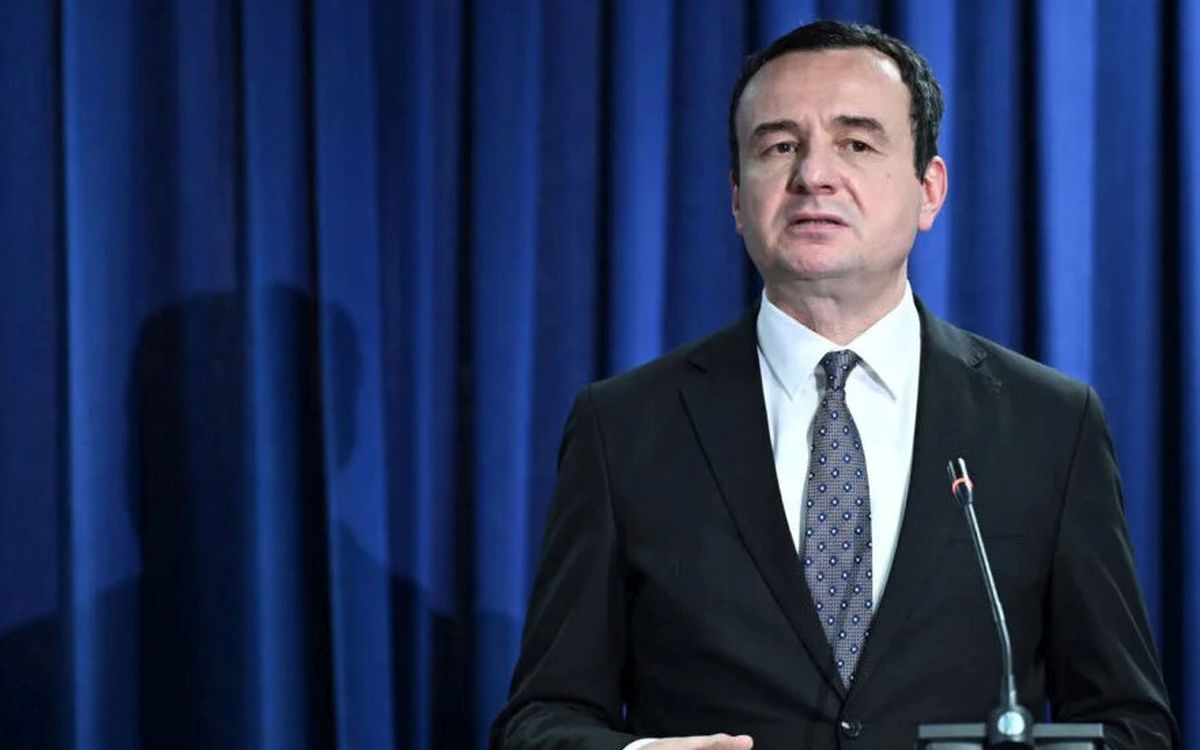
The Assembly of temporary institutions in Pristina did not elect the president of temporary institutions due to a lack of a quorum. The speaker of the parliament stated at midnight that this is the end of the presidential election process.
Based on the decision of the constitutional court, this is the end of the election process for the president and this session of parliament, and elections will be scheduled within the constitutional deadline, said Albulena Haxhiu at the end of the session, at midnight.
The deadline set by the constitutional court in Pristina for the election of the president of temporary institutions expired at midnight, and according to the court’s decision, if the president is not elected, the assembly is automatically dissolved and new elections must be held within 45 days.
Only members of Self-Determination attended the session, while members of opposition parties did not attend, so there was no quorum of 80 members, which, according to the constitution of temporary institutions, is necessary for the election of the president.
The session on the election of the president began on Monday evening, when the members of Self-Determination started the voting procedure for the president, even though there was no quorum because only 64 members were in the hall.
The session was interrupted, and on Tuesday the assembly tried to elect a president four times, but there was no quorum a single time.
Opposition members announced before each continuation of the session that they would not participate in the voting without a prior agreement.
The opposition blames Self-Determination and the president of that party, Albin Kurti, for the failure to elect a president, pointing out that Self-Determination violated the constitution at the session on Monday by starting the voting procedure without a quorum.
On Tuesday, Kurti held two press conferences, at which he again blamed the opposition for the failure to elect a president, stating that they rejected all of Self-Determination’s proposals and did not present their own proposal.
FIND OUT MORE
After the session was postponed three times, he called on the Democratic League of Kosovo (LDK) to submit their 15 signatures for a presidential candidate, stating that Self-Determination would provide the rest of the signatures.
He also promised that one of the two Self-Determination candidates would withdraw.
The president of the LDK, Lumir Abdixhiku, however, called Kurti’s proposal to withdraw one candidate a game to ensure a quorum for voting.
The strongest opposition party, the Democratic Party of Kosovo (PDK), announced after a meeting of the party leadership that it would oppose any action contrary to the constitution, while the Alliance for the Future of Kosovo (AAK) also assessed that Self-Determination’s moves directly violate the constitution.
According to the constitution of temporary institutions and the ruling of the constitutional court, two-thirds, or 80 votes, are required to elect a president in the first two rounds of voting, while a simple majority of 120 members, or 61 votes, is required for the third round.
The Assembly of temporary institutions has 120 parliamentary mandates.
In the current composition of the assembly, Self-Determination had 57 members, PDK 22, LDK 15, and AAK 6 members.
Of the remaining 20 mandates, 10 are guaranteed to representatives of Serbs, and 10 to representatives of non-majority non-Serb communities.
The upcoming elections for the assembly of temporary institutions will be the third in the last 16 months, as regular elections were held in February 2025, and extraordinary elections in December because a government was not formed after the February elections.
If the local elections held last year are also counted, these will be the fifth elections in KiM in the last 16 months.
MORE TOPICS:
Source: B92; Photo: EPA-EFE/ ARBEN LLAPASHTICA
 Add Serbian Times as your Google source