




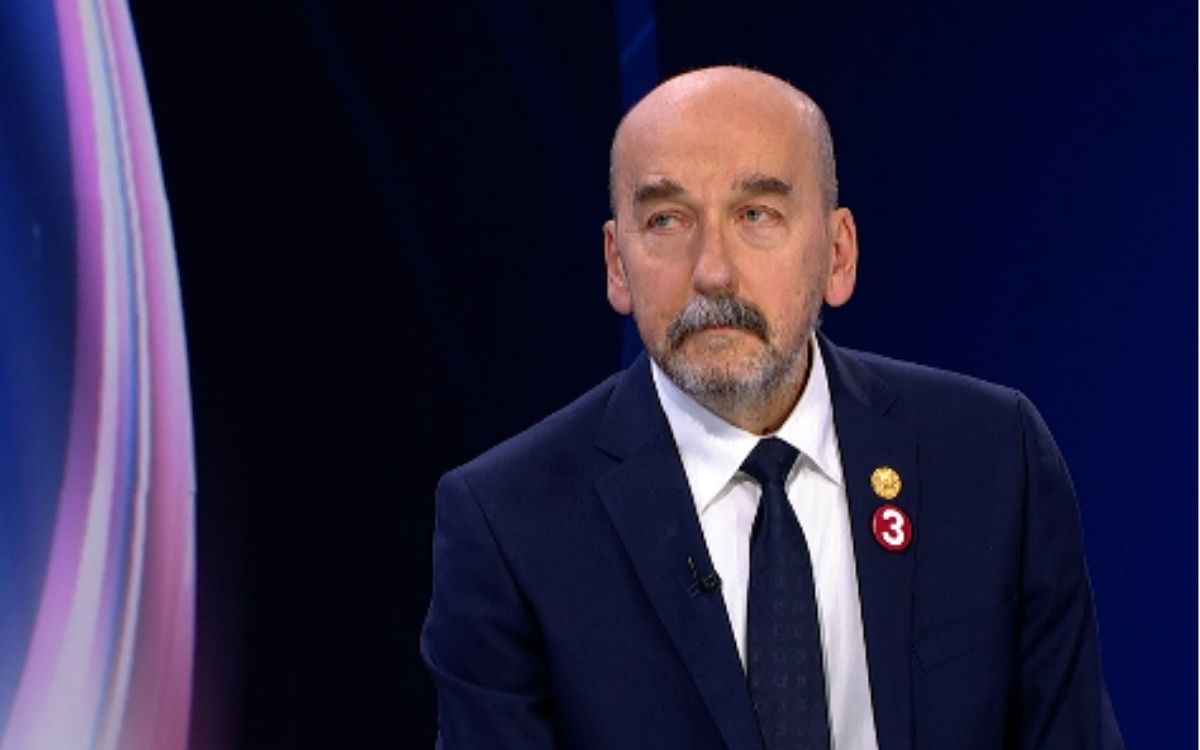
“Students did not sign the Washington, Brussels, or Franco-German agreements. They did not abolish the dinar, hand over the energy sector, Gazivode, license plates or other jurisdictions,” academician Radomir Saičić, a candidate of the Students’ List in Serbia’s upcoming parliamentary elections, said while appearing on the RTS program “Oko.” He assessed that Russia currently advocates Serbia’s territorial integrity more than the authorities in Belgrade do, while he considers Kosovo “a temporarily occupied territory” – “Until it is decided otherwise. Which I sincerely hope will never happen.”
He emphasized that this does not imply war, but rather a serious diplomatic struggle and the creation of conditions for a quality life for Serbs in Kosovo. At the same time, he criticized the people who have represented Serbia’s interests in Kosovo so far, mentioning Veselinović and Radoičić, and said that the student movement has experts who could take responsibility for this issue.
Academician Radomir Saičić, a member of the Serbian Academy of Sciences and Arts and a professor at the Faculty of Chemistry in Belgrade, appeared on the Radio Television of Serbia program “Oko” as part of the pre-election program dedicated to the parliamentary elections scheduled for October 25.
Saičić, who is 91st on the Students’ List, spoke about Kosovo, Serbia’s relations with Russia, the policies of the student movement, as well as corruption, state institutions and Serbia’s future.
“Russia advocates Serbia’s territorial integrity more than our authorities do”
Asked about relations with Russia, Saičić said Serbia should maintain good and productive relations with Moscow, recalling the historical ties between the two countries as well as the importance of Russian energy support for Serbia.
“We have a long history of relations with Russia in which they have helped us and been our friends. We have an energy need in terms of gas, oil and those derivatives, where they support us considerably.”
He then assessed that Moscow currently advocates Serbia’s territorial integrity more consistently than its own government.
“The current political situation is such that Russia, for example, advocates the territorial integrity and wholeness of Serbia more than our own government does.”
When RTS host Gorislav Papić asked whether he was referring to Kosovo, he replied: “I mean Kosovo and Metohija, yes.”
He criticized government representatives who, in his assessment, express patriotism declaratively while accusing students of not being sufficiently nationally oriented.
“Those false patriots wrap themselves in flags and praise the heroes of Košare, while accusing students of lacking patriotism. But students did not sign the Washington Agreement. They did not sign the Brussels Agreement. They did not sign the Franco-German Agreement. They did not abolish the dinar as a means of payment. Students did not hand over the energy sector. They did not hand over Gazivode. They did not hand over various other things – car license plates, postal codes, Kosovo.”
“Students did none of that and would never do it,” he emphasized.
“For me, Kosovo is a temporarily occupied territory”
The RTS host recalled a previous appearance by Miloš Jovanović, president of the New Democratic Party of Serbia, who described his policy toward Kosovo as a “frozen conflict with a more active role for the state,” and asked Saičić what policy the Students’ List would pursue.
Saičić said he starts from the Constitution of Serbia.
“One thing is clear. Kosovo and Metohija are, according to the Constitution, an inalienable part of our territory. We must accept it that way. And that is what it will remain until, potentially, it is decided otherwise in a manner provided for by the Constitution and the law, which I sincerely hope will never happen.”
He then presented his view of the status of Kosovo and the position of Serbs.
“Until then, for me it is a temporarily occupied territory. And we must strive to ensure conditions, through negotiations with relevant international factors, for our people there to have a quality life. They are suffering torture there. They are suffering because of the duplicity shown by this government here.”
Patriarch Pavle as an example of a different approach to Kosovo
Explaining how Serbia should represent the Kosovo issue before international actors, Saičić recalled meetings Patriarch Pavle had with U.S. congressmen.
“If you look at who the people dealing with Kosovo are… I know that about thirty years ago Patriarch Pavle went to America and spoke with several American congressmen about Kosovo. And now people generally think – everything is settled, it is the policy of the great powers, nothing can be done, whether someone is noble, honest, good or bad. No, it has a great deal to do with it.”
According to him, the American interlocutors of Patriarch Pavle were not indifferent to his appearance.
“They listened to him with their mouths open. And among themselves they said: A holy man. Patriarch Pavle did not solve the issue of Kosovo, but if that were our policy, if there were a clear readiness to protect our territory at all costs, because that is a struggle for freedom… People have died for Kosovo for a long time, shed blood for it.”
Saičić immediately emphasized that his insistence on protecting the territory does not mean advocating war.
“That does not mean that we are now going to rush into war. But for us, that is a temporarily occupied territory. We are trying to ensure living conditions.”
His message is that policy toward Kosovo must be based on personal integrity, credibility and the readiness of those representing Serbia to consistently advocate for the interests of the population.
“Who is defending Kosovo’s interests today? Veselinović, Radoičić and people like that?”
In the continuation of the interview, Saičić criticized the previous selection of people entrusted with policy toward Kosovo, questioning their suitability to represent the interests of Serbia and Serbs.
“Who is defending Kosovo’s interests today? Who goes to Kosovo often enough? Did you have those scandals, I don’t know, Radoičić, Veselinović and people like that?”
The host then asked whether there were people on the Students’ List who would deal with Kosovo.
“Of course. That is one of the essential issues,” Saičić replied.
Asked who those people were, he did not name specific individuals, but explained that future positions would be decided after the elections.
“As with everything else, when the voting takes place, when the government is formed, the various ministries, foreign affairs, that will be seen,” he said.
“Victory for the Students’ List is certain”
Speaking about the upcoming elections, Saičić expressed his confidence in the victory of the Students’ List and a change in the value system in Serbia.
“This is a unique movement. I have been in this movement from the very beginning, I saw that energy, I saw those noble intentions, and it resonates deeply in people’s hearts. So I think, not that I think, but the victory of the Students’ List is certain, as is the change in the value system that we have been waiting for a long time.”
He criticized RTS for insufficient coverage of the student columns that have set out toward Belgrade.
“If you showed on your television right now the student columns moving toward Belgrade from four directions, covering hundreds of kilometers, with people greeting them, the enthusiasm among the people… It is such a wave of energy, love, tears of joy in people’s eyes. If your viewers saw that, many things would become clearer to them.”
He accused the authorities of corruption and a style of governance that he described as “mafia-like.”
Reviewing contracts and fighting corruption
Saičić announced that the Students’ List, if it takes power, would review contracts related to major state projects.
He spoke about the reconstruction of the railway station in Novi Sad, the Morava Corridor and the Expo project, claiming that the costs were significantly higher than originally planned.
“When we take over the government, we will be able to review all the contracts our state has made. And, of course, all those that are legally binding and in our interest, we will honor, but we will examine many things.”
He particularly criticized the lack of transparency in state affairs.
“You know, a lot of things are secret. All contracts here are somehow secret. Not only contracts in the area of defense and security, where that is understandable. However, for example, contracts with Chinese companies, contracts for the reconstruction of the canopy, the contract for building a monument in Belgrade… For some reason, that is secret. So, we will make all those secrets transparent to the people.”
On Jovo Bakić: It does not matter who is left or right, but what we can offer together
The host also raised the issue of ideological differences among candidates on the Students’ List, particularly between Saičić and sociologist Jovo Bakić.
Saičić replied that common goals must be more important than ideological and religious differences.
“I don’t look at such things. I look at what those common interests are, what we can offer to the citizens of Serbia. And what we can offer together, regardless of whether we are religious, whether we come from the left or the right, is, for example, the rule of law.”
“A state in which everyone is equal before the law. To offer an economy based on different principles. A party membership card will not be a condition for employment, but knowledge, a degree and expertise. Going to a rally of the ruling or another party will not be a condition for keeping your job.”
He stated that the Students’ List brings together 160 PhDs, as well as experts and businesspeople from Serbia and the diaspora.
He described student plenums as an example of horizontal democracy, in which decisions are made without a traditional party hierarchy.
On Republika Srpska: “Just as they protected Serbs in Kosovo, they will protect them too”
Saičić also spoke about the position of Serbs in Montenegro and Republika Srpska, advocating stronger mutual ties, cooperation and unity.
Regarding Republika Srpska, he said he sees its future as part of the future of the Serbian people.
“Our brothers in Republika Srpska should understand that they will have the greatest support, in fact the only support for their survival, existence and a future perspective, from the Students’ List and the new leadership that is coming.”
He again criticized the authorities in Belgrade, referring to the position of Serbs in the region.
“Because these people who are currently in power here, just as they protected the Serbs in Knin, just as they protected the Serbs in Kosovo, that is how they will protect the Serbs in Republika Srpska. God forbid.”
“I want to return to science as soon as possible”
At the end of the interview, Saičić said that he did not join the Students’ List because of personal political ambitions.
“I did not join this because of political ambitions, but so that, if I have professional knowledge, integrity and intelligence, I can put them at the service of the students and at the service of Serbia. As long as it is necessary, I will deal with this.”
“My wish is to return as soon as possible to the activities I am more inclined toward and more capable of. But here I will do everything I can to be useful,” academician Radomir Saičić concluded.
MORE TOPICS:
Source: Kossev Foto: RTS
 Add Serbian Times as your Google source