




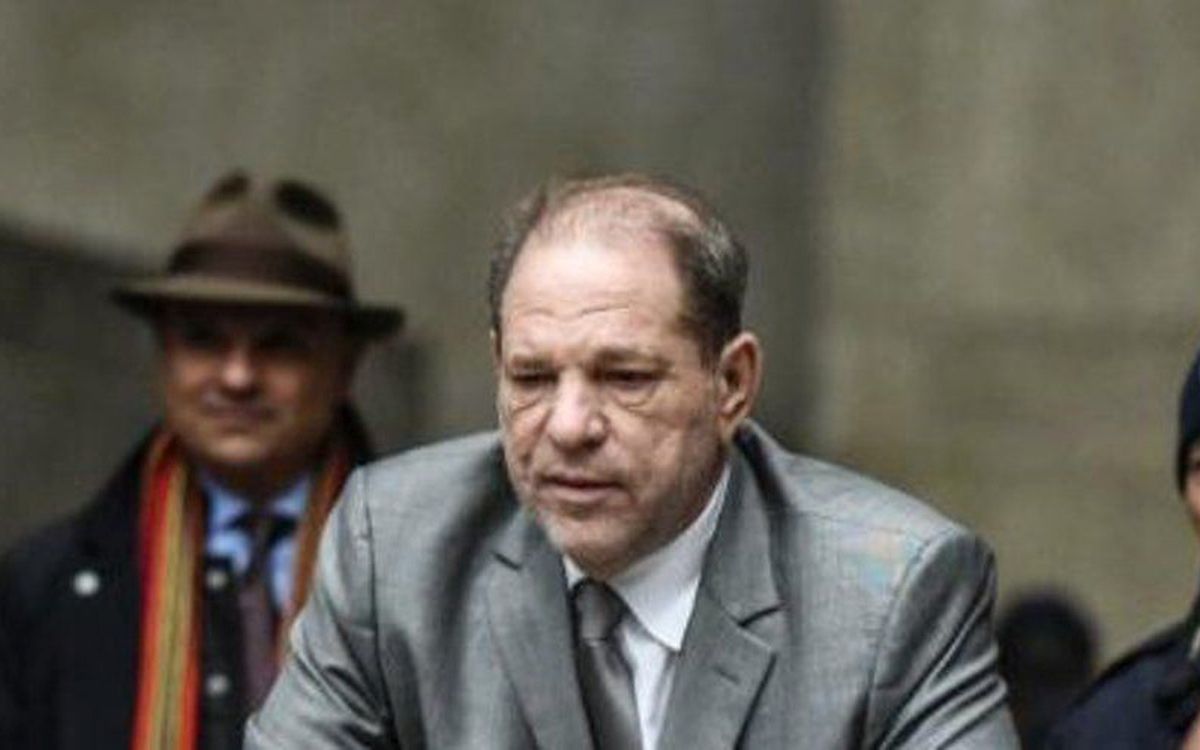
In his first major interview from prison, once one of the most powerful (and today disgraced) men in Hollywood, Harvey Weinstein complained about life on Rikers (“I am dying here”) and his ruined reputation, but also showed conviction that things will change for him – “It will be proven that I am innocent. I promise you that,” he told the editor of The Hollywood Reporter.
In his first major interview from prison, once one of the most powerful (and today disgraced) men in Hollywood, Harvey Weinstein complained about life on Rikers (“I am dying here”) and his ruined reputation, but also showed conviction that things will change for him – “It will be proven that I am innocent. I promise you that,” he told the editor of The Hollywood Reporter.
In his first major interview from prison, once one of the most powerful (and today disgraced) men in Hollywood, Harvey Weinstein complained about life on Rikers (“I am dying here”) and his ruined reputation, but also showed conviction that things will change for him – “It will be proven that I am innocent. I promise you that,” he told the editor of The Hollywood Reporter.
The interview was conducted by The Hollywood Reporter (THR) editor-in-chief Maer Roshan, writing that it is only slightly easier to enter the prison complex on New York’s Rikers Island than it is to escape from it.
A long path, barbed wire and metal detectors are the first obstacles on the way to the decaying concrete block building that the mogul has called home for the past two years.
Harvey Weinstein (73) has been hospitalized several times since his imprisonment due to a whole range of illnesses: diabetes, heart surgery and cancer. Spinal stenosis keeps him in a wheelchair most of the time. Because of his poor health condition he is housed in the prison’s medical unit, while for security reasons he is locked in his cell 23 hours a day.
Roshan recalls at the beginning of the interview his earlier encounters with Weinstein. He remembers him, he writes, for his roughness, vulgarity and vindictiveness.
However, he adds, he could also be charming, witty and generous – “a strange duality that some of his victims testified about in court”.
He had a sharp eye for talent and stories and was fiercely loyal to people close to him.
At the peak of his career, Harvey mostly escaped punishment for terrible behavior, he states. He was a top Hollywood producer with enormous influence in magazines, theater, publishing and politics. He socialized with prime ministers and presidents.
Then in 2017 a series of major stories – in The New York Times and The New Yorker – exposed his history of sexual harassment and abuse, triggering a dizzying fall from the top.
Harvey, as Roshan remembered him, loved grand entrances, usually followed by a pack of assistants. This Harvey simply appeared quietly – thinner, gray-haired and pale, hunched in a wheelchair pushed by a prison guard.
“And so, we meet again,” he said theatrically.
Roshan says that during the strictly limited 60 minutes of the interview Weinstein went through a whole range of almost operatic emotions – pride, anger, self-pity, shame. But not remorse. He writes that Weinstein still sees himself as a victim of a past era of Hollywood. He admits that his behavior may have been vulgar, pathetic and even violent.
But he insists that he is not a rapist – just a man with an enormous libido who “made a few stupid moves” and accidentally triggered a global social movement.
Three consecutive juries did not agree with that. Nearly 100 women have accused Weinstein of sexual misconduct – although only a handful of cases actually reached court. Many testimonies were dismissed when it was established that women accusing him of forcing them into sex did not know that, due to a surgery he had many years ago, Weinstein has no visible testicles.
The first trial in New York in 2020 ended with a conviction on charges including third-degree rape, with a sentence of 23 years in prison. The verdict was overturned in 2024 due to a procedural ruling, and in 2025 a new trial was held that ended with conviction on one count, acquittal on another and a mistrial on a third.
In 2023 he received a sentence of 16 years in prison for rape and other crimes after a long jury trial in Los Angeles. The judge ruled that this sentence would be served consecutively – and not concurrently – with the New York sentence.
Another retrial in New York has now been postponed until April 14.
You can read the entire interview in The Hollywood Reporter on their website, and we present the key details.
Are you worried about the possibility that you might die here?
– “It scares me to madness. Cold and heartless. It is incredible to have a life like I had and all the things I did for society, and to receive no kindness in the way they treat me. Whatever they think I did wrong in life, I did not receive the death penalty. I turn 74 in March. I do not want to die here.”
While we are recording this conversation, the world is obsessed with the story of Jeffrey Epstein. Did you know him?
– “No. Maybe I ran into him once or twice. He did not move in my circles. We certainly were not friends.”
The last time a story like Epstein’s caused so much global attention was when you were arrested. Does it look different now from your perspective? I know you believe you were unfairly accused and complained about a media witch hunt. Do you think he might also be innocent?
– “No. I only know what I read in the newspapers – I cannot say either way. I do not have much trust in the media. Nor in prosecutors, either. But the crimes he is accused of are truly terrible. They are not at all like mine.”
Let’s talk about your crimes. There are dozens and dozens of women telling variations of the same basic story. You followed them to their hotel rooms or trapped them in yours. You forced them to have sex with you. You raged or retaliated when they rejected you. You claim none of that is true. But how do you explain the consistency of all those reports? Why do you think all those people are so willing to lie about you?
– “For many reasons. But mainly because of money. You know, two women received about 500,000 dollars each. A third received three million dollars. All someone had to do to walk away with a check was fill out a form saying I sexually assaulted them. So they filled it out, and the insurance company ended up paying tens of millions of dollars. And Disney too – Disney did not want a public fight, so they simply paid people to go away. It becomes a snowball effect. People can say whatever they want about me, and it enters the public record. But very few of those stories actually went through a court process.”
Some of your accusers – like Gwyneth Paltrow – were close friends of yours. Others worked with you for years. None of them took a single cent. Are you really claiming they all did it for money? Is there any part of you that admits you did something wrong to them?
“Did I unsuccessfully court some of those women? Did I go too far? Yes. Was I aggressive or overly seductive? Yes to all of that. Look, I should never have dated women I dated. I was married to a fantastic woman who had no idea what I was doing. I lied constantly. I improperly used my employees to hide those things. But did I ever sexually assault a woman? No. I never did that.”
How much have you paid in settlements since all this began?
“I did not pay most of those settlements. Disney paid them. The insurance company paid them. But before all this, I personally spent several hundred thousand dollars on settlements.”
You forced people to sign various strict confidentiality agreements and spent a lot of money to silence them. You hired private investigators to follow women who accused you and journalists. Isn’t that evidence of guilt?
“Yes, but what I did wrong was not sexual assault. It was cheating on my wife. I was desperate to hide it from her. I did not want Disney to find out. I did everything to protect myself from that kind of scandal.”
You mentioned that your staff helped cover it up. Some of them escorted young women to your room, fully aware of what awaited them there. Don’t they deserve some responsibility for that?
“No. There is only one person to blame. That is me. Those people were so happy to work at The Weinstein Co. or Miramax – to be at the very center and top of the industry – that they were willing to lie for me. And I made them lie. My staff was great. They lied like champions. But I did it. Everything is on me. Still, I will say this: when a man invites you to his hotel room in the middle of the night, you know what is on the agenda.”
Do you mean to say that everyone who came to meet you knew it would end with you touching them and chasing them around the room?
“Not at all. Many people came to see me. But there were some women who knew exactly what was expected. Maybe they later felt bad or regretted it. Maybe they saw an opportunity for a payout. But they were not all as naïve as they later liked to present themselves.
Look at the last case. I lost in the case of Miriam Haley. But I was not guilty on the charge of Kaja Sokola, who said I raped her. We won because in her diary she wrote about four men who attacked her. But the only sentence she wrote about me in that diary was that Harvey disappointed her. Harvey disappointed her because I did not make her a star. And many of those women were actresses who did not get what they wanted.”
She was a model in her twenties. You were a world-famous mogul. Do you acknowledge the power imbalance in that situation? You were a powerful man who did not like being told no. I have seen how intimidating that could be.
“Yes, there was a power imbalance. I know I can be intimidating and difficult. But that is still very far from sexual assault. Excessive flirting, ridiculous situations. Bad and stupid behavior. Yes. But I did not force anyone. I did not physically move anyone. I did not do that, Maer. And I took polygraph tests to prove it.”
As I listen to you, I cannot help thinking of the Italian model in New York – Ambra Gutierrez – and the recording the New York police made during the sting outside her hotel room. There was something about your behavior – persistence, aggressiveness – that is impossible to forget. If that was not assault, what was it?
“I think I was trying to be seductive and I went too far. It was shameful and pathetic. But I never touched her. You never saw me put my hands on her. Her case was never even brought to court.”
You always considered yourself a fairly tough guy. Would you punish any of those women if they rejected you?
“Absolutely not. I may be a tough guy, but I am not crazy. The mere threat of Harvey was enough – maybe more than enough. But it never went so far as to blacklist someone. If the camera is on, I will just say: Rosanna Arquette, Gwyneth Paltrow, Angelina Jolie – they simply went too far. They wanted to be part of the club. And they destroyed me.”
That is an extremely serious claim about women who have nothing to gain from it. But it is not only them. Peter Jackson says you told him not to work with Ashley Judd and Mira Sorvino.
“Peter Jackson is the worst. For him it is personal. He still resents what happened with Miramax and ‘The Lord of the Rings’. So the moment he sees that I have fallen, he says I ordered him not to work with Ashley Judd or Mira Sorvino. That is a complete f***ing lie. If he repeats it, I will sue him too.
The truth is that I fought until my last breath for Ashley Judd to get a role in ‘Good Will Hunting’. I fought like crazy to put her in that film. But Gus and Matt insisted on Minnie Driver and that was the end of the story. And when Mira Sorvino’s husband needed a role in a television series, I removed another actor and cast him. The truth is that if I had wanted to take revenge on those women, I would have needed the cooperation of agencies. Call Ari Emanuel! Call Bryan Lourd! That never, never, never happened.”
You said you wanted to testify at your trial but were talked out of it. Do you regret that?
“Yes. Because I could have explained things to the jury. Those people were my friends. You do not send someone emails saying ‘I love you’ and ‘I miss you’ and ‘come see me’ after that person has sexually assaulted you.”
All those arguments were presented at trial and they did not convince the jury.
“That is because the prosecution brought a psychologist – paid 750 dollars an hour – who testified that victims sometimes remain emotionally attached to their abusers. We did not challenge that. We should have challenged it. And I was the one who should have done it, because no one knew the truth about those relationships better than me. My testimony would have made the difference.”
How much money have you spent on your defense?
“Millions and millions and millions.”
Are you worried you might run out of money?
“That keeps me awake at night. I had real estate and other income, but it is not unlimited. Disney canceled my insurance. Do you know how much I earned for that company? Back in the Talk Books days, editor Jonathan Burnham found ‘Artemis Fowl’, which sold 21 million copies. We acquired ‘Percy Jackson’, which sold 200 million copies. I made a billion dollars in publishing just from that one book. Do you know what my Disney pension is? 60,000 dollars a year. I made billions and billions for Disney, and they give me 60,000 dollars a year. And my ex-wife Eve takes half of that.”
Of the many women who spoke against you, Gwyneth Paltrow particularly upset you. Why?
“Because she was a good friend of mine. I do not know what made her do what she did. To make such a big deal out of nothing. I left a pleasant meeting with her and said: ‘How about a massage?’ And she just said: ‘No, I do not think so.’ I got the message. I never laid hands on her. She told that to Brad Pitt. Brad Pitt came to me and said: ‘Do not do something like that with my girlfriend.’ I said: ‘Do not worry, Brad. I understand.’ But then Gwyneth goes to Howard Stern and the New York Times and makes a big story out of it. She knows nothing happened. But that person who was my friend, who owes her career to me, simply stabbed me in the back. She wanted to be part of the crowd. I will never forgive her for that.”
Long before the stories in the Times and The New Yorker, journalists had been investigating your behavior toward women for years. David Carr spent six months at New York magazine working on a cover story that was never published. Some people would have stopped after that kind of public scrutiny. But you simply continued. Was that arrogance? Self-destruction? Did you just think you would never get caught?
“Arrogance is a good word. And obviously it was self-destruction. But those affairs relieved some of the pressure from the life I was living. It was a temptation that was always there, and I always gave in to it. It was stupid and wrong.”
In Greek tragedies the hero is brought down by his fatal flaw. What do you think yours was?
“I crossed boundaries. That is certain. I could be a terrible bully. I used power in an arrogant way. I was aggressive and persistent, and I feel terrible about that. I am ashamed of that behavior and now I see it in a way I could not before. Ironically, I distributed the film ‘Bully’, and the organization GLAAD gave me an award for it. In my speech I said: ‘The irony of me distributing Bully is not lost on anyone.’”
Has this experience made you at least somewhat more introspective?
“There is no way to avoid introspection because in prison the only thing you have is to deal with yourself. I constantly think about what I would do differently if I had another chance.”
And what would that be?
“I would respect those women more. I would never have been with them at all. I would have remained faithful in my marriage. I would have said: ‘I have a family. I will protect it.’ I was a fool. I admit that.”
Have you ever apologized to any of the women who accused you?
“I apologized to them generally. You cannot call them when you are in legal proceedings with them. But I will say it here today: I apologize to those women. I am sorry. I should never have been with them. I misled them.”
I am not sure that is much of an apology, honestly. It sounds like you are most sorry for cheating on your wife. Are you sorry for your misconduct beyond that?
“I misled them. I cheated on both of my wives. That is immoral. But I did not assault them. That is the big lie in all of this. I will not apologize for something I did not do. I will be declared innocent. I promise you that.”
From the outside it seems your life was driven by insatiable appetites – for power, money, food, sex. Where do you think that comes from?
“Some of it goes back to childhood. While I was growing up, I remember that my uncle was very wealthy and my father helped him get there, and then my uncle did not return the favor. I remember how much that hurt my father, who was a good and honest man. But my uncle was powerful and rich, and I wanted to be like him, not like my defeated father. That is where I went off the path. It shaped my values somewhat. I did not want to be a fool in life.”
What do you think drives your behavior toward women?
“I was married to Eve for a very long time – 17 years. I met Georgina a year and a half later and we were married another 12 years. I just never… I do not know. I was not exactly a big charmer when I was younger, and then at one point everything became too easy. Many of those women came to me.”
They came to you because you could make or destroy their future.
“Sometimes, yes. And sometimes simply – because. Maer, believe it or not, I had a bit of charm.”
I know two of your daughters changed their surname and do not want to speak with you. Have you tried to contact them?
“Many times. They never answer. Their mother has also removed me from her life. Since the accusations began, there has been complete silence from them.”
Do you think you will ever be able to repair those relationships?
“Yes, I think I will. I am convinced I will – when I get out of here and prove my innocence. I won the last appeal. I will win this one too. When I lie in that cell and think about them, I just want them to know that I love them. I did not do the things they think I did.”
Your brother Bob was closely involved in building your company. But after the scandal he also left you. Did that surprise you?
“No. Not at all. He is desperate to work, and this destroyed his career too. He just hopes that if he spits on me he will be able to get back to work. But unfortunately for him, they will never let him return to work. He is stuck here with me. But it did not surprise me. In the last years of The Weinstein Co. there was a lot of bad blood between us.”
He said your recklessness destroyed the company.
“I destroyed the company? He destroyed the company. Look at his films – one disaster after another. I saved the company! ‘The King’s Speech’. ‘The Artist’. ‘Silver Linings Playbook’. Hit after hit after hit. And it was not only films. I built our television company. People do not know this, but one of the last things I did was bring Taylor Sheridan to the series ‘Yellowstone’. Sheridan wanted to cast Robert Redford, but I said: ‘You should take Kevin Costner.’ And it became a huge hit. But then all this happened and people forget.”
We are in the middle of Oscar season, which used to be your favorite time of the year. You treated the Academy Awards like a blood sport – you turned it from a sleepy ceremony into a brutal and expensive competition. Was that a good thing?
“Before I came along, a few big studios ran the Oscars. They simply traded awards with each other. I allowed smaller independent films to finally get attention. They complained that I played dirty or made everything too expensive. I do not care about them. I fought for great films because I loved them. Is that a bad thing?”
People once said they thanked only God more often than they thanked you. How is it watching them from prison?
“I try not to think about it too much. I just try to root for films I like. Although this year I actually have not seen any of the films. On the tablet we only get those that already passed the first screening round.”
Who are you rooting for this year?
“It is a race between two men — Paul Thomas Anderson (‘One Battle After Another’) and Ryan Coogler (‘Sinners’). I had the pleasure of working with both. They are two giants. The Academy should declare a tie.”
You once famously called yourself “the sheriff of this f***ing town.” Who is the new sheriff now?
“First of all, I did not mean it that way. It was an ironic statement. Martin Scorsese called me right after that and said: ‘Remember one thing – irony does not work well in print.’”
Are there producers or studio executives you truly admire?
“Ted Sarandos. He loves films, loves documentaries, has incredible taste and built a company from nothing. The guys at A24 are also excellent. And Tom Quinn from Neon – look at him, he works with foreign-language films and two are nominated for Best Picture.”
Hollywood has changed a lot since you were there – many layoffs and corporate mergers. What do you think of the industry today?
“It saddens me when I see it. I am sorry that people do not love films enough to fight for them. I see Christopher Nolan and Quentin Tarantino leading those lonely crusades and I wish I were outside to join them. Those mergers are really bad. We need more films, not fewer. And those short theatrical release windows are killing the business! Films need time to break through. People complain that I was a bully – that I was too rough on directors. But they cannot say I did not love movies. I love movies and I had the power and boldness to do what was right for cinema.”
Your case triggered a global movement. Leaving aside your personal story, do you think the industry needed a reckoning with such things? Do you think #MeToo was good for society?
“I think it was. If women were being hurt or exploited, then I think that is good.”
And how do you feel about the fact that you were the central figure of that movement?
“I do not feel good about it at all. When Alyssa Milano said ‘Me too’, she did not mean #MeToo about Harvey. She said ‘Me too’, and then everyone said #MeToo about me. Every woman I had been with, every friend I had. It was a march toward a pile of money.”
I know you think a lot about your legacy. When you are gone, do you think you will be remembered more for the films or for the scandal?
“I do not know. I hope for the films. But I do not know. Probably not.”
Was there ever a moment when you thought about taking your own life?
“No! Never! It has been very hard for me, but I would never do that to my children.”
Which films do you think you will be remembered for the most?
“‘Pulp Fiction’ and ‘Shakespeare in Love’ – those were the most iconic films I made. They represent two sides of me. ‘Shakespeare in Love’ represents all those historical films; ‘Pulp Fiction’ represents all those cool films. My greatest regret is ‘Confessions of a Dangerous Mind’, directed by George Clooney. It is such a great film, but I completely ruined it. If I ever get out of here, I will buy the rights and re-release it.”
If you were making a film about all this, how would you portray your character? As a villain? A victim? A tragic hero?
“All three. I did wrong and ugly things. But I also did many great things – I helped change the culture. I built many careers. I was good to many people. I am not a victim. I am a survivor. A survivor of my own flaws. But I am in a difficult situation, and I know that. I have to give myself motivational speeches because no one else will.”
You lived a life of cinematic extremes – enormous power, wealth and fame, followed by public humiliation and shame. Sitting here, I wonder whether it was all worth it. Would you give up the Oscars and the recognition if you could avoid all this and live an ordinary life?
“That is a very interesting question, but when I think about it – the answer is yes. Prison is an excellent way to reflect on your choices and priorities. All those Oscars and big films – I am still very proud of them. But what use are they to me now? If I could choose again, I would gladly make that trade. A life outside the spotlight, raising children and living with family – that would be a much better life.”
MORE TOPICS:
Source: N1 Foto: Printscreen Twitter @WeinsteinTrial