




Have we finally found proof of the existence of aliens? Well, not exactly. Scientists emphasize that additional analysis is needed to determine the true origin of the minerals and to clarify whether they are truly indicators of life, the so-called “biosignals”, or the result of some other, completely inorganic processes.
“I want to remind everyone that what we are describing here is a potential biosignal. It’s an element, a molecule, a substance or a characteristic that could have a biological origin, but we need more data and further research before we can make a final conclusion about the presence or absence of life,” said Lindsay Hayes, a senior Mars research scientist in the Planetary Science Division at NASA Headquarters, during the conference.
In any case, the findings do show that complex reactions once took place on Mars, whether they were of organic origin or not, which adds another layered story about the planet that humans have been trying to understand since the beginnings of astronomy.
“Bright Angel” and the unusual rock Cheyava Falls
To be more precise, the samples that Perseverance, the rover on Mars, collected, and which are suspected to contain interesting minerals, were found in a formation known as “Bright Angel”, on the northern edge of Neretva Vallis. Within that formation, one rock is particularly interesting, named “Cheyava Falls”.
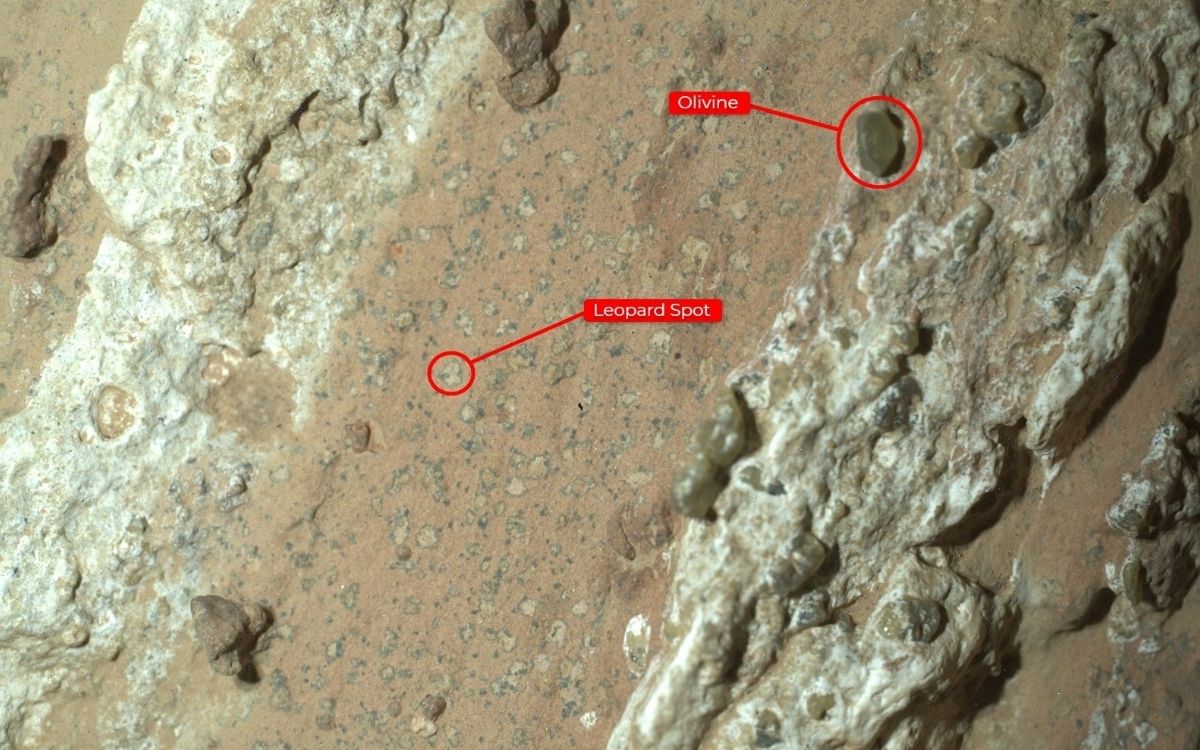
Recently, when Cheyava Falls was first presented to the public, it made headlines around the world because scientists openly showed their enthusiasm for its unusual, speckled structures that resemble “poppy seeds” or “tiger stripes”. These spots, only a few millimeters in size, are surrounded by black rings, and analyzes using the instruments of the Perseverance rover showed that they contain iron and phosphates. Both substances can be formed on Earth by chemical processes driven by microbes.
“These dots are a really big surprise,” said David Flannery, an astrobiologist and member of the Perseverance mission science team from the Queensland University of Technology in Australia. “On Earth, such structures in rocks are often associated with fossilized traces of microbes that lived beneath the surface,” for “Space”.
“In that rock, we saw layers of very fine-grained, rusty red mudstone that contained these incredible structures,” added Ken Hurowitz. “Their appearance clearly indicated to us that something very interesting had happened in those rocks, a series of chemical reactions at the moment the deposits were formed.”
The “Sapphire Canyon” sample
The natural next step was a more detailed examination of the Cheyava Falls formation. So, on July 21, 2024, the Perseverance rover drilled the rock and collected a sample. It was the 25th sample in total, and it was named “Sapphire Canyon”.
“I would call the Sapphire Canyon sample mysterious,” said Morgan Cable, a researcher on the Perseverance team, in a video released by NASA on April 10. “We see signals that indicate that chemistry took place, perhaps including organic matter, but what does that actually mean? Was life involved in all of this, or were the processes that have nothing to do with it?”
And that’s where the story, at least then, stopped.
New analysis and traces of life
Now a new study brings a detailed analysis of the rocks from the “Bright Angel” formation. And indeed, researchers have found evidence that this site could be a key clue in the search for life outside Earth. According to the official statement, the team “identified tiny nodules and dots rich in iron-phosphate and iron-sulfide. These structures are associated with organic carbon and appear to have formed after the deposition of sediments, at low temperatures.”
The key lies in the possibility that so-called “redox” reactions took place, chemical processes in which electrons are transferred from one substance to another, with one being oxidized and the other reduced.
“It appears that organic carbon participated in these post-depositional redox reactions that led to the formation of the observed iron-phosphate and iron-sulfide minerals,” the study authors wrote.
In the “News and Views” article published with the results, Janice Bishop from the SETI Institute in California and Mario Parente from the University of Massachusetts in Amherst state: “The exciting discovery of reduced iron-phosphates and sulfides associated with organic compounds in clay-rich muds in the Jezero crater suggests that organic material could have participated in unusual redox reactions.”
On Earth, microorganisms often interact with minerals and have been shown to be able to convert sulfates (which contain oxidized sulfur atoms) into sulfides (which contain reduced sulfur), in cold, airless lakes in Antarctica. “On Mars today we have no evidence of the existence of microbes, but if they ever existed, they could have also reduced sulfates to sulfides in a similar lake in the Jezero crater,” the text further states.
Several other results further strengthen the possibility that there is a biosignal in the Bright Angel formation. For example, new research suggests that green dots in the clay-rich mud may contain the mineral vivianite, which can help in understanding the redox reactions that may have occurred on Mars.
The problem of returning samples to Earth
However, there is one major limitation: to be sure whether there is really evidence of life on Mars in the Perseverance rover tubes, these samples must be returned to Earth. Unfortunately, NASA’s Mars sample return program is currently at a standstill due to financial constraints, changes in priorities since the Trump administration, and the extremely complex plan of the mission itself.
Scientists still emphasize that with small rock samples, 225 million kilometers away, only limited analysis can be done.
“We are pretty close to the limits of what a rover can do on the surface,” said Katie Stack Morgan, chief scientist of the Perseverance mission at NASA’s Jet Propulsion Laboratory in Pasadena. “That was also planned. The instruments of the Perseverance rover were chosen with the idea of a future return of samples. Our goal was to get to the point where we can say that there is a potential biosignal, and for the final story to be told by instruments on Earth.”
As the authors of the “News and Views” text conclude: “Laboratory analyzes of samples brought from Mars could shed light not only on the possibility of pre-biological, but also biological chemistry on worlds outside Earth.”
MORE TOPICS:
TRAMP CONFIRMS THE DEATH OF CHARLIE KIRK: “Great, legendary, now he is no longer with us…”
GREAT HOLIDAY AND RED LETTER DAY: Today we celebrate the Beheading of Saint John the Baptist!
Source: Nova.rs; Photo: NASA