




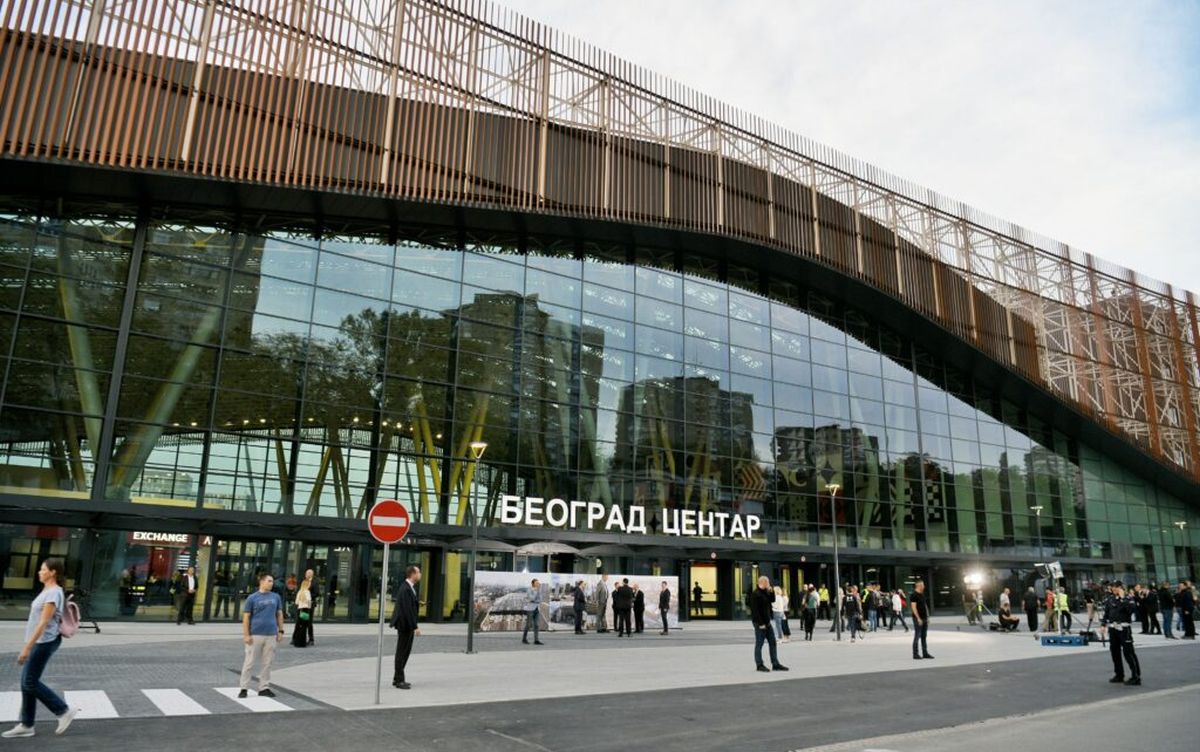
Engineer Edin Drljo, who works in Austria, told Nova ekonomija that he personally looked at the cracked beams and pillars at the Prokop railway station, and that it should be “closed immediately” because, as he says, it is simply not safe.
“From what I’ve heard, they want to put pillars in the middle of the span, which is a radical cut and requires drilling piles and other works. If there was a little bit of rebar missing, they could have done a cladding, but obviously that was not enough. That is a big problem. What bothers me is that they allow 550 people to stay in a building that is directly above that. The building practically stands on those two pillars and if they fail, the building will fall. They also gave a contradictory statement that safety is not endangered, but that they have to repair it. An object either meets the legally prescribed standards or it doesn’t. If not, why? Because this is a radical intervention,” Drljo told Nova ekonomija.
Drljo had previously posted his photos of the works on Prokop on social media, which show how workers are “patching up” the cracks, i.e., filling them with mortar or glue, so that passengers will not notice them from the outside, but the problem will still exist, although it will be “hidden” from passers-by.
Professionals and state officials and leading people of Serbian Railways Infrastructure, which is in charge of this station, on the other hand, are silent about the modifications being carried out on the project of “national importance.”
However, from the documents published on the public procurement portal, certain knowledge about the size of the problem, as well as the intentions of the authorities on how to solve it, can still be glimpsed.
“On the platform beams of the Prokop station in the middle of the spans, it was noticed that cracks appeared in the lower zone. Based on the tests performed by the “IMS” institute (Institute for Materials Testing) from Belgrade, it was concluded that the rebar in those beams is less than what was delivered with the previous project. After that, subsequent computational analyzes were performed and it was concluded that in order to ensure durability, it is necessary to reinforce the constructed platform beams. In order to reduce the static influences in them, it was proposed to install new pillars under the beams in the middle of the spans,” the technical documentation for the tender states.
The tender related to the reinforcement of the platform beams will be open until August 14, and in addition, the Infrastructure already in April received approval for works on the rehabilitation of two pillars, which are located within the underground part of Prokop, as Forbes Serbia previously announced.
Driving mega piles
The tender documentation specifies exactly which pillars are cracked, as well as the fact that the so-called “MEGA” piles Ø 219 millimeters, with lengths of about 10 meters, were adopted, “with the proviso that the minimum lengths of the piles should not be less than four meters, so that the load from the piles is not transferred to the existing collectors.”
The next section gives a brief description of the works. At the beginning, it is necessary to dismantle the stone floor covering with a base dimension of one by five meters. Then, the concrete with a thickness of 15-20 centimeters is broken underneath. After that, manual excavation of the foundation pits for the foundation pads above the piles is performed. The dimensions of the pits are 4.4 by 0.6 by 1.8 meters. When these works are finished, a tower with a hydraulic press for driving mega piles is mounted.
“A beam that is being reinforced is used as a ballast for driving the piles. Since it is at a height of 4.75 meters, it is necessary to install an additional steel structure from the tower to the beam. Mega piles are made of elements of steel pipes that are driven into the ground with hydraulic presses. The lengths of these elements are from one to two meters. Piles of a smaller diameter – 219 millimeters with a wall thickness of 7.1 millimeters were adopted. Smaller pile diameters were adopted so that they could be driven into relatively hard ground as well. The piles are driven into the ground until a driving force of 1,500 kilonewtons is reached. If the soil layers are too hard, so it is not possible to reach the minimum depth with the piles, which is at the elevation of the bottom of the existing collectors, then pre-drilling and driving pipes of a smaller diameter will be performed. At each pillar location, it is necessary to install four mega piles. An reinforced concrete pad is installed above the piles, and a steel pillar is installed above it up to the concrete beam,” according to the description in the tender documentation.
These are serious works, and since the tender for them is still open, the question arises of how the works at this station that Drljo saw are already being carried out and who is performing them.
According to Drljo, all these works also significantly increase the cost of the project itself. And he confirms what others from the profession have warned about before, that the load is large and that so many buildings were not intended to be on the slab that supports all these buildings. The use permit in June of this year was issued for three buildings C1, C2, D1 and a parking lot with 257 spaces, while for building D2, which is mentioned in other documents, there seems to be no use permit for now.
As Drljo states, the static calculation was obviously not done well. He warns that the static calculation of this public building must be immediately made available to the professional public for “independent verification.”
Regarding the questions related to this case, neither CIP nor Serbian Railways Infrastructure provided answers to Nova ekonomija.
MORE TOPICS:
Source: N1; Photo: Filip Krainčanić / Nova.rs