




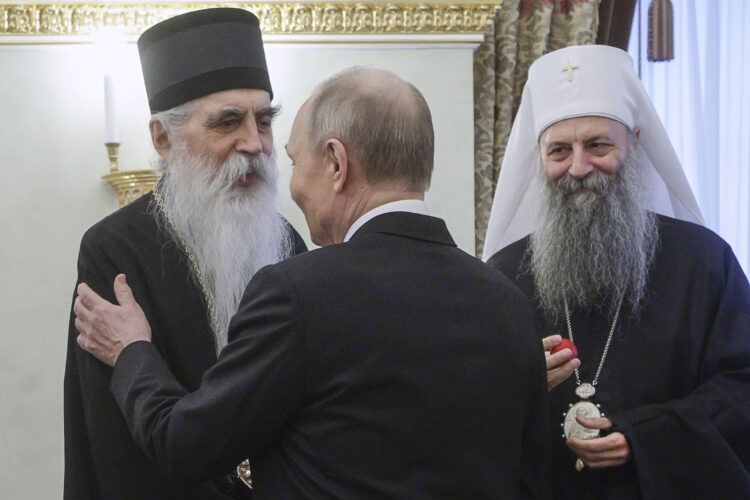
In a significant meeting in Moscow, Serbian Patriarch Porfirije, Russian Patriarch Kirill, Metropolitan Irinej of Bačka, and Russian President Vladimir Putin discussed deepening church and state relations, their shared spiritual history, and geopolitical tensions—including what Porfirije described as a “color revolution” in Serbia.
The high-level talks focused on the long-standing bond between the Serbian and Russian Orthodox Churches, the political relationship between the two countries, and concerns about Western influence in the Balkans.
“Your Holiness! Allow me to warmly welcome you to Moscow. There is a special atmosphere in these halls. We are pleased to see you. I know the Serbian Orthodox Church plays a significant role in strengthening the deep, traditional, and trustworthy alliance between our peoples. Let me also wish you a blessed Easter—our shared holy day,” said President Putin at the start of the meeting.
He emphasized that Russian-Serbian ties have always had a “special character,” rooted in shared spiritual foundations. Putin also confirmed that Serbian President Aleksandar Vučić would attend Victory Day celebrations in Moscow on May 9, despite current European tensions.
Patriarch Porfirije, assisted by Metropolitan Irinej in translation, addressed the room with gratitude and concern. He praised the spiritual bond between the two nations and the continued support of the Russian Church and government in key regional issues.
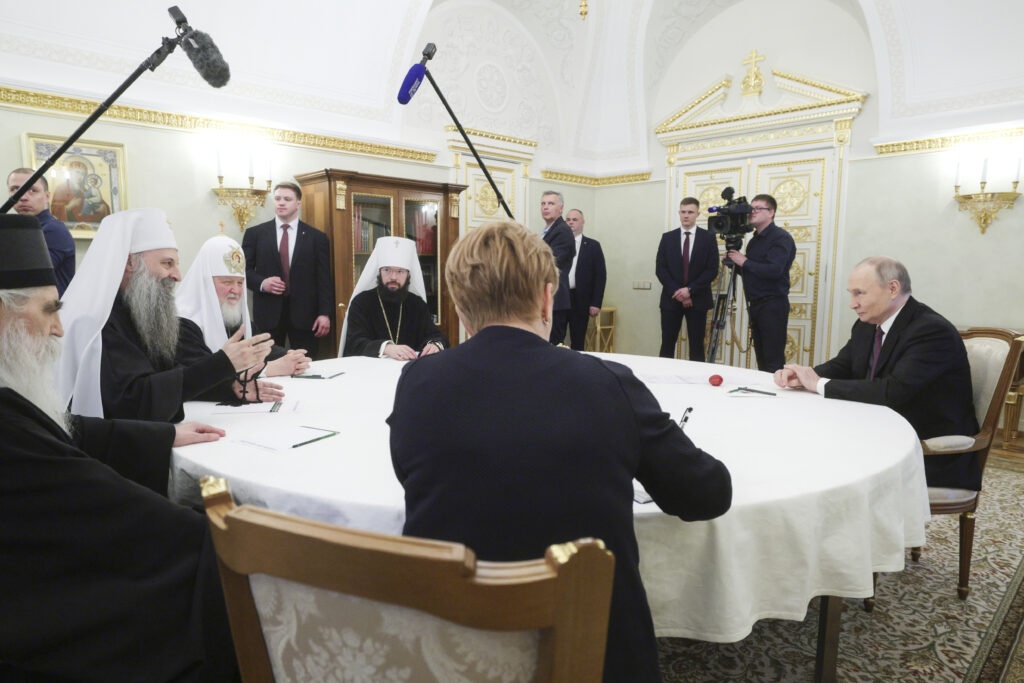
Porfirije specifically thanked Russia for its stance on Kosovo, Republika Srpska, and Montenegro, stressing that without the backing of Russia and China, “the future of the Serbian people would be in question.” He described the city of Peć as “the patriarchal capital,” affirming the religious and cultural importance of Kosovo.
He also relayed greetings from President Vučić and noted that Serbia looks to Russia as a geopolitical and spiritual anchor: “There is a feeling among Serbs that they place more hope in Russia than in their own political leadership.”
On the topic of internal unrest in Serbia, Porfirije introduced the term “color revolution,” with Irinej providing the Russian translation. “We hope to overcome this trial,” he said, “because we know and feel that Western centers of power do not want the Serbian identity and culture to develop.”
Vaša svetosti, bruka i sramota. pic.twitter.com/kXTdJUFqBb
— Stevanović Vladimir (@VladimirStev) April 22, 2025
Putin responded by reaffirming the Church’s role in protecting national identity, adding that Patriarch Kirill plays a crucial role in preserving traditional values.
Patriarch Kirill echoed this sentiment, calling the Serbian Church Russia’s closest ally among Orthodox Churches—culturally, linguistically, and historically. He highlighted that Serbia has never wavered in its loyalty to Russia, unlike some other Slavic nations that have shifted their allegiances under Western pressure.
“The love for Russia, for the Russian people and the Russian Church, is deeply embedded in Serbian culture. It may even be genetic,” said Kirill. He warned of moral decay in the West, calling it “the devil’s work,” and criticized secular ideologies that blur the lines between good and evil.
Patriarch Porfirije agreed with Kirill’s remarks and emphasized that the Russian Orthodox Church’s defense of moral values is an essential part of their shared mission.
The conversation also touched on the late Pope Francis. Both Kirill and Putin spoke respectfully about the Pope, who had passed away during the Easter season. Kirill shared a moment of personal significance, recalling how the Pope resisted pressure to distance himself from the Russian Church, saying simply, “Don’t make me fight with Kirill.”
Putin concluded the discussion by noting Pope Francis’s warm disposition toward Russia and affirmed that, despite global tensions, the spiritual and cultural bond between Orthodox believers remains strong.
This historic meeting not only reaffirmed the close relationship between the Serbian and Russian Orthodox Churches but also underscored the broader geopolitical dimensions of faith and identity in a rapidly shifting world.
MORE TOPICS:
BLOODY EASTER 1944: How the Allied Bombing Shrouded Belgrade in Mourning! (PHOTO, VIDEO)
Source: N1 / Serbian Times Foto: Gavriil Grigorov, Sputnik, Kremlin Pool
 Add Serbian Times as your Google source