




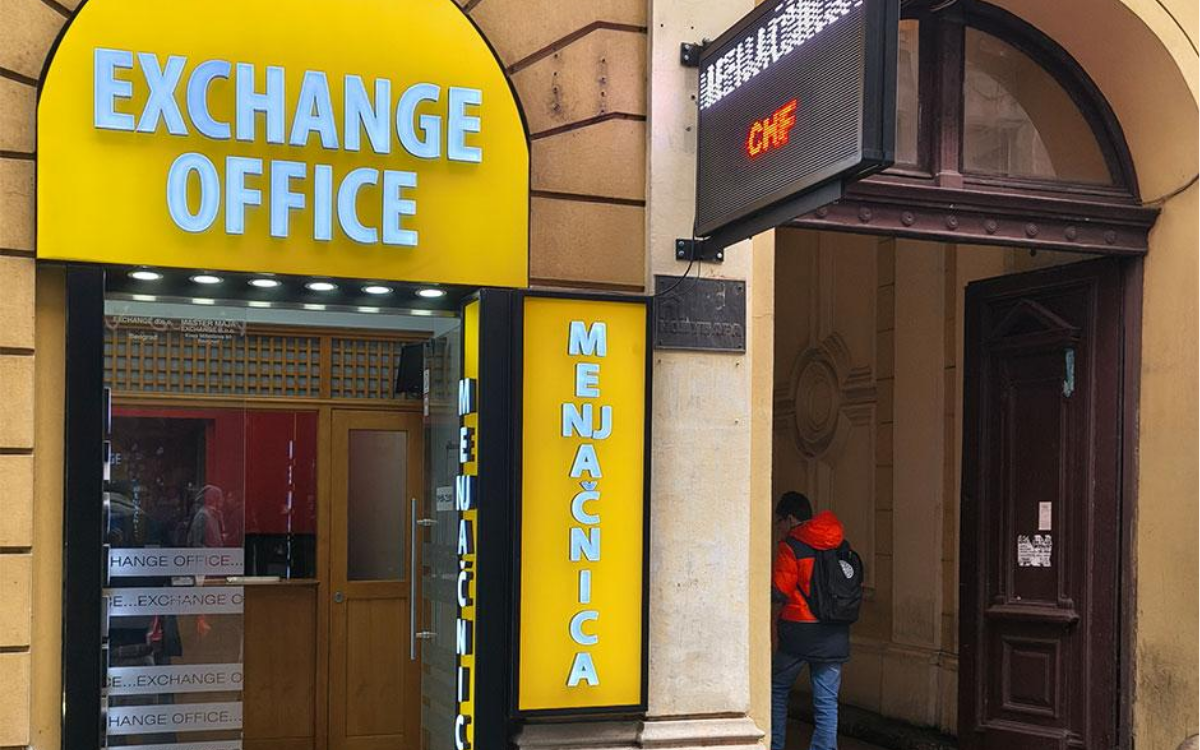
In the vast majority of Serbian exchange offices, from Niš and Užice to Belgrade, euros were unavailable for purchase yesterday because there was no supply.
Following up on this information, we spoke with several exchange office owners, who confirmed to Serbian Times that euros are currently unavailable for sale on the open market.
They cite a drastic reduction in the amount of foreign currency available on the street, including euros, dollars and other currencies, which they interpret as an extraordinary situation caused by money flowing out of the country.
“Most of the money that reaches exchange offices comes from banks. When their supply dries up, we feel it immediately in our business. It gives the impression that euros are leaving Serbia,” the owner of a chain of Belgrade exchange offices told our portal.
He added that he had heard reports that some banks were transferring money to accounts abroad, which, he emphasized, could be a key reason for the shortage of euros.
Yesterday, Serbian Times published an article reporting that Alta Banka had begun transferring large sums from the accounts of private individuals and companies in Serbia to accounts held by foreign banks, according to information obtained by Serbian Times from highly informed sources.
As our source, an employee of the bank, told us, requests for transactions began arriving on Monday morning, once it became clear that Vučić and the SNS had lost the election.
“These are all companies and individuals connected to Vučić’s regime and family, who are now apparently trying to take money out of Serbia before the Student List takes power,” our source claims.
He added that employees had been threatened that no information about these transactions must reach the public, describing his decision to contact our newsroom as a “patriotic duty.”
Lawyer Ivan Ninić also announced on his X account yesterday that a bank had begun transferring money abroad. He said he had notified the National Bank of Serbia (NBS) and requested an urgent inspection.
“An insider at the heart of the system tells me that a bank began transferring money abroad yesterday. I informed the NBS this morning and requested urgent supervision so that public-sector depositors would not be left with empty accounts. I consider this an act of patriotism and my civic duty,” Ninić wrote on his X account.
He also published a document requesting the urgent initiation of an extraordinary inspection of a bank’s operations, with the name redacted, over concerns about the liquidity and security of public-sector deposits.
“As a conscientious citizen/person with direct knowledge of the operations of financial institutions in the Republic of Serbia, I hereby inform the National Bank of Serbia of observed activities that could seriously jeopardize the stability of the financial system and the security of depositors. According to the operational information available to me, immediately after the elections in the Republic of Serbia, beginning on October 26, 2026, a process of intensive and accelerated transfers of funds (liquid capital) abroad was initiated from the bank [name redacted], a.d. Belgrade. Specifically, the funds were transferred to accounts and legal entities located in Moscow (Russian Federation) and Skopje (North Macedonia), where the bank in question, or entities affiliated with it, holds ownership stakes in the banking and insurance sectors,” the document published by Ninić states, among other things.
He requested that the National Bank urgently launch an extraordinary on-site inspection and review at the bank’s premises to establish the scale, basis and legality of all foreign-currency and dinar transfers made abroad during the preceding period.
Among the measures proposed in the document, Ninić also called on the NBS to impose a temporary ban or restriction on the use of funds and transactions involving affiliated entities abroad, in order to prevent further capital outflows until the inspection is completed.
He also called on the central bank to order measures to maintain liquidity and protect the deposits of legal entities and individuals, with particular emphasis on deposits held by public companies and institutions.
Academician Radomir Saičić, one of the leaders of the Student List, also commented on the issue, saying that “there are concerns about attempts to take capital and archives out of the country during the transfer of power.”
MORE TOPICS:
Source: Serbian Times Foto: Promo
 Add Serbian Times as your Google source