




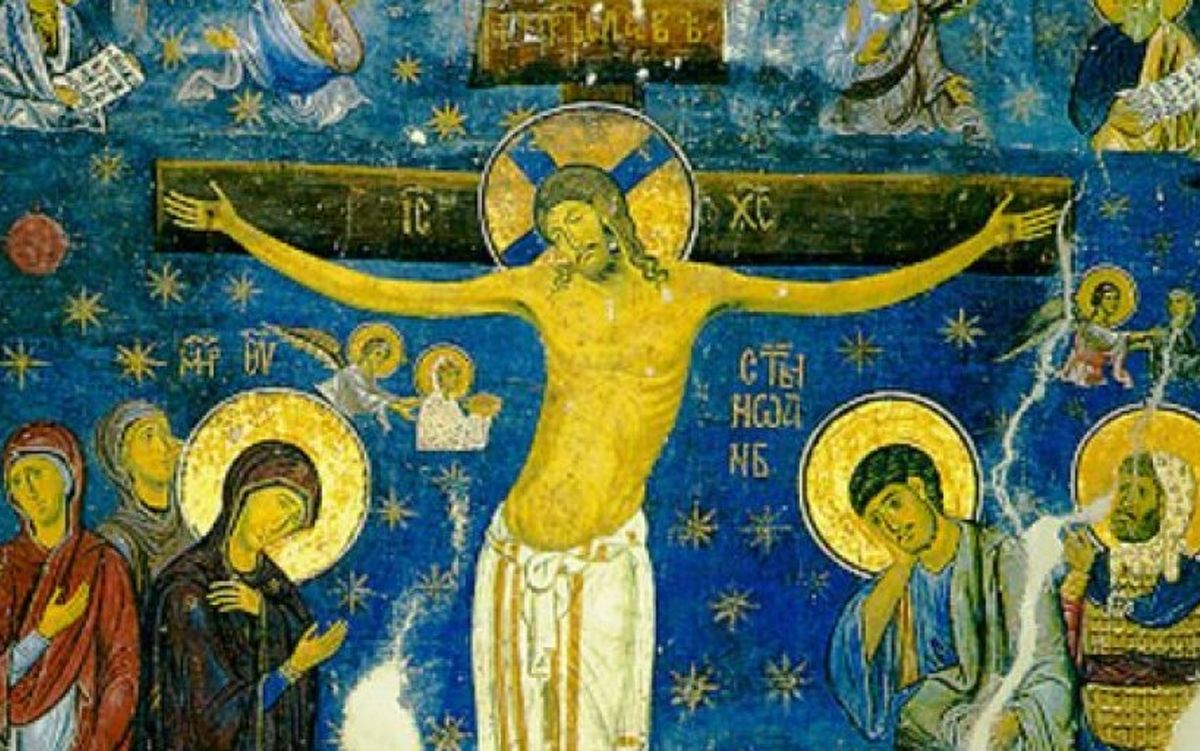
The Serbian Orthodox Church will today mark the saddest day for Christians – Good Friday, the day of Christ’s suffering, when Jesus was condemned and crucified on Golgotha, sacrificing himself for all people and the salvation of the world.
It is the day when the Romans sentenced Jesus Christ to death, at the instigation of Jewish priests and Pharisees.
On that day, Orthodox believers strictly fast – on “water,” and many also observe “one-day fasting,” meaning they eat or drink nothing all day until the evening, after the evening service, when they take a little bread and water.
As a sign of sorrow and mourning, on Good Friday, church bells must not ring, starting from the vigil on Holy Thursday, but wooden clappers are used to call to worship. In most parts of Serbia, eggs are dyed on Good Friday.
There is no liturgy on Good Friday, but the “Royal Hours” are read in the morning. The “Royal Hours” during Matins commemorate Christ’s being led to trial before Pontius Pilate, the time of condemnation, the time of the suffering on the cross and crucifixion on Golgotha, and then the removal of Christ’s body from the cross during the evening service at which the Holy Shroud is brought out.
In all Orthodox churches, the Holy Shroud, which symbolizes the linen in which Jesus was wrapped after being taken down from the cross and depicts Christ’s burial, is brought out in the afternoon. The Holy Shroud is placed on a specially decorated table in front of the altar, which represents Christ’s tomb, and believers approach it with deep reverence to kiss it.
After the evening service, the Matins of Holy Saturday with the Lamentations (the burial service for Jesus Christ) are served, after which a procession with the Holy Shroud goes around the church. The Lamentations are hymns that describe the sorrow and suffering of the Most Holy Mother of God due to the crucifixion and death of her son Jesus Christ, as well as the sufferings that foreshadow his glorious resurrection. On the night between Holy Thursday and Good Friday, Christ was tortured and scourged. Pontius Pilate handed Jesus over to the Jews, saying that he could not condemn him because he found no fault in him and that this man was innocent. The Jews realized that they could only torture Jesus, but could not condemn him, so they told Pilate that Jesus was actually rebelling against the emperor because he was proclaiming himself king, and for such a sin, the Romans had to punish the perpetrator. Since it was the eve of Passover, the greatest Jewish holiday, custom dictated that one prisoner be released, so Pilate asked the people whom he should release: Jesus Christ or the robber Barabbas who had killed several Roman soldiers. The people, incited by the Pharisees, demanded Barabbas, and when Pilate asked what he should do with Jesus, they replied: Crucify him! Crucify him! They put a crown of thorns on Christ’s head, placed a heavy cross on his shoulders, and led him along the road that even today, more than 2,000 years later, bears the name Street of Sorrow. They spat on him and hurled insults at him. There was also a good man there, Simon of Cyrene, who took pity and helped Jesus carry the Cross of Suffering. On the hill of Golgotha, they set up three crosses, on which they crucified Christ and two robbers. Christ’s cross was in the middle. And after all the suffering and humiliation he endured, Christ prayed to his Heavenly Father to forgive the people, for they knew not what they were doing.
According to tradition, when around three o’clock in the afternoon (according to our reckoning of time) he gave up his spirit to the Father, all of nature, God’s creation, rebelled against injustice and crime: the sun darkened, graves opened, the earth shook. The veil in the temple tore from top to bottom. Stones, with a terrible crash, disintegrated. Rocks cracked. Thus, according to tradition, Christ’s words that even dead stones would testify to the living God came true. The captain who was guarding the cross said that this man was truly righteous, and an unspeakable horror seized the gathered people.
Folk Customs
Dyeing eggs for Easter is one of the oldest Christian customs and symbolizes the day when Mary Magdalene came to Rome to preach the Gospel. She also reached Emperor Tiberius, to whom she brought a basket of eggs as a gift. The emperor did not believe in Christ’s resurrection and said that it would be as if the white eggs in the basket changed color. Mary Magdalene then said: “Christ is risen!” and all the eggs in the basket turned red.
Red is a symbol of joy and resurrection, and the first red egg is kept until the next Easter as the “guardian of the house,” the protector of the family.
According to another legend, the inhabitants of Jerusalem mocked the Christians that Christ had not risen, because it was impossible, just as it was impossible for hens to lay red eggs.
The following year, on Easter Day, all the hens in Jerusalem laid red eggs. Good Friday is a day of mourning, but also an introduction and preparation for the greatest Christian holiday, Easter.
MORE TOPICS:
SHAMEFUL MOVE BY KURTI BEFORE EASTER: Kosovo police removing Serbian flags in Gračanica! (VIDEO)
Source: Novosti; Photo: Novosti
 Add Serbian Times as your Google source