




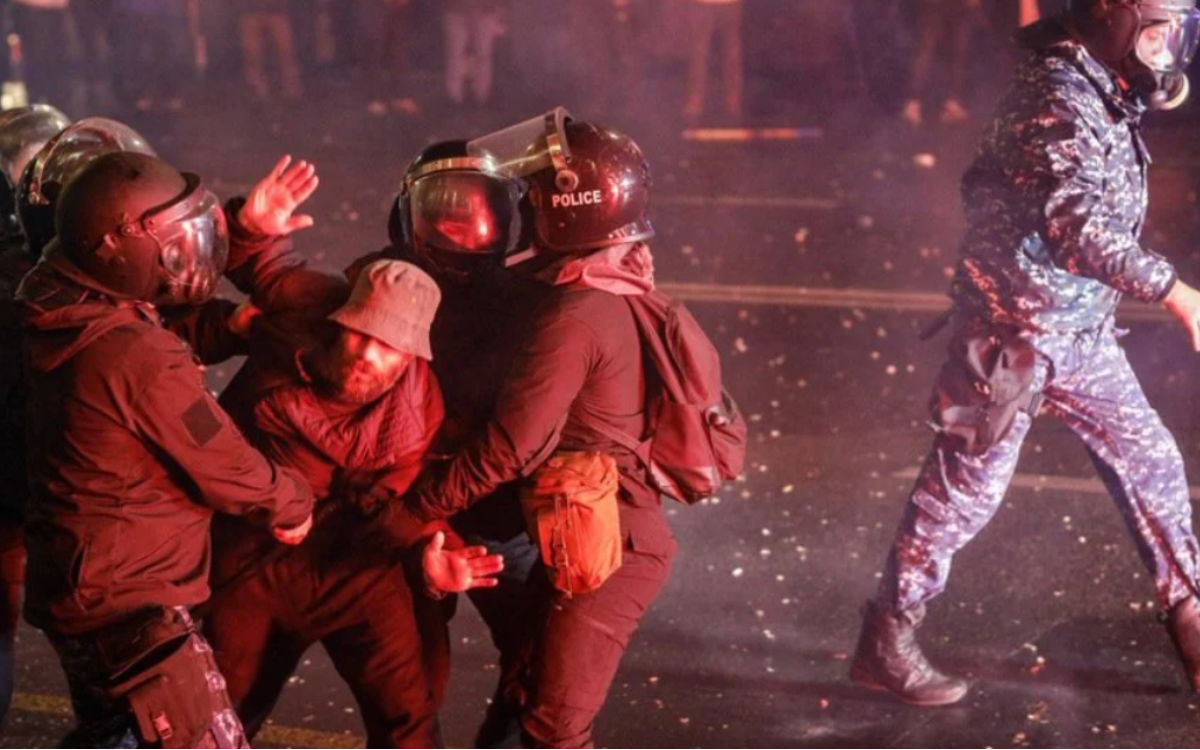
Authorities in Georgia used World War I-era chemical weapons to suppress anti-government protests last year, evidence collected by the BBC shows.
“You felt the water burn,” said one protester, describing the experience of being hit by water cannons aimed at him and others on the streets of the capital, Tbilisi. He said the sensation could not be immediately washed off.
Protesters opposing the Georgian government’s decision to suspend EU accession talks also reported other symptoms, including shortness of breath, coughing, and vomiting that lasted for weeks, according to Klix.ba.
BBC spoke with chemical weapons experts, whistleblowers from the Georgian riot police, and medical professionals, concluding that the evidence points to the use of a substance the French military called “camite.”
Camite was used by France against Germany during World War I. There is little documentation of its later use, but it is believed to have been withdrawn in the 1930s due to concerns about long-term effects. CS gas—commonly known as tear gas—later became the standard alternative.
Konstantin Chahunashvili, a pediatrician, was among those gathered outside the Georgian Parliament during the first week of protests, which began on November 28, 2024. Demonstrators were angered by the ruling party’s announcement to pause EU accession negotiations—a goal enshrined in the Georgian constitution.
The Georgian police responded with various crowd-control measures, including water cannons, pepper spray, and CS gas.
Dr. Chahunashvili, who was hit by the water cannons, said his skin felt like it was burning for days, and the sensation could not be washed away.
Camite was briefly used by U.S. police forces after World War I but was abandoned when safer alternatives like CS gas were developed.
Under international law, police may use chemicals for crowd control if they are proportional and have only short-term effects. Experts consulted by the BBC noted that using an outdated and much stronger chemical could classify as chemical warfare, given the availability of safer alternatives.
The findings are alarming, said UN Special Rapporteur on Torture Alice Edwards, who has previously reported to the Georgian government on allegations of police violence and torture during protests.
The lack of strict regulation regarding chemicals in water cannons is a problem that needs to be addressed.
“This leads me to consider this practice as experimental weapon use. Populations must never be subjected to experiments. It absolutely violates international human rights law,” Edwards said.
She emphasized that the effects of crowd-control agents must be temporary under international law, and the symptoms described exceed what would be considered temporary or acceptable.
“All such cases should be investigated, including under procedures for torture or other forms of abuse,” she added.
Protests along Rustaveli Avenue in Tbilisi have decreased in size since the government increased fines and prison sentences but have not ceased in frequency.
Almost every night over the past year, protesters have demanded the resignation of the government, accusing it of rigging elections, siding with Russian interests, and passing increasingly repressive laws against civil society.
The ruling Georgian Dream party denies that the government or honorary party president Bidzina Ivanishvili is pro-Russian or follows Russian interests. The party told the BBC that legislative changes over the past year were in the best interest of the public good.
MORE TOPICS:
RESIGNATION OF ŽELJKO OBRADOVIĆ REJECTED: Partizan’s Executive Board made a unanimous decision!