





Two tourists discovered a treasure near Dvur Kralove nad Labem in February, whose estimated value is more than seven and a half million Czech crowns. The two boxes, which contained gold coins, jewelry, and other items weighing a total of seven kilograms, were handed over by the finders to the Museum of East Bohemia in Hradec Kralove. The coins, weighing almost four kilograms, are guaranteed to be gold. Scientists are also analyzing other metal objects.
The boxes were placed in the 20th century in an artificially created stone embankment on the edge of an unused field covered by trees.
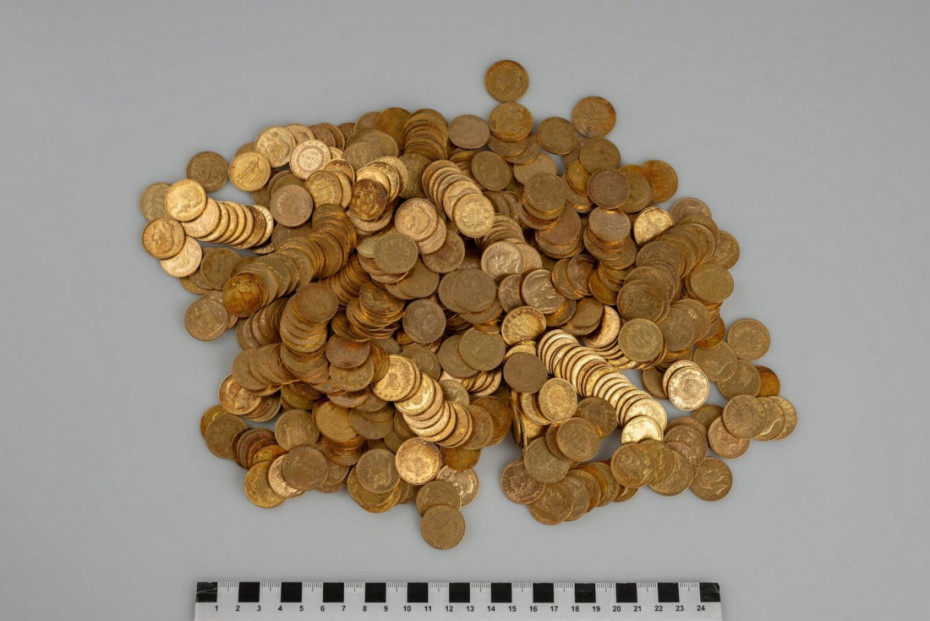
“The aluminum box that protruded above the surface of the embankment contained a total of 598 coins arranged in 11 columns, wrapped in fabric. In the metal box found about a meter away, there were objects made of yellow metal, namely a total of sixteen tobacco tins, ten bracelets, a purse made of fine wire mesh material, a comb, a chain with a key, and a powder compact,” described the find Miroslav Novak, head of the archaeological department of the Museum of East Bohemia.
FIND OUT MORE:
In the case of the coins, experts say that the collection cannot be considered regular currency from that period, ct24 reports.
“The treasure was hidden in the ground for just over a hundred years, at most. According to the dates printed on the coins, it contains coins from the period 1808 to 1915,” said the museum’s numismatist Vojtěch Brádle.
However, in this case, the year 1915 is not crucial for determining when the treasure was hidden.
“The reason is the presence of several pieces with mini-marks, so-called countermarks, which could only have been placed after the First World War. The coins were minted in the territory of the former Yugoslavia in the 1920s and 1930s,” noted Bradle.
According to him, this is a very specific collection compared to similar finds in the Czech Republic.
“Because most of it consists of coins of French origin, and apart from the Austro-Hungarian mints, the collection also includes Belgian and Ottoman coins in larger quantities. On the other hand, there are no German and Czechoslovak coins at all,” added Bradle.
For non-coin items, the analysis of the Precious Metals Testing Office determines the exact composition of the metal, which is crucial for determining the appropriate conservation method, assessing the value of the find, and for later exhibition.
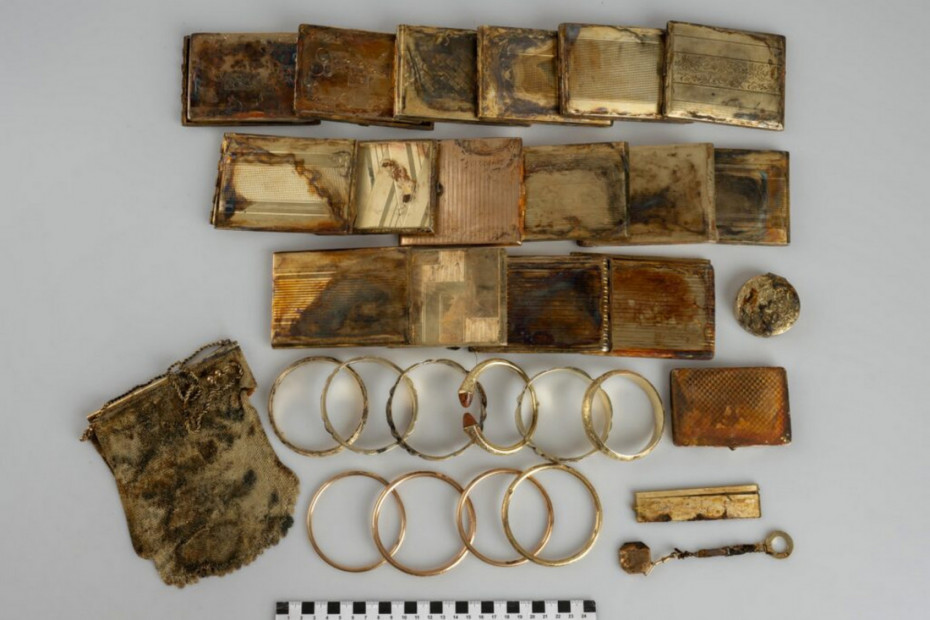
“At current precious metal prices, the value of the find could start at 7.5 million crowns,” Novak said. However, according to him, the historical value of this treasure is immeasurable.
Experts at the Museum of East Bohemia are still piecing together how this valuable collection was buried at this location. Numismatist Vojtěch Bradle expressed his astonishment, stating that his “jaw dropped” when he saw the find. He noted that the coins originate from Serbia sometime in the 1920s and 1930s, based on their markings, but how they arrived in the Czech Republic remains a mystery, reports the Arkeonews portal.
Several theories have emerged regarding the burial of the treasure. One possibility is that it was hidden by Czech citizens fleeing Nazi occupation after 1938. Another assumption is that it could have been hidden by Germans expecting expulsion after World War II in 1945. The third theory points to the communist monetary reforms of 1953 as a potential catalyst for hiding it.
MORE TOPICS:
COLUMN, KOVAČEVIĆ: On the police, batons, revolution and its children…
ALL MEMBERS OF OUR TEAM WON MEDALS: Six medals for Serbia at the Balkan Mathematical Olympiad!
Source: Euronews, Foto: Muzeum východních Čech Hradec Králové