




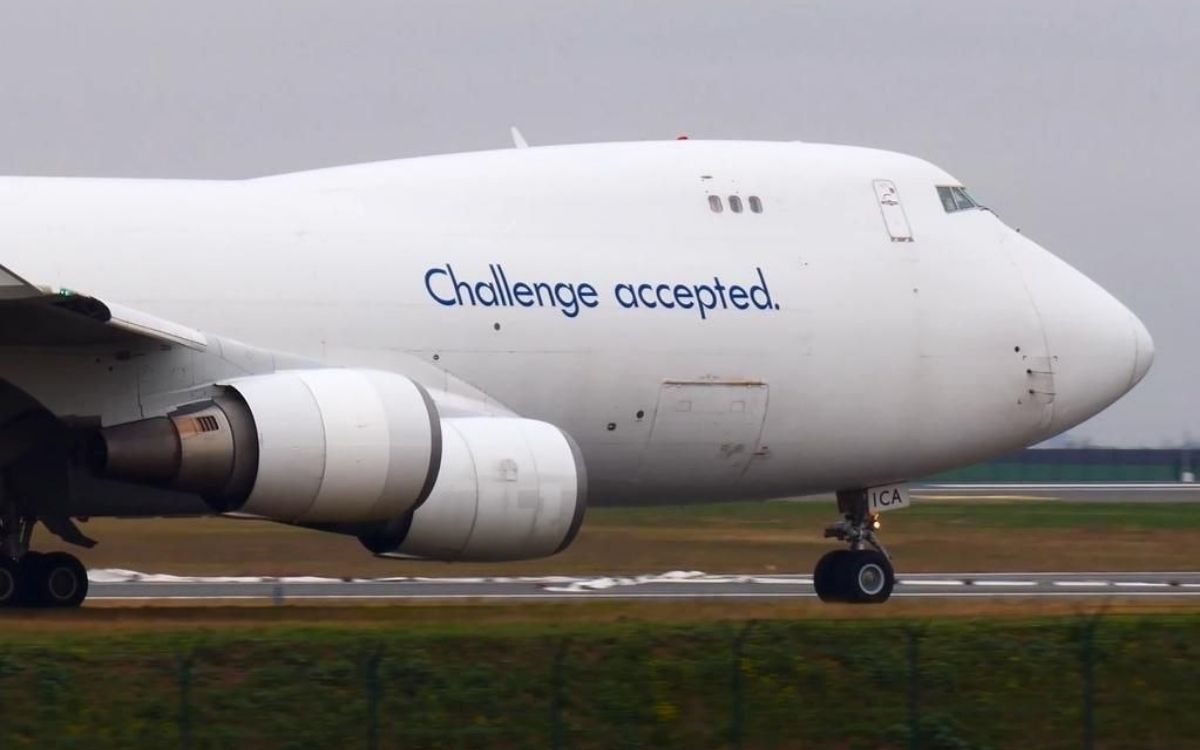
Radio Free Europe has determined that two cargo planes from a private Israeli airline were in Belgrade at least nine times during February and March.
The planes are specialized for transporting cargo, such as weaponry. Serbian institutions, however, are not answering RFE regarding what these planes were transporting while conflict flares in the Middle East.
According to information confirmed to RFE from two state weapon factories, the export of weaponry abroad was restarted in February following an eight-month embargo.
The relevant ministries, however, are not responding to questions about whether and what they are exporting and under what conditions.
From Tel Aviv to Belgrade and back to Tel Aviv was the flight path of an Israeli cargo plane on March 5, during the conflict in the Middle East – Radio Free Europe (RFE) determined through an analysis of specialized flight-tracking websites.
This aircraft is intended for the transport of heavy and dangerous cargo, such as weaponry.
It is not known, however, what the plane was transporting, and the competent institutions are silent.
And this is not the only time that a cargo plane from the private Israeli airline “Challenge Airlines IL” has come to Belgrade in the past month.
During February and early March, RFE recorded that two cargo planes from this company had at least nine flights on the route from Serbia to Israel or vice versa.
Of those, two flights were recorded after the outbreak of conflict in the Middle East on February 28, when the USA and Israel began attacks on Iran.
But the ministries of defense, foreign affairs, and trade did not respond to RFE’s questions about these flights and what is being transported by the time of publication.
No response was received from the Israeli company that owns the cargo planes either.
Following instructions from President Aleksandar Vučić, Serbia suspended the export of weaponry at the end of June 2025 – in the heat of the Israeli-Iranian conflict at the time and frequent accusations from Moscow that it was exporting ammunition to Ukraine via intermediaries.
However, according to information confirmed to Radio Free Europe from two state weapon factories, exports abroad were restarted in February.
State institutions, however, are not answering RFE regarding to whom and what they are exporting and under what conditions.
According to data from the Statistical Office of the Republic of Serbia, in 2025, Serbia exported weapons and ammunition worth about 50 million dollars.
This is half as much as in 2024, when exports, according to the same data, exceeded 104 million dollars.
These, however, are not the final amounts.
Because precise data is not publicly available.
That is, for several years now, the state has not published what weaponry and military equipment it exported, to whom, in what quantities, or how much it cost.
#Serbia #Israel | New possible delivery of Serbian 🇷🇸 munitions to Israel 🇮🇱:
— Luka | Дунав Intel (@Lukai1861) March 6, 2026
Yesterday, #LOY732 (Reg: 4X-ICK, Hex: 738C0B, Boeing 747-412F) of the Challenge Airlines IL 🇮🇱 departed from Tel Aviv 🇮🇱 and landed in Belgrade 🇷🇸. Shortly after, the aircraft headed towards Tel Aviv… https://t.co/qR6HGF2HIY pic.twitter.com/GOeUtBG0wA
What does the Belgrade airport say?
Belgrade’s “Nikola Tesla” Airport does not provide details on what the cargo planes flying between Belgrade and Tel Aviv in February and March were transporting.
The firm Belgrade Airport, which manages the airport, said in a short response to RFE that it allows airlines to use the airport infrastructure “in accordance with international and national regulations governing the transport of passengers and various types of cargo in air traffic.”
It is not known who hired the Israeli private air carrier, as the relevant ministries are not responding to RFE’s inquiries.
Israeli “Challenge Airlines” describes itself as an airline specialized in the transport of “non-standard cargo.”
According to data from their official website, they own three Boeing aircraft intended for cargo traffic.
The company, as stated, provides regular services between Tel Aviv and European countries, as well as to the United States of America (USA), via the airport in Liège, Belgium.
They also say they possess various security licenses for cargo air traffic issued by the European Union, the USA, China, and other states. They emphasize that they are trained for the transport of various goods – from food to explosives, medicines, and large machinery.
Since the outbreak of the conflict in the Middle East at the end of February, a large part of international air traffic to that region has been suspended, and the flow of goods significantly reduced.
“Challenge Airlines,” however, continues to fly to Israel and perform cargo services.
Earlier, in November 2024, Belgian media reported that this airline filed complaints against federal and regional regulations in Belgium that restrict the transport of weapons and military equipment to Israel.
According to Belgian media reports, “Challenge Airlines” denied at the time that it was transporting weapons – claiming that it delivers humanitarian aid and food to Israel.
Israeli defense ministry says it has begun military sea and air bridge to supply equipment & ammunition, involving Boeing 747 (4X-ICK, they blurred the number ..)
— MenchOsint (@MenchOsint) March 2, 2026
Latest destination were Ramstein, Germany 🇩🇪 & Belgrade, Serbia 🇷🇸 pic.twitter.com/VNpAvIjEr7
A plane also landed in June 2025
RFE tracked the flights of two cargo planes from the company “Challenge Airlines,” with registration marks 4X-IAJ and 4X-ICK, which came to the Belgrade airport.
One of them, aircraft 4X-ICK, landed in Belgrade in June 2025 – at the time the embargo on weapon exports was introduced.
The President of Serbia refused to answer questions about this plane at the time, stating that “it doesn’t occur to him to say what took off and what landed.”
The website Flight Radar records the flight history of this aircraft over the past year.
Besides Belgrade, the same cargo plane has flown to European cities and the United States of America in recent months.
In Israel, besides the airport in Tel Aviv, its destination was also the Nevatim military airbase, not far from Beersheba, in the south of the country.
The United States is the largest exporter of weapons to Israel, and the value of shipments is measured in billions of dollars. Two-thirds of Israeli weapon imports come from the USA.
And from Serbia, according to the admission of the President of the state Aleksandar Vučić, the delivery of ammunition was accelerated starting in October 2023.
At that time, Israel was attacked by Hamas, a Palestinian organization that the USA and EU consider terrorist.
Israel subsequently launched a ground offensive on the Gaza Strip, which led to mass casualties of Palestinian civilians, the destruction of cities, and a humanitarian crisis.
The United Nations has accused Israel of serious human rights violations and war crimes.
Even before the authorities in Belgrade admitted that weapon deliveries to Israel were accelerated, international teams of investigative journalists published that weapon exports from Serbia to Israel increased 30-fold starting in October 2023.
Following this, Vučić became a target of criticism from parts of the opposition and the public in Serbia – with the assessment that he had aligned himself with the Israeli authorities.
However, after Israel’s attack on Iran in June 2025, Vučić assessed that both countries were “friendly” to him, and the Ministry of Defense announced that the export of weaponry and military equipment was suspended following Vučić’s instructions.
“An entire branch of industry has been stopped, from June onwards, without a legal basis, because someone wants it that way, because a confused foreign policy is being led,” points out military analyst Aleksandar Radić.
He adds that for this “embargo,” aside from the Ministry’s statement and the president’s remarks, no official document was published that would, for example, be adopted by the Government of Serbia and legally explained.
❗️Izraelski teretni avion 🇮🇱 povezan sa transportom municije za Izrael 🇮🇱 sleteo je u Srbiju 🇷🇸.
— ☦️Милан Ђорђевић☦️ (@sremac_1) November 14, 2025
Danas je LOY201 (4XICK) (Reg: 4X-ICK, heksadecimalni broj: 738C0B, Boing 747-412F) avio-kompanije Challenge Airlines IL 🇮🇱 poleteo iz Tel Aviva 🇮🇱 i sleteo u Beograd, Srbija 🇷🇸.… pic.twitter.com/zALndgtAJ2
Workers in weapon factories say that exports have continued
And although the state does not confirm that the “moratorium” on exports has now been lifted, employees in two state weapon factories in Serbia told RFE this.
They said that in February 2026, they received a memo stating that, after an eight-month ban, exports abroad are continuing.
“Information reached the union from management that the state approved part of the export of military weaponry,” Aleksandar Tadić, president of the union at the “Zastava Oružje” factory in Kragujevac, told RFE.
“We don’t officially know who the buyers are or from which countries, but this is a first and good step for the factory, because it found itself in a difficult situation due to that export ban,” he adds.
He also emphasizes that shipments of sporting hunting weapons, which are also produced in this factory in central Serbia, started “a long time ago” toward the United States of America, which is among the key partners for these shipments.
The management of “Zastava Oružje” did not respond to questions about exports.
And in Užice, in western Serbia, where the headquarters of the weapon factory “Prvi Partizan” is located, the same news reached the workers.
“We received information about a month ago that exports have started; we have no idea where or what is going,” one of the members of the “Sloga” union at “Prvi Partizan” told RFE, on the condition of anonymity.
The management of this factory also did not confirm this information for RFE.
Responses also did not arrive from the headquarters of other state companies for the production and trade of weapons that are members of the Defense Industry of Serbia.
Whether the export of weapons abroad has continued and under what conditions is also not answered by the Ministry of Defense for RFE.
RSE je utvrdio da su dva aviona izraelske aviokompanije specijalizovana za prenos tereta, poput oružja, bila u Beogradu najmanje 9 puta u februaru i martu. Za RSE je u dve državne fabrike oružja potvrđeno da je od februara opet pokrenut izvoz naoružanja.https://t.co/vFoftArN3A
— Radio Slobodna Evropa (@RSE_Balkan) March 11, 2026
Did Serbia export weapons during the ‘moratorium’?
“In the meantime, since June last year, there has been firm evidence that exports functioned in some exceptional situations when someone decided on it,” claims military analyst Aleksandar Radić.
For while a ban on weapon exports was in effect in Serbia according to the instructions of the President of the state, Azerbaijan and Cyprus boasted about artillery pieces from Serbian factories.
During the past year, Azerbaijan showcased “Nora” self-propelled howitzers, while Cyprus showcased “Tamnava” rocket launchers.
“Both systems were displayed for the first time in the second half of 2025, and it is very possible they were exported after the ‘moratorium’ was announced,” Katarina Đokić from the Stockholm International Peace Research Institute (SIPRI) told RFE.
Serbia is obliged to report the export of heavy and light weaponry in accordance with international conventions. Those international reports are published in the middle of the year for the previous year.
“But the bulk of exports is not seen there, because large quantities of ammunition (which are not subject to those reports) leave Serbia. The value and volume of ammunition exports cannot be seen from those reports,” points out Aleksandar Radić.
Secret data on weapon exports
Permits for the export of weapons and military equipment are, by law, issued by the Ministry of Internal and Foreign Trade.
For this, the consent of the ministries of foreign affairs, internal affairs, defense, and the Security Intelligence Agency is required.
An End User certificate verified by an official organ of the end-user state is also required.
When issuing a permit, care is taken that the export does not violate international sanctions, does not endanger the respect for human rights in the country of final destination, and does not enable the outbreak or continuation of armed and other conflicts in the state of final use.
And following the president’s statement on the ban of weapon exports in June 2025, the Ministry of Defense announced that exporters would also need the consent of the National Security Council.
This body includes, among others, the President of Serbia, the Prime Minister, the Minister of Defense, and the Minister of Internal Affairs.
“I think it is completely clear that the decision comes down to one man. Because, according to the law, the president is the only one who until now was not recognized in the decision-making mechanism for granting permits for weapon exports,” assesses military analyst Aleksandar Radić.
Precise data on what weaponry and military equipment Serbia exports and imports and in what quantities is not publicly available.
In recent years, the Ministry of Internal and Foreign Trade has not published annual reports on issued export permits on its website.
And according to the latest publicly available data, significant importers of weapons from Serbia included Gulf countries – the United Arab Emirates, Saudi Arabia, and Bahrain.
Military analyst Aleksandar Radić describes them as “new partners” in the weapon trade.
“Deals with the Gulf countries started in a big wave in 2012 and 2013, with the arrival of the Serbian Progressive Party to power. They then became important buyers, whereas earlier they were either small buyers or did not have such a decisive significance. And then suddenly official statistics showed that they are at the very top of countries to which weapons are exported,” he adds.
He also believes that potential exports from Serbia to the Middle East region at this moment “would be in accordance with the policy of the authorities in Israel,” in whom official Belgrade sees a partner.
“It is exported to Israel, it is imported from Israel, and the other countries to which it is exported – Saudi Arabia, UAE – are obviously positive markets from Israel’s perspective because they are political allies at this moment,” Radić points out.
Citing an example of weapon imports from Israel, he mentions that in the autumn of 2026, Serbia displayed the PULS rocket artillery system, imported from Israel.
He also points out that Serbia, respecting international sanctions, does not export weapons to Iran.
Since the outbreak of conflict in the Middle East in October 2023, RFE has repeatedly requested data on permits for the import and export of weapons to Israel under the Law on Free Access to Information of Public Importance.
The data was not provided.
According to data from the Statistical Office of the Republic of Serbia, among the Middle Eastern states to which Serbia exported weapons and ammunition during 2025 were Israel, Bahrain, and Saudi Arabia.
According to those data, about 250 thousand dollars worth of weaponry and ammunition was exported to Bahrain in 2025, shipments to Saudi Arabia exceeded 100 thousand dollars, while the value for Israel passed 1.3 million dollars.
These, however, do not have to be the final amounts, because only part of the weapon exports is seen in them.
MORE TOPICS:
Source: N1; Photo: Printscreen X