


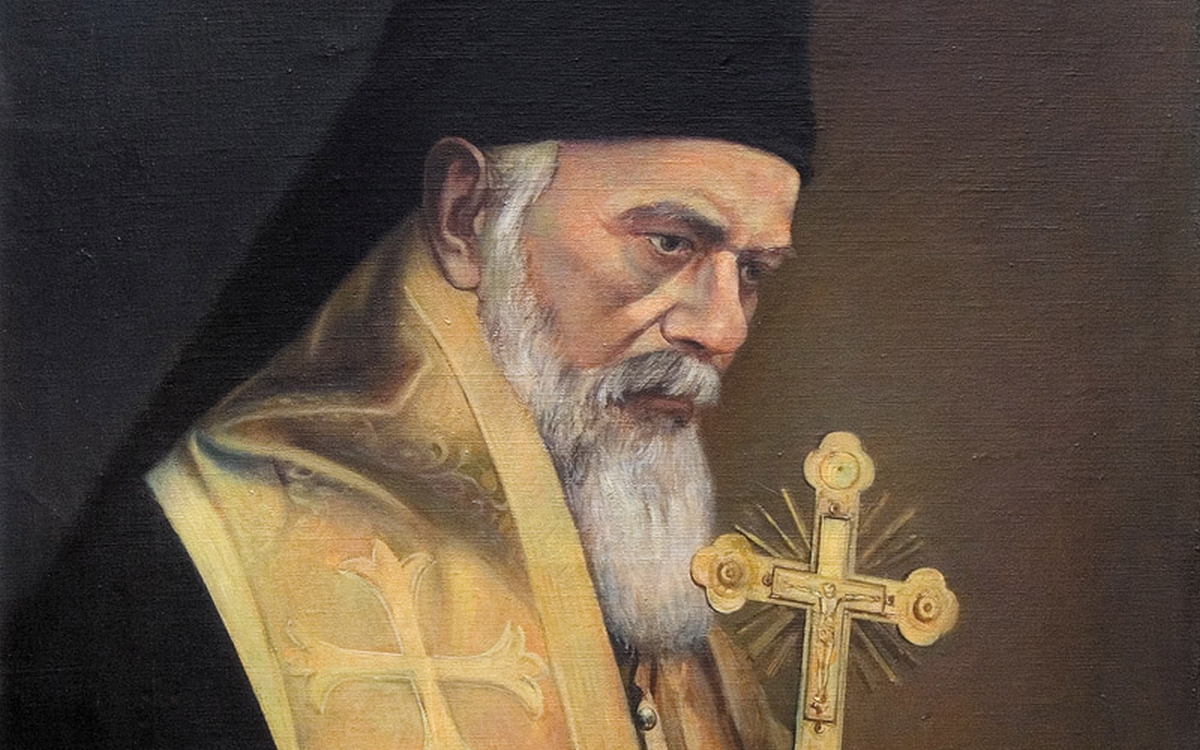
Bishop Nikolaj Velimirović was born on Tucindan in 1881. The birthplace of Bishop Nikolaj is the small mountain village of Lelić, located on the northern slopes of Mount Povlen, not far from Valjevo.
His parents, Dragomir and Katarina, simple Šumadija peasants, had nine children. Nikola (the bishop’s secular name) was the first child of his parents. The other eight died of various diseases, and one of them – Dušan (father of the late Bishop Jovan), was killed in the war in 1914. Little Nikola was baptized in the Ćelije monastery, which was then the parish church of the village of Lelić.
FIND OUT MORE IN ENGLISH:
The distinguished Velimirović family originates from Antonije-Ante Jovanović, who moved to the Valjevo region from Srebrenica in Bosnia. Even today, that hamlet in Lelić is called “Bosniaks.” Antonije was the head of the Podgor district and one of the prominent people in then Serbia. He is buried in front of the north gate of the Ćelija monastery. His grave is well preserved to this day with a stone slab and a red marble cross. Joakim Vujić, in his “Journey through Serbia,” recorded an encounter with the head of the Podgor district, Antonije Jovanović, in Lelić. The surname Velimirović originated from Antonije’s son Velimir.
Little Nikola was raised and educated in a respected Serbian patriarchal cooperative that had over thirty members. His father, Dragomir, was a rarely literate peasant for that time. In addition to the usual village work, he was a scribe and clerk of the Podgor district. Separation judgments written in his beautiful and legible handwriting have been preserved to this day. Since he was often absent from home due to work, his modest wife Katarina – later the nun Ekaterina – took over the care of raising the children. She was the first teacher and educator of little Nikola. Even as a child, she led him by the hand to the nearby Ćelije monastery for services and communion. She taught him to make the sign of the cross and how to pray to God. Nikola later often remembered those first childhood days by his mother’s warm skirt. He described one such event in his autobiographical prayer poem – “Prayer of a slave in prison.”

Elementary School and Gymnasium
When Nikola grew a little older, his father Dragomir decided to enroll him, as the eldest and brightest of his children, in school. The elementary school of the village of Lelić was in the Ćelije monastery. Since children attended school from other villages more than twenty kilometers away, the spacious monastery dormitory was converted into a boarding school. On Sundays and holidays, parents came to the monastery for services, visited their children, and brought necessary food and clean clothes. The Velimirović house is 4-5 kilometers away from the monastery. Nikola was by nature small and thin, so that he would not have to walk that long way every day, his father placed him in the school boarding school. Thus began Nikola’s schooling and education under the domes of the Saint Archangel temple in the Ćelije monastery.
The Ćelije teacher, Mihailo Stuparević, noticed Nikola’s zeal and talent, so after completing elementary school, he advised his father Dragomir to send Nikola for further education. The bright and quick-witted peasant listened to the teacher and enrolled Nikola in the Valjevo Gymnasium. The Gymnasium in Valjevo had a good reputation but was not complete. It had only six grades.
After graduating from Gymnasium, a dilemma arose: where and how to continue further education. With the approval of his father Dragomir, Nikola went with his friend Petar Kosić to enroll in the Military Academy. Due to malnutrition and small chest size, Nikola was rejected in the competition, and Petar enrolled and became a high officer of the Serbian and Yugoslav armies, known for the events around General Simović’s coup in 1941.
Enrollment in Theology
Searching further for a school to enroll in, Nikola learned that a call for enrollment of students in the last generation of the old Belgrade Theology had been published. An unlimited number of students were accepted. Nikola applied and was accepted and enrolled in the first grade.
His friends were mostly enrolled in theology with two grades of gymnasium. That’s how much was needed. Nikola had completed six grades and was already a fairly formed young personality – a young intellectual. He was immediately noticed in theology. He delighted his professors and friends with his understanding of the most intricate problems in the fields of science, philosophy, and theology. In addition to the mandatory textbooks and scripts, he began to make extensive use of theological and philosophical literature in mastering the curriculum. He used every moment of free time to read and learn as much as possible. From his first theological days, he began reading the works of world classics. By the end of his education, he had read the works of Njegoš, Dostoevsky, Pushkin, Tolstoy, Shakespeare, Goethe, Hugo, Dante, Voltaire, Nietzsche… His spirit soared over the mysterious wisdom of the Far East, reading and studying the sacred and philosophical books of ancient India. And later, throughout his life, he returned to India. He regretted that Christianity had not managed to penetrate Asia. He believed that the Indian spirit, prone to contemplation and mysticism, had further deepened and enriched him. That is why he wrote several well-known works on this topic: “Christ, come to Asia,” “Indian Letters,” “Indian Saul,” and others.
After graduating from theology, Nikolaj was appointed as a teacher in the village of Dračić near Valjevo, on the road to Kosjerić. There he met and befriended the priest Stevo Popović, an emigrant from Montenegro. He went with him to various sacred ceremonies in the village where he learned about the spiritual life of the Serbian village and peasant. He spent his summer vacations in Boka for treatment. He wrote from Boka to his friend, the priest Stevo, and those letters contain beautiful descriptions of Boka Kotorska and the life of the people in Montenegro and Dalmatia. At that time, Nikola had already mastered the art of writing and oratory. In addition to writing and collaborating in the “Christian Herald,” he also wrote in other church and secular magazines and newspapers. As a teacher in Dračić, he wrote a play that was performed in the Valjevo theater. Unfortunately, that work has been lost. After a short teaching period in Dračić, he was appointed by the decision of the Minister of Education of Serbia as the head of the school in Donji Leskovci. But the teaching service was not the goal of young Nikola.

Two Doctorates
Immediately after graduating from theology, as an excellent and talented student, he was offered to go to study in Russia. He wanted to go to the West at all costs. He could not get a scholarship immediately. He decided to wait. And one day, the decision of the Minister of Education arrived that Nikola was to be provided with a scholarship to continue his studies at the Old Catholic Faculty in Bern, Switzerland. The wish was fulfilled. Nikola packed his bags and traveled to Switzerland.
In Bern, Nikola for the first time received the necessary conditions for learning and studying. He had a state scholarship that provided him with a decent life. From photos from that time, it can be seen that he had already become a refined and well-dressed European student and gentleman. He learned German well and, in addition to his home faculty in Bern, he went to listen to lectures at other faculties throughout Switzerland and Germany. He stayed entire semesters at famous faculties listening to famous professors of theology and philosophy. After graduating from faculty, he submitted his doctoral thesis and received his doctorate on the topic: “Faith in the Resurrection of Christ as the basic dogma of the Apostolic Church.”
From Switzerland, Nikola returned to Belgrade, intending to continue his studies at Oxford in England. He did not immediately receive a scholarship, but he traveled to England. Probably through the intervention and connections of Proto Ilić, he was soon awarded a scholarship. Without great difficulty, Nikola learned English and graduated from the Faculty of Philosophy in Oxford and received his doctorate in philosophy on the topic: “Berkeley’s Philosophy.” He defended this topic in French in Geneva. And thus, with two doctorates and perfect knowledge of three major European languages, Nikola returned to Belgrade.
In Belgrade, he was not greeted with enthusiasm. The small Balkan environment greeted him with envy, and church people were wary of him because he had been educated in Roman Catholic Europe. None of his diplomas were recognized, allegedly because he had not completed a full gymnasium. And he, with two completed faculties and two doctorates from two of the most famous European universities, returned to high school and took the seventh and eighth grades in the Second Belgrade Gymnasium. After that, he was appointed as a teaching assistant at the Belgrade Theology as a graduate student of philosophy. He taught secular subjects and languages.

Monasticism
Just as he began lecturing in theology, Nikola fell ill again. He was sick for a long time and severely. In the hospital, he vowed that if he survived, he would receive monastic vows and put himself entirely at the service of the Serbian church and his people. And as soon as he left the hospital, he went to the Rakovica monastery, near Belgrade, and there on December 20, 1909, he received monastic vows, adding only one letter “j” to his secular name
MORE TOPICS:
TRANSFERRED BY THE SERBIAN ARMY: Twelve injured in the Kočani fire arrive in Belgrade for treatment!
LEST WE FORGET: The March pogrom in Kosovo was deadly for many Serbs, while thousands got expelled!
DUE TO THE UNPRECEDENTED TRAGEDY IN KOČANI: North Macedonia declares seven days of mourning!
Source: Pokret obnove Kraljevine Srbije Foto: Wikimedia Creative Commons