




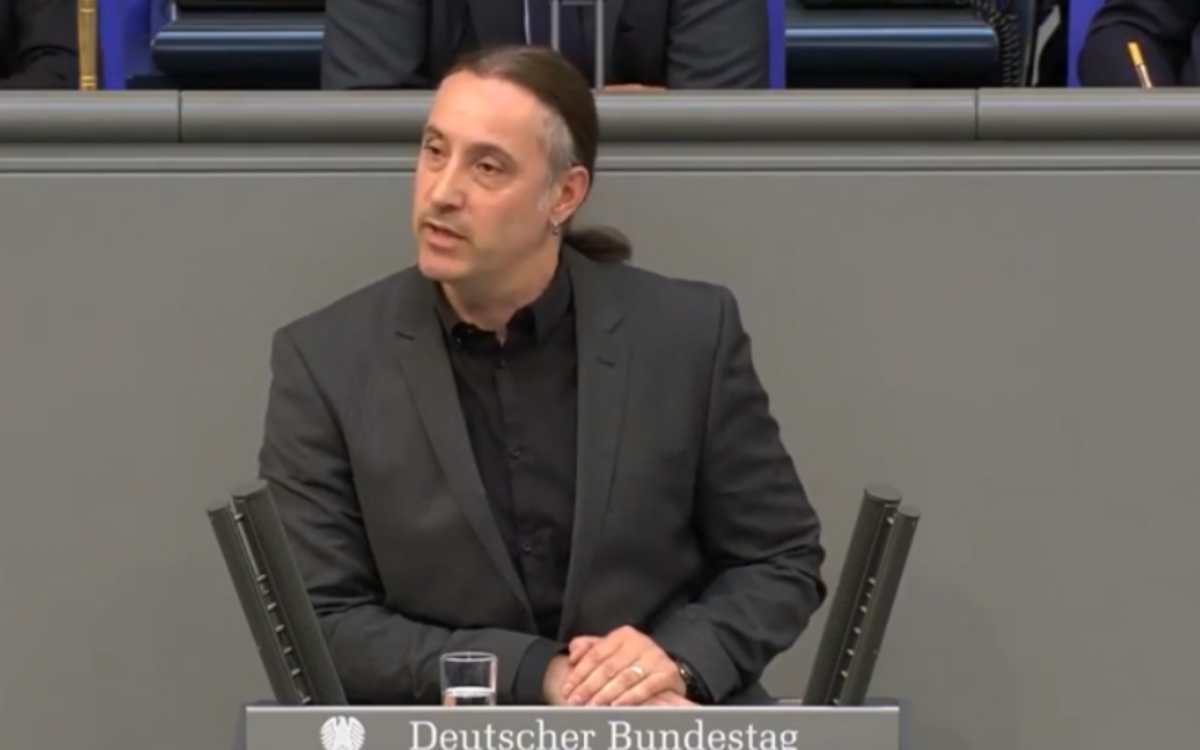
Not all civilian victims of civil wars are treated equally, writes Left Party member and former Bundestag MP Aleksander Neu, asking: Who, for example, in Germany today knows about the war crimes committed against Bosnian Serbs in 1992 in villages in the Srebrenica municipality? This, of course, is no justification for the massacre of Muslims in Srebrenica in 1995, Neu notes, adding that anyone who tries to deny the complete picture reveals where they truly stand. Only if all victims are viewed equally is it possible to claim moral and humanistic convictions for oneself – everything else is a double standard, Neu concludes.
In his opinion piece “Victim Politics of Two Classes – or: How Some Self-Proclaimed ‘Humanists’ and ‘Moralists’ Can Be Exposed,” published on the Nahdenkseiten portal, Neu writes about the course of the war in Bosnia and Herzegovina.
We present the full text:
The secessionist wars in the territory of the former Yugoslavia, before the eyes of modern mass media, revealed what people are capable of in exceptional situations, such as wars.
Overnight, neighbors, acquaintances, and friends became murderers, rapists, and torturers. Civil wars often surpass the cruelty of classic interstate wars: rebels against government troops.
Armed groups fight each other for natural resources, territory… In the midst of all this is the civilian population: women, children, the elderly, and men who do not want to kill or be killed. But not all civilian victims of civil wars are treated equally. Who in Germany, for example, knows about the war crimes committed against Bosnian Serbs in 1992 in villages in the municipality of Srebrenica?
The pressure on the population to take sides intensifies with each passing moment: neutrality, remaining aloof, and the desire to be left alone become increasingly difficult. Even within families, discord becomes evident when brothers or fathers and sons oppose each other – as is the case today in Ukraine, and previously during the breakup of Yugoslavia.
Religious affiliation is often instrumentalized to ultimately bring “one’s own” population “into line.”
The extraordinary state of war suddenly allows or even encourages behaviors that were previously unthinkable, morally and legally – maximum harm to the “enemy” in one’s own social environment: killing, maiming, raping their women, or even abducting them, as Islamic State terrorists and other Islamists did and still do in Iraq and Syria.
Even before, social “losers,” idlers, and criminals saw a chance for a “new life” by looting, taking, raping, and killing. They are the new heroes until the post-war period, at least for a while.
And these human behaviors, these psychological abysses, exist to varying degrees in every civil war and among every active warring party. Our widespread, but actually more than infantile, dichotomy of good and evil prevents and aims to prevent a view of the complex whole of both intra-state and inter-state conflict.
Many years ago, Anne Morelli published a book titled “The Principles of War Propaganda.”
In it, she summarized principles that have recurred in wartime and pre-war times. The application of these principles is not limited to authoritarian or dictatorial systems. They apply to the entire political structure of states.
Three of these principles, and those relevant to this essay, are: “The enemy camp bears sole responsibility for the war,” “The enemy has demonic features,” “The enemy deliberately commits atrocities. If we make mistakes, they are only unintentional.”
Even in the post-war period, these principles are still maintained so that the legitimacy of the war and its alleged lack of alternatives are not subsequently jeopardized – after all, enormous sacrifices were made. With a new, honest narrative, one would only have to recognize one’s own stupidity. And yesterday’s warlords also need a continuation of the narrative to permanently secure their privileges – even if the country remains in a state that is no longer war, but not peace either. Examining the causes of war, examining the war crimes committed in it, preferably takes place with a view to the (former) enemy: They did this and that to us; but we are innocent, we were drawn into the war (“The enemy camp bears sole responsibility”).
Re-examining one’s own role in the war is avoided as much as possible – at least as long as the generation that waged the war still holds the levers of power; a situation that effectively prevents the reconstruction of the country, as in Bosnia and Herzegovina.
Flight, Expulsion, and Murder
Flight, expulsion, and murder are inherent characteristics of civil war. In some cases, they are called “ethnic cleansing,” in others “resettlement” or “flight,” depending on political expediency.
Every year in July (the 30th anniversary was recently commemorated), the Srebrenica massacre is politically and mediately commemorated in international circles: Approximately 8,000 Muslim men and young people were separated from women, children, and the elderly and executed by Bosnian Serbs. This is considered the largest war crime in Europe since the end of World War II.
But who knows about the war crimes committed in 1992 in the villages in the municipality of Srebrenica? Bosnian Serbs – figures vary, depending on the “source,” from 400 to over 1,000 civilians (men, women, and children) – were massacred by Bosnian-Muslim units. No, this is not a justification or relativization (“whataboutism”) for the massacre of Bosnian-Muslim men in 1995.
Presenting this massacre by the opposing side is part of the broader picture, part of the truth. Anyone who tries to deny the complete picture reveals where they truly stand. Anyone who selectively acknowledges and condemns crimes, murders, and expulsions is not a humanist but follows a political agenda with a “humanistic fig leaf.” Anyone who instrumentalizes humanism degrades humanism into a propaganda weapon – then as now.
“Storm” – A Storm of Good Against Evil
In a few days, the 30th anniversary of the Croatian “Operation Storm” will also be commemorated. No media coverage of this is to be expected in Germany; and if it is, it will probably be more like in the past, in accordance with Anne Morelli’s principles of war propaganda.
Rule number 1: “The enemy camp bears sole responsibility for the war” and therefore must bear the consequences, including its own victims, for whom it is also responsible, according to the sub-message that can be read between the lines.
Rule number 2: “The enemy deliberately commits atrocities. If we make mistakes, it is only accidental” – of course, one would like to add with a note of sarcasm, as usual. And, if the facts clearly indicate the opposite, see rule number 1.
In any case, this offensive expelled about 200,000 Serbs living in Croatia from the Krajina region or forced them to flee. Others were shot on the spot. The artificial distinction between flight and expulsion, which ignores reality, is often justified through propaganda – the population fled unnecessarily. The Croatian rule of law promised Serbs safety, but they preferred to rely on propaganda from Belgrade, which explains the “mass exodus” (of course, there was no talk of expulsion) of Serbs. This was also the case with the statement of the ZDF news anchor – and this was not a statement under the heading “commentary,” but pure journalistic cynicism.
This or something similar is a common argument to this day in the post-Yugoslav region and among various parties to conflicts around the world, while in reality the conditions at the scene of the crime (killing civilians, destroying apartments and houses, sexual violence) are designed in such a way that people “flee” out of fear for their lives – in other words, they are effectively expelled.
In English, there is a corresponding term “displaced persons.” This means something like “people deprived of their homeland, their home.” This formulation denies the possibility of a clear distinction between flight and expulsion, which is closer to the reality of (civil) wars.
And the truth is also: At the beginning of the war, according to reports, about 170,000 Croats from Krajina became “displaced persons” by the Serbs, i.e., forced to flee or expelled. This prior expulsion of Croats can explain the final expulsion of Serbs, but it cannot justify it.
Just as the massacres committed by Bosnian Muslims against Serbs in the Srebrenica region in 1992 cannot justify the massacre committed by Bosnian Serbs against Bosnian Muslims three years later; or the expulsion and forced flight of Kosovo Serbs (approximately 230,000) by Kosovo Albanians under the watchful eye and with the tacit approval of NATO in 1999/2000 after the end of the war.
When asked about the de facto tacit approval of the expulsion, the repeated answer was:
“We (KFOR, actually NATO) cannot place a NATO soldier behind every Serb to protect him” – I heard this argument several times during my time on the OSCE mission in Kosovo when I raised complaints.
No, you could not place a NATO soldier behind every Serb, but you could bomb Serbia for 77 days because of the rejection of the so-called Rambouillet Agreement, which was in fact an ultimatum to Belgrade to agree to the secession of Kosovo. And yes, Serbia also expelled hundreds of thousands of Albanians from its province of Kosovo – not to mention the internally displaced Kosovo Albanians before the NATO bombing. Because the mass expulsion from Kosovo apparently began after the start of the NATO war, not before, as the Western public wanted to believe.
Since this narrative collapsed, the then German Defense Minister Rudolf Scharping created the “Horseshoe Plan,” which was supposed to prove the planning of the expulsion. The narrative of a humanitarian intervention to prevent the “completion” or “imminent” genocide was NATO’s official reason for the war. This urgent narrative of the “Horseshoe Plan” also collapsed because it was a fabrication.
And here too I say: There was no justification for the expulsion of the Albanian population in Kosovo by Serbia; just as there was no justification for the subsequent expulsion of Serbs from Kosovo, which continues to this day.
A Small Linguistic Experiment
But one thing must be clear: From a humanistic perspective, there can be no two-class system of victims, no good victims versus bad victims – at least not when it comes to civilians.
Here’s an experiment:
Sentence 1: “Just as every Ukrainian child has a right to life, so too must every Russian child have a right to life.”
Sentence 2: “Just as every Russian child has a right to life, so too must every Ukrainian child have a right to life.”
Although the statements appear identical at first glance (all children have a right to life), the word order provides a different perspective.
Two sentences with two demands that are obvious to humanists. Only those who are biased will pause and consider what they don’t like about this or that statement. Only they will begin with the words: “Yes, but…” to still put the victims of the other side into perspective.
Here’s the solution:
The first sentence calls for empathy for Russian children, while the second sentence calls for Ukrainian children – depending on which nationality of children is mentioned first, they become the reference group.
In the first sentence, empathy, and probably compassion, lies more with the Russian side in the conflict, and the speaker suggests unequal treatment of Russian children compared to Ukrainian children.
And in the second sentence, it is precisely the opposite: Empathy, and probably compassion, lies more with the Ukrainian side in the conflict, and the speaker suggests unequal treatment of Ukrainian children compared to Russian children.
This experiment can be universally applied: to Croats and Serbs, Bosnians and Croats, Serbs and Albanians, Israelis and Palestinians, Ukrainians and Russians, etc.
Only if all victims are viewed equally – regardless of the underlying political motives of their warring governments – and only if a two-class victim policy is not practiced, is it possible to claim moral and humanistic convictions for oneself. Everything else is a double standard, Aleksander Neu concludes in the text.
MORE TOPICS:
Source: Euronews, Photo: Printscreen Youtube