




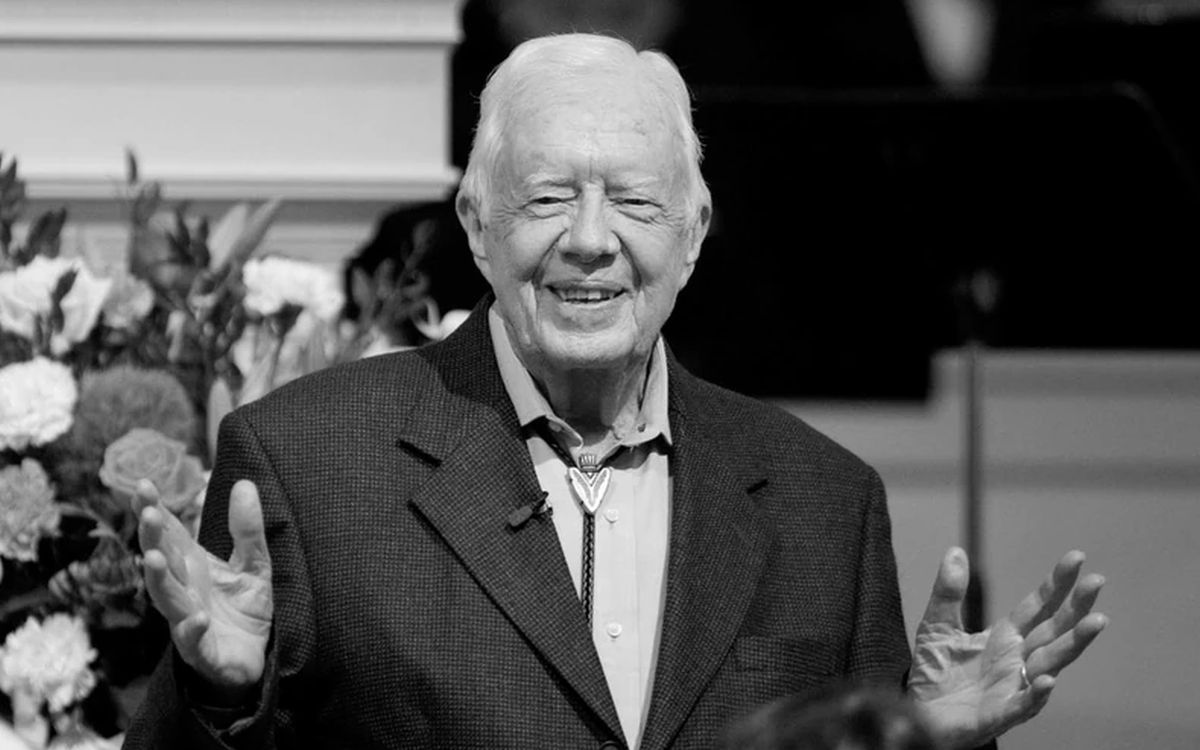
Outgoing US President Joseph Biden has scheduled a state funeral for former President Jimmy Carter on January 9 in Washington.
Biden has also declared January 9 a national Day of Mourning across the US and ordered American flags to be flown at half-staff for 30 days from Sunday, AP reported.
Jimmy Carter, the 39th President of the United States and Nobel Peace Prize laureate, passed away last night at the age of 101 at his home in Plains, Georgia, his son James E. Carter III announced, without specifying the exact cause of death.
Carter was the oldest living US president of all time.
Treated for aggressive melanoma
In February 2023, the Carter Center announced that the former president, after a series of hospital stays, would discontinue further treatment and spend his remaining time in home care. He had been treated in recent years for an aggressive form of melanoma skin cancer, with tumors that had spread to his liver and brain.
His wife, Rosalynn, died on November 19, 2023, at the age of 97. The Carters, who were close partners in public life, were married for over 77 years, the longest presidential marriage in US history. His last public appearance was at her funeral in Plains, where he sat in the front row in a wheelchair.
FOLLOW US ON FACEBOOK:
Last photo
Carter was last photographed in front of his home with family and friends as he watched a flyover held for his 100th birthday.
Who is Jimmy Carter?
Carter, a peanut farmer from a small town, a US Navy veteran, and governor of Georgia from 1971 to 1975, was the first president from the Deep South since 1837 and the only Democrat elected president between Lyndon B. Johnson and Bill Clinton.
As the 39th US president, he ruled with a strong Democratic majority in Congress.
Four years after taking office, Carter lost his bid for re-election, decisively, to one of the most conservative political figures of the time, Ronald Reagan, the Washington Post reports.
Embargo on the USSR and boycott of the Moscow Olympics
When he left Washington in January 1981, he was widely considered an average president, even a complete failure, largely due to the stagnant economy and high unemployment and inflation, after the 1979 Iranian Revolution disrupted the global oil supply.
A month after the Iranian hostage crisis erupted, emboldened by the Soviet Union, it invaded Afghanistan, and Carter ordered an embargo on grain sales to the Soviet Union, which angered American farmers.
He also ordered a US boycott of the 1980 Summer Olympics in Moscow, a move that was unpopular with many Americans and seen as weak and ineffective.
Historic agreement
However, Carter is credited with achieving the historic Camp David Accords between Israeli Prime Minister Menachem Begin and Egyptian President Anwar Sadat.
The Camp David Accords led to the first significant Israeli withdrawal from territory captured in the 1967 Six-Day War and a peace treaty that existed between Israel and its largest Arab neighbor.
Begin and Sadat shared the Nobel Peace Prize in 1978, and the honor was awarded to Carter 24 years later.
Panama Canal and nuclear weapons
Carter pushed through the Panama Canal treaties, a major step towards improving US relations with its Latin American neighbors.
He signed the Strategic Arms Limitation Talks (SALT II) treaty with the Soviet Union but withdrew it from Senate consideration when Soviet forces invaded Afghanistan.
Building on the opening begun by President Richard Nixon, Carter gave full diplomatic recognition to China.
Human rights and the environment
He made human rights a central theme of US foreign policy, a sharp departure from the approach of Nixon and his national security adviser and second secretary of state, Henry Kissinger.
He was ahead of his time on environmental issues, and in June 1979, he installed 32 solar panels on the roof of the West Wing of the White House.
In a 2018 interview with the Washington Post, Carter, speaking about his time in office, said he “very much regretted” the Iranian hostage crisis and that he hadn’t done more to unite the Democratic Party. He added that he was most proud of the Camp David Accords, working to normalize relations with China, and focusing on human rights.
He was president for more than four decades, lived modestly
Carter was a former president for more than four decades, longer than anyone else in history and was only the second to live to be 94, after George H.W. Bush, who died in 2018.
Carter lived more modestly than any other former president, and Harry Truman was one of his favorite predecessors.
He and his wife Rosalynn lived until the end in Plains in a house on the estate they built for themselves in 1961, and where he will be buried next to her near a pond.
Carter declined corporate board memberships and lucrative speaking engagements that earned other former presidents tens of millions of dollars, saying he did not want to “financially capitalize on being in the White House.” He wrote 33 books on topics ranging from war to woodworking, and won three Grammy Awards for the audio versions of his books.
The Carter Center
In 1982, the Carter Center was founded at Emory University in Atlanta, which sponsors programs in education, agricultural development, and health and supports fair elections in countries around the world.
In 1994, at the request of President Bill Clinton, he helped broker an agreement that removed the brutal military regime in Haiti and prevented a possible US invasion of that country.
He met with some of the world’s most notorious dictators, including Kim Il-sung of North Korea and Muammar Gaddafi of Libya.
He was asked to oversee elections in Panama, Nicaragua, Haiti, the Dominican Republic, Zambia, the West Bank, and Gaza, and the Carter Center has monitored 115 elections in 40 countries, according to its website.
Talked to Karadzic
On the eve of Christmas 1994 in the Balkans, he spoke with the first president of the Republic of Srpska, Radovan Karadzic, who was convicted of genocide by the International Criminal Tribunal for the former Yugoslavia in 2016, and his efforts resulted in a four-month ceasefire in the conflict in the former Yugoslavia.
In his book “Palestine: Peace, Not Apartheid” (2006), Carter sparked controversy by equating Israel’s occupation of Palestinian territories with the former apartheid regime in South Africa.
In awarding him the Nobel Peace Prize in 2002, the Nobel Committee praised him “for decades of tireless effort to find peaceful solutions to international conflicts, to advance democracy and human rights, and to promote economic and social development.
READ MORE:
Source: Blic, Photo: AP
 Add Serbian Times as your Google source